

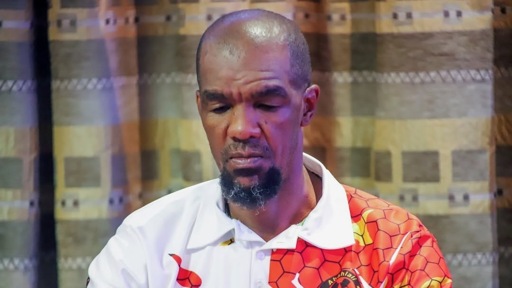
South Africa’s radical shack-dwellers movement, Abahlali BaseMjondolo (AbM), has laid to rest its 26th martyr in less than 20 years. His family members, residents of neighboring villages, and AbM leaders from all provinces attended the funeral on February 21 as Zweli Mkhize, better known by his comrades as Khabazela, was buried in his hometown of Estcourt in KwaZulu-Natal province.
The 52-year-old, survived by a spouse and three children, was gunned down about 400 km northwest of his hometown on February 12 at the eNkanini informal settlement near Midrand in Gauteng province, where he had been residing since 2024.
Elected as the treasurer of the AbM’s branch established here last June, Khabazela had been at the forefront of resisting the land mafia, preying on its poor residents ever since they first occupied this land in August 2023.
Unable to pay rent after losing their jobs in the nearby industrial areas of Johannesburg and Thembisa, unemployed workers built shacks to live on this unused and unfenced land with corrugated metal sheets and scrap wood they could forage.
Mafias set sight
“Occupations often start in an unplanned manner,” with individuals setting up shacks before a community is formed, explained AbM’s deputy president, George Bonono. “In its early chaos, criminals also come in.” Their purpose is often entrepreneurial – occupying plots by erecting shacks to profit from renting them out to new arrivals from the desperate, shelter-seeking poor who inevitably follow.
The eNkanini occupation was penetrated by multiple local mafias. One of the most powerful among them is led by Biza Shabalala, a wealthy businessman connected with South Africa’s notorious taxi mafia, the AbM maintains.
The other powerful mafia boss is Sithole, who claims authority from the title “induna”, the plural for “izinduna” – headmen appointed by the chiefs of the Zulu King, who still commands customary authority in Zulu land in the northeast of KwaZulu-Natal.
But the izinduna have carried the title far beyond its customary setting of rural Zulu land into urban South Africa, to extort the poor in informal settlements abandoned by the state, except in acts of demolition.
Unrelenting attacks by the state
Red Ants Security and Eviction Services, a notorious private force hired by various municipalities of South Africa to raze and burn down informal settlements, was unleashed on eNkanini in 2024. Residents rebuilt their shacks. But Red Ant struck back. “Homes were destroyed again, and people lost belongings and furniture,” AbM said in a statement.
Forcing the residents off the land, local authorities fenced it with razor wire. “However, residents cut the fence and went back to reoccupy in November 2024,” Bonono recalled. Many were then arrested for trespassing.
Amid these unrelenting attacks by the state, the criminals affiliated with these mafias stepped in, posing as saviors. They started collecting money from residents, ostensibly to pay the lawyers to fight in courts to halt the demolition. The repeated money collections forced the community members into debt, while demolitions continued.
“We have spoken to the lawyers they named. We can confirm they were not paid anything. This was simply extortion,” AbM’s general secretary, Thapelo Mohapi, told Peoples Dispatch. It was in these circumstances that the community first approached AbM.
Organizing shackdwellers: a meticulous and dangerous affair
“Communities often approach us thinking we can provide lawyers for free,” Bonono explained. Although lawyers do argue AbM’s cases pro bono, “we have to explain to them that we are not a legal aid organization but a grassroots movement of the shack-dwellers. Without a movement on the ground, land rights cannot be won in courts alone. We explain why we are a movement that knows how to win the struggle for occupation.”
In February 2025, the AbM leaders held their first presentation at the eNkanini occupation, explaining the democratic processes through which AbM functions, with all elected leaders – 50% compulsorily women – subject to the community’s right to recall.
AbM’s opposition to the commodification of land – and therefore the prohibition on renting or selling of shacks – its rationale for direct mass action to secure urban housing, and its guiding principle of “socialism from below” was articulated in a political workshop in April.
“After these presentations, we leave the community. Residents meet, discuss, and argue amongst themselves to decide whether they want to proceed to form a branch of Abahlali in their occupation,” explained Bonono.
In this period, at least two residents who were particularly keen on joining the movement were murdered – one from eNkanini and another from the neighboring Mayibuye settlement, where similar efforts to organize were underway. AbM suspects a third, killed in a car accident, on paper, was in fact murdered.
In the meantime, the izinduna and the taxi mafia made it clear to the community that they objected to any election to determine who leads the occupation – it had to be them. Defying them, the community members informed AbM that they were ready to join.
Abahlali general secretary surrounded by armed men
AbM’s general secretary, Thapelo Mohapi, was leading the launch of the eNkanini branch on June 7. Sithole – the induna-title claiming criminal with a gang based in the notorious hostels of eHlazeni, Jeppe, and Booysen – arrived at the scene.
He handed Mohapi a list of names to be appointed to the branch leadership. “I refused. He summoned six men armed with guns. They surrounded me. Within minutes,” Mohapi recalled, Biza Shabalala from the taxi mafia also arrived.
Despite competing interests, the two mafias, he remarked, have made a united front against AbM, “because they know we are the greatest threat” to their mutual interest in grabbing land and extorting the poor.
Sithole and Shabalala discussed amongst themselves, while Thapelo stood surrounded by armed men. “Then, they told me I should leave if I did not accept their leadership list. I was ready to leave. But then 1,500 residents from the community came out together in my defense,” he recalled.
Facing off the armed men, “they told me, ‘listen, you will launch this branch – guns or no guns. We are fed up with these goons.’ It was Comrade Khabazela who had mobilized the residents against the mafias in this manner.”
Never having seen such a display of unity and confidence from the residents, “they did not dare use their guns.” Shabalala retreated to his Mercedes from where he watched the election unfold. But Sithole put up his name as a candidate for the treasurer position, perhaps assuming that no individual would step up to contest the mafia boss. Khabazela squared off against him. Defeating Sithole, he became the treasurer of AbM’s eNkanini branch.
“A natural leader”
“Khabazela was an artist. He wanted to make music, but never got an opportunity,” said Bonono. “He used to roam Tembisa in search of jobs.” Rarely finding any, struggling to make ends meet, he had built a shack in eNkanini in 2024.
“When he was elected as the treasurer of its AbM branch, he came out as a natural leader. He led the community action to pool in money and buy the tools to connect the occupation to water and electricity that the government failed to provide.”
The eNkanini settlement was “a very dark place” after sundown, recalled Mohapi. “For the first time, they had light. They had communal taps. This made him very popular. People saw him as a leader they could trust.”
Mafia strikes back
With these successes, momentum was also picking up in the older Mayibuye settlement across eNkanini, where an AbM supporter was murdered on the very night after its branch was successfully established in eNkanini.
The program to launch AbM’s Mayibuye branch started on November 29 in a local church, whose Pastor had allowed its use for the community. “Just as people were electing the leaders, criminals attacked the church, broke its windows, and started throwing stones at us. I was physically attacked,” said Mohapi, who was leading the launch.
The equal presence of women in the leadership, mandated by AbM’s rules, was an affront to the izindune’s hyper-patriarchal, centuries-old, reactionary worldview.
Yelling “We will not be ruled by women!”, one of the gang members, wielding a large hammer, lurched out at Mohapi, “when Khabazela, and the president and the chairperson of the eNkanini branch, who were also present at the launch, escorted me to safety. They saved my life,” he said.
“But their main target was not me, it was Khabazela,” Mohapi added. “I realized this only later in January when he told me about the death threat he received.”
Claiming to be a hitman paid R30,000 to kill him, the caller on Khabazela’s phone last month, on January 20, told him his life would be spared only if he coughed up R40,000 and stopped his organizing work. “Khabazela said he didn’t have that kind of money and asked the hitman to do what he was paid for,” Mohapi said.
Determined to re-establish fear in the defiant community, the mafia goons then went on armed forays inside eNkanini, demolishing shacks and demanding money for permission to rebuild.
Khabazela’s last stand
“They also destroyed the shack of a very poor woman, and told her she would not be allowed to rebuild unless she paid up,” added Mohapi. “Khabazela rebuilt her shack. He told her there was no need to pay anyone. This act became a symbol of resistance in the community.”
On Feb 22, the first anniversary of the launch of AbM’s eNkanini branch, he was to convene a decisive meeting in the occupation, to “expose and name and shame the profiteers of land mafia,” and organize collective resistance.
Ten days before, on the morning of Feb 12, “a call was made to our office in Durban”, issuing a death threat to Khabazela and one other leader of the branch council, the AbM said in its statement.
Khabazela remained in eNkanini. At around 6:30 that evening, two unknown men walked up to him and opened fire, shooting him dead outside a friend’s shack, and fleeing to Modderfontein road before speeding away in a white Renault.
“His murder has robbed his branch and the movement of a principled leader who has paid the ultimate price for his work with Abahlali baseMjondolo,” the Socio-Economic Rights Institute of South Africa (SERI) said in a statement.
The remaining six leaders of the branch council have been forced into hiding. Surviving attempts on their lives, three national council members of the movement were already underground.
“Over the years, Abahlali has been attacked for insisting on the dignity of impoverished people … A failure to hold those responsible for these assassinations breeds a culture of impunity that further corrodes the little trust left in South Africa’s criminal justice system,” it warned.
“We hold the political establishment responsible for this death.”
“We hold the political establishment responsible for this death,” the General Industrial Workers Union of South Africa (GIWUSA) declared unequivocally. “The political establishment is responsible for the horrific conditions in informal settlements across this country – conditions marked by intolerable levels of criminal violence, poverty, and abandonment,” said its solidarity statement.
“The state’s repeated violent evictions, its refusal to engage meaningfully with organizations of the poor,” which it is instead criminalizing, “have all contributed to making leaders like Khabazela targets.”
Although Khabazela is gone, Socialist Movement of Ghana (SMG) proclaimed, “his vision, water and sanitation for all, land organized for social use, and collective leadership accountable to the majority will not be buried by bullets.”
Buried, it will not be, reassured Bonono, adding that despite grave dangers, the women from his occupation have vowed at his funeral on February 21 to continue the battle in which Khabazela fell.
“We must pick up his spear and continue to fight for land justice”: South Africa’s largest trade union
“The National Union of Metalworkers of South Africa (NUMSA) dips its Red Flag in honor and memory of … Comrade Zweli ‘Khabazela’ Mkhize,” South Africa’s largest trade union said in a solidarity statement on February 23.
“The whole country, and much of the progressive world knows that Abahlali baseMjondolo has been losing members and leaders to assassinations – almost 30 of its members have been violently assassinated since 2009,” it recalled, adding that “Mkhize now joins this list of martyrs”.
If he “must not have died in vain, we who are alive, and suffer the same conditions Khabazela was fighting, must pick up his spear and continue to fight for land justice.”
“We will not be stopped by the mafia,” asserted Mohapi. “We are going back,” not only to continue the struggle in eNkanini, but also “to relaunch the branch in Mayibuye.”
The need for “an independent working-class defense strategy”
Reiterating AbM’s demand for police actions against land mafia and protection of the urban poor, GIWUSA added, however, “we should have no illusions about the police and their ability to bring about lasting peace and security in our community and movements.”
Arguing that “the police and the criminal justice system have proven themselves either unwilling or unable to protect the poor and their organizations,” it called for “the development of an independent working-class defense strategy … We call on all progressive formations, trade unions, and community movements to unite in building structures capable of protecting our people, our organisations, and our leaders” like Khabazela “from the assassins who continue to target the poor with impunity.”
The post The death, and life, of Khabazela: a portrait of Abahlali’s 26th martyr for land rights appeared first on Peoples Dispatch.
From Peoples Dispatch via This RSS Feed.