

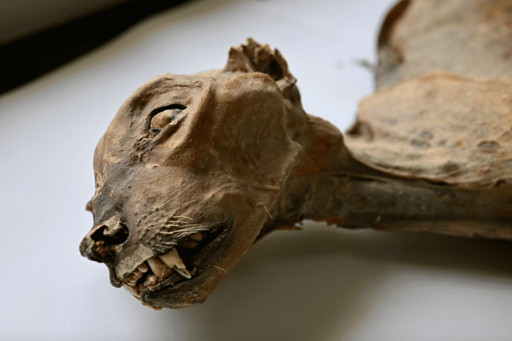
Researchers exploring a cave network in northern Saudi Arabia have made an unexpected find: seven naturally mummified cheetahs, along with the skeletal remains of 54 more, preserved for up to 4,000 years in arid underground chambers. “It was a big surprise,” lead author Ahmed Al Boug of Saudi Arabia’s National Centre for Wildlife told Scientific American. One of the mummified cheetahs as it was found in situ in a cave in northern Saudi Arabia. Photo courtesy of National Center for Wildlife – Saudi Arabia The discovery, published in the journal Communications Earth & Environment, is already reshaping how scientists think about reintroducing the big cats to the Arabian Peninsula. The mummies were found during surveys of 134 caves spanning an area the size of New York City (1,211 square kilometers, or 468 square miles) near the city of Arar. Five of the caves contained cheetah remains, with one sinkhole-accessed cave alone yielding 41 specimens. “The fact that they went into over one hundred caves and were able to find mummies — that’s highly unusual outside of permafrost,” Liz Kierepka, a wildlife geneticist at North Carolina State University in the U.S., who wasn’t involved in the study, told Science News. The hot, dry microclimate of the limestone caves created ideal conditions for natural preservation, inhibiting bacterial decay and keeping soft tissue intact for centuries. An above ground view of one of the caves where a mummified cheetah was found. Photo courtesy of David Chancellor/Ahmed Boug et al./Communications Earth & Environment CT…This article was originally published on Mongabay
From Conservation news via This RSS Feed.