

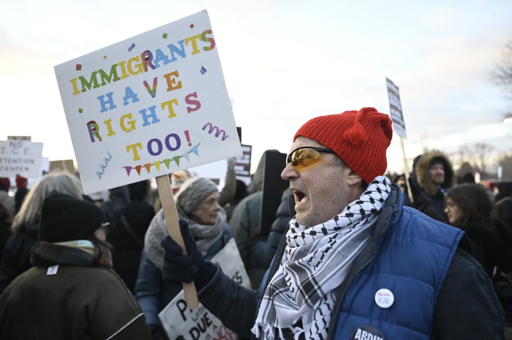
In Romulus, Michigan, where the Department Homeland Security (DHS) bought a building to construct a new detention center, over 1,000 people mobilized to make clear their opposition to the expansion of ICE. Even before public comment, the Romulus City Council passed an unanimous resolution opposing the construction of a detention center, and pledged to deny any rezoning or permit requests for the facility.
At the same time, hundreds of people mobilized in Southfield, attending the city council meeting to speak out against ICE leasing office space in the city. The council passed a resolution saying that ICE was not welcomed in Southfield and that Southfield Police will not cooperate with the agency.
These are good results for the movement, and points to the growing unpopularity of Trump’s anti-immigrant policies. Yet it has important limitations that even Romulus and Southfield city councils had to acknowledge.
Due to the exemption clauses in the U.S. Constitution, the federal government is not subject to zoning and permits requirements of local municipalities. So the strategy to stop the detention center’s construction cannot center on a legal approach. Instead, we must build a mass, militant struggle that directly channels the social power of the working class and oppressed of the metro Detroit area.
If We Don’t Get No Justice, Then They Don’t Get No Peace!
The movement in Minneapolis dealt with ICE in the streets, and we have to do the same.
The campaign against ICE expansion has to be a massive one, directly disrupting ICE’s ability to use these new facilities. We need to reach out to unions representing construction and logistics workers to demand they stand with immigrant workers and their families and refuse to do work for the detention center. We also need to build actions and events at the construction site of the detention center in Romulus and the office space in Southfield to show our willingness to stand firm against ICE’s usage of these spaces.
We need a coordinated mobilization that harnesses the full force of the movement against both plans of expansion. We need to use the mobilization in one city to build the mobilization of the other, and use the campaign to demand that every city in the Metro area speak out against ICE.
In Minneapolis, we saw the important role that labor played in the fight against ICE and the organizing of the January 23 rally that shut down important areas of the city. We have to demand that labor’s action against ICE not be a one-off event, and that they respond to the Trump administration’s attempts to expand ICE operations across the country. In Michigan, the UAW and President Shawn Fain have a responsibility to take part in the campaign against ICE expansion in Metro Detroit, and use the power of the unions to shut it all down.
It is also important for the teachers unions, like the Michigan Education Association (MEA) and the Detroit Federation of Teachers (DFT), to mobilize its members and resources. Teachers and schools were at the heart of the resistance against ICE in Minneapolis, and with the renewed activism of high school youth, the teachers union can play an important role in mobilizing whole communities against ICE since schools serve as an anchor for their neighborhoods.
Mass Meetings, Assemblies, and Self-Organization to Expand the Struggle
Another important lesson from Minneapolis is the crucial role of networks rooted in neighborhoods, schools, and workplaces in the fight against iCE. These organizations were an organic and essential part of the city-wide resistance that was able to organize ICE patrols and mutual aid efforts to those threatened by the agency.
Recently in Minneapolis, The Communication Workers of America organized an assembly that provided space for the movement to discuss next steps, which includes calling for another day of “no work, no school, and no shopping” on May 1.
Since the beginning of Trump’s second term, the Detroit People’s Assembly/Assemblea Popular has been an important space for bottom-up organizing resistance against ICE. Several mass meetings organized in Detroit have opened up space for wider discussion and coordination of the movement in the Metro area, with the aim of strengthening the organizing in Detroit.
We have to continue to expand these efforts and make sure that they continue to be places where we debate the strategic goals of the movement, assess our experience, and develop concrete plans to keep the movement mobilized.
ICE’s brutal tactics are reminiscent of those deployed by the state during Jim Crow. These tactics — both then and now — have the aim of enforcing second-class citizenship rights of undocumented immigrant communities who, like Black people, occupy an important role in the working class.
Trump’s offensive against immigrants builds on a bipartisan, neoliberal plan aimed at clawing back civil rights for workers and the oppressed. If we want to use the moment of outrage against ICE to make fundamental change, then we have to fight against the second-class treatment and legal rights of immigrants, and the continued erosion of civil and voting rights of Black people too.
Our campaign against ICE expansion must therefore take up the fight for full political and civil rights for everyone in the country, no matter their legal status or their criminal history. In that way, we can build a movement that unites the fight against exploitation and oppression that gets at the center of addressing the needs of the working class and oppressed.
The post We Need a Campaign to Kick ICE Out of Metro Detroit and Fight for the Full Rights Of Immigrants appeared first on Left Voice.
From Left Voice via This RSS Feed.