


Kevin AbourezkICT
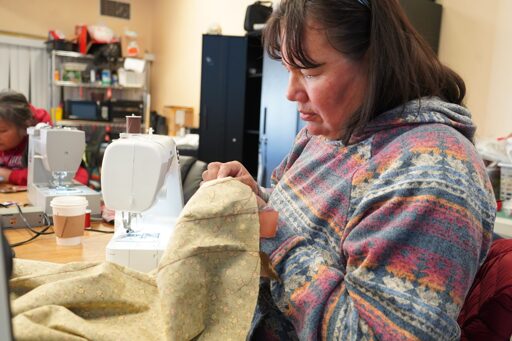
MINNEAPOLIS – Seated at a large round table covered with sewing machines, stray pieces of fabric and coffee cups, four women and one man focus intently on sewing colorful fabric, stitching ribbons and beading medallions. They take breaks periodically to enjoy hot soup and visit with one another.

Audrea Smith, Red Lake Nation
Just one year sober, Audrea Smith, Red Lake Nation, said the sewing circle keeps her mind off drinking and helps her financially as she occasionally sells what she makes. On this day in early February, she works on a red ribbon skirt embroidered with red hands to signify missing and murdered Indigenous relatives. She said she plans to wear the skirt for a Valentine’s Day MMIR march in Minneapolis.
The sewing circle – held in the community building at Little Earth, a housing complex in urban Minneapolis primarily occupied by Native tenants – also helps her keep her mind off her fears of her children being detained by federal immigration enforcement agents.
“I don’t think about it because you’re concentrating on something other than what’s going on out there,” the 52-year-old said. “It’s scary for the people around here.”
In a city recently in the grip of a massive immigration enforcement surge, parents of the 9.4-acre, 212-unit Little Earth housing complex said they fear that their children might be detained and incarcerated.
The Trump administration’s decision to send nearly 3,000 armed federal agents, including Immigration and Customs Enforcement and Border Patrol personnel, in early 2026 as part of “Operation Metro Surge” led to many Native residents of Minneapolis fearing they might get swept up in immigration raids.
The operation and subsequent waves of protests, as well as the killings of Renee Good and Alex Pretti at the hands of federal agents, led to many Indigenous people deciding to remain in their homes and keep their children home from school. Nowhere was that more apparent than in Little Earth, where many parents refused to even leave long enough to buy groceries.
Among them was Keiko Lussier, Mexican-American and a Leech Lake Ojibwe descendant.

Little Earth Native housing community in Minneapolis, Minnesota. (Kevin Abourezk/ICT)

Keiko Lussier, Mexican and Leech Lake Ojibwe
For nine years, the 34-year-old mother has lived in Little Earth, which is mostly made up of a series of apartment buildings. She said she’s been able to reconnect to her Ojibwe heritage, despite having been adopted by a non-Native woman when she was young and not being able to find her birth mother and get herself or her children enrolled.
But recently, Little Earth has begun to feel like a community under siege, she said.
A few weeks ago, Lussier and her young son were standing at a bus stop when an ICE agent approached them and began speaking to her in Spanish. Although she can speak Spanish, she responded in English, trying to hide her Mexican heritage.
While she and her son were not detained, she decided not to risk having her children taken from her and enrolled them in online classes so they wouldn’t have to leave their home, she told ICT in an interview inside her Little Earth apartment.
“If I was ever put in a situation where I had to defend my kids, I don’t know what I’d do,” she said, choking back tears. “We’ve been relying on the community to help us with groceries because I’m not enrolled and because I am Mexican-American. … It’s not safe being Mexican-American.”

Volunteers unload donations outside Pow Wow Grounds coffee shop in Minneapolis on Jan. 29, 2026. The coffee shop serves as a gathering place for activists and others protesting federal immigration enforcement efforts. (Kevin Abourezk / ICT)
Native organizations, like the Indigenous Protector Movement and the Minnesota Indian Women’s Resource Center, have gathered donated food and diapers and distributed them to families like Lussier’s who have decided to remain in their homes to avoid potentially being detained or incarcerated by immigration enforcement agents.
While the Trump administration recently decided to draw down the number of federal agents in Minneapolis, at the height of the immigration enforcement surge, several Native people were approached, detained and incarcerated, including a Red Lake Nation man and Rachel Dionne-Thunder, co-founder of the Indigenous Protector Movement.
On Jan. 6, ICE agents even attempted to enter Little Earth, but were turned away by property managers. The incident brought national attention to the community, which was founded in 1973.
Robert Pilot, host of Native Roots Radio, Ho-Chunk Nation, said ICE agents have been seen regularly patrolling Franklin Avenue, which has historically been an area where Native people live and work.
“They’ve been out at Little Earth,” he said. “They’ve been here on Franklin Avenue continuously. So they’re just badgering the Native community for sure.”
Little Crow Bellecourt, executive director of the Indigenous Protector Movement, said Little Earth was once called South High Housing, which was built on the site of the former South High School. When South High Housing was facing foreclosure, members of the American Indian Movement – including his father, Clyde Bellecourt, co-founder of AIM – asked to have the property given to the organization.

Donavan Begay Postier, Diné, director of adult and family empowerment programs for the Little Earth Residents’ Association in Minneapolis, Minnesota. (Kevin Abourezk/ICT)
Donavan Begay Postier, Diné, director of adult and family empowerment programs for the Little Earth Residents’ Association, said Little Earth – often referred to as a “little reservation” – was founded during an era of Indigenous resistance against housing discrimination and during a time when large numbers of Native people living on reservations began relocating to cities like Minneapolis and St. Paul.
She said it is the only Native preference federal rental assistance community in the United States and is home to around 700 people, but in early 2026 it became the focus of immigration enforcement efforts.
Begay Postier said federal agents entered the community several times and patrolled the area around Little Earth most frequently in early January, around the time that Renee Good was killed on Jan. 7. Agents followed an employee of the Little Earth Residents’ Association into the community but were turned away by residents who informed them that they were on private property.
Federal agents also approached and questioned parents as they left and arrived at the Little Earth Neighborhood Early Learning Center. When they saw parents being questioned, other community residents would begin blowing whistles and telling the federal agents to leave them alone.
She said the Little Earth Protectors, a group focused on monitoring federal immigration enforcement in and around the community, American Indian Movement and the Indigenous Protector Movement all keep staff and residents of Little Earth informed and send support anytime federal agents attempt to enter the community or approach residents.
“I would say the fear is real,” Begay Postier said. “It just reminds me of the times when the federal government was taking our children away from our families, without our permission, sending them away to schools.”

This sign is inside the Little Earth Residents’ Association building in Minneapolis, Minnesota. (Kevin Abourezk/ICT)
The residents’ association provides computers for youth to use who are being kept home to attend classes online and coordinates food deliveries to their families, she said. The residents’ association also has provided space for tribal employees who have visited Little Earth to provide tribal IDs to their tribes’ citizens.

Naomi Bull Child, Blackfeet Nation
Naomi Bull Child, Blackfeet and organizer for the Little Earth Protectors sewing and beading class, said the class is offered twice a week, offering ribbon skirt-making class on Tuesdays and open crafting classes on Thursdays. Participants learn how to make star quilts, quill work, ribbon skirts and beaded crafts.
She said the classes improve participants’ mental health and help them reconnect to their Indigenous identities and cultures, as well as foster a sense of community. Some participants sell the crafts they make at powwows and other cultural events.
By early February, ICE activity around Little Earth had decreased, and Bull Child said she had begun trying to reassure residents and visitors that the community was safe again. The residents’ association even began offering carpool service to residents who needed to get groceries or other essentials.
“There is a lot of convincing that is involved with trying to get them out of their house,” she said. “They’re not bothering our residents and people that do visit us every day. … As of currently, this is the safest area that people can come and enjoy.”

Participants of the Little Earth Protectors sewing and beading class gather to work on crafts on Jan. 31, 2026, in the Little Earth community building in Minneapolis, Minnesota. (Kevin Abourezk/ICT)
Inside the Little Earth community sewing room, Charlene New, Oglala Lakota, stitched a sage-green ribbon skirt with a floral design. She said all of the materials to make crafts are free and people can use the sewing machines at no cost. The sewing group often will set up their own tables at powwows to sell crafts and to demonstrate how to make crafts.
As an employee of the Hennepin County Medical Center, New said she has seen ICE agents enter the hospital to find potential undocumented immigrants.
As she worked on her ribbon skirt, New joked with the other women and exchanged news about ICE activity in the city.
“We see them here on the streets, and they come around here in our Native community, just driving by like gangsters to intimidate us,” she said.
The post ‘Little reservation’ in Minneapolis held its breath amid immigration crackdown appeared first on ICT.
From ICT via This RSS Feed.