

This article was first published in the Daily Struggle, the publication of Unite All Workers for Democracy (UAWD). Left Voice reproduces the article below.
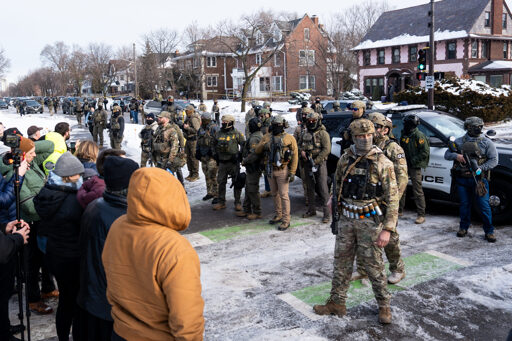
On February 10th, UAW Local 2325 voted overwhelmingly to convene an emergency membership meeting and strike vote in the event of ICE escalation in New York City. Navruz Baum, a paralegal in New York City and one of the authors of this article, worked with other UAWD members in Local 2325 to introduce the resolution because of what we have all watched unfold in Minneapolis: a federal occupying force beating, kidnapping, and murdering residents, while labeling protestors “domestic terrorists.”
Navruz first writes about the experience of organizing to pass the resolution. In the second section, he and Andrew Bergman, an autoworker at General Motors’ Detroit-Hamtramck Assembly plant and a member of UAW Local 22, write about how we can organize our unions to prepare for the fight against ICE in cities across the country.
Laying the groundwork to fight ICE in New York City
On January 23rd, workers in Minneapolis organized an inspiring mass mobilization. More than fifty thousand people flooded the streets, and many rank-and-file workers called out sick to disrupt business as usual. Their organic reaction of halting production shows a working class with a growing readiness to fight.
Unfortunately, most Minneapolis union leaders did not meet the moment. Our strongest weapon against the ruling class is our ability to withhold our labor and shut down society. Yet timid executive boards kept the decision of whether to strike out of the hands of membership. Instead of holding mass meetings and strike votes, they took the limited step of only coyly endorsing a “day of action,” encouraged members to “decide for themselves” individually how to participate, and emphasized street protest and consumer activism over labor action. Terrified of their “no-strike” clauses and labor law, all but a few failed to use some of the most basic elements of union power. UAW leadership made the same decision, issuing a statement of “solidarity with the people of Minnesota, including hundreds of UAW members,” but making no effort to organize workers to consider collective action—and failing to connect the fight against ICE to building towards a general strike in 2028. Shop-floor leaders did not want our local to make the same mistakes.
Organizing for the resolution in Local 2325 started small. I began by sharing a draft with other UAWD members and supporters in my local. We revised it together, debated it, and then circulated it more broadly in union chats and on union listservs. Our coworkers reacted with a range of excitement, curiosity, and fear, but the conversations were serious and engaged. We eventually collected more than two hundred signatures in support, and when we got to the union meeting delegates voted 98 to 10 to commit that:
“In the event of a movement in New York City for a mass response to ICE escalation, the ALAA – UAW 2325 Executive Board shall convene a membership meeting to discuss and vote on whether and how to take labor action including striking. Any strike votes at the meeting must have two-thirds of voters in favor to pass.”
Our resolution is now being discussed in various other locals, in the UAW and in other unions. Even before we won our vote, UAWD members in other locals had asked me for copies and were discussing with their coworkers how to bring it to their own membership meetings. Our resolution intentionally calls for our strike vote to happen in the context of a “mass response,” because these tactics will only work if we unite across workplaces and sectors.
Our work of building toward an anti-ICE political strike has only just begun. But if thousands of ICE agents are deployed to New York City, we’ll have laid the groundwork in our local for a broad, democratic deliberation on striking against ICE. Now is the time for union members to build up those same democratic structures to prepare for the fight against ICE in New York City and in cities around the country.
Strategically building power for a general strike in every U.S. city
As militant union members, if we want to build the capacity for citywide general strikes for political demands, we must bring our coworkers into a shared strategy: shutting down their facilities, halting profit accumulation, and inflicting real costs on the capitalist class and the political elites who serve them. This strategy is the only way to frighten the ruling class and force politicians to change their behavior. That means our focus should be on convincing rank-and-file members, not just the union bureaucracy, which we can only do by putting the debate and the vote about a political general strike to the membership.
In manufacturing plants, like legal services offices, we encounter precarious conditions every day. Even with the protection of our union, workers face retaliation for political speech and activity. Many workers, understandably, feel unready to strike for their own pay and benefits, and can’t even imagine striking over a political demand. But—as we saw in Minneapolis—that begins to change quickly when people are confronted with a violent occupying force that is threatening their families and neighbors. If we prepare our unions for the moment of escalation, we can help our coworkers see that working-class organizations like unions can give us political cohesion and structure. They enable us to move from a safer but loosely organized and largely ineffectual individualistic approach, to a riskier but tightly organized and much more powerful collectivist action.
Bringing proposals like the Local 2325 resolution to locals across the UAW, spanning shops in manufacturing, legal services, higher ed, and beyond, will enable a debate about how to wield working class power. Even in locals where there isn’t agreement that a strike should be called directly at an emergency membership meeting, or in settings where union meetings aren’t well attended, the emergency meeting presents an opportunity for class struggle unionists to bring our ideas. We can demand that action be decided democratically through a membership-wide vote held in the wake of the meeting, not by union leadership in isolation from the rank and file.
What would happen if, as with votes to authorize strikes over our own contracts, thousands of UAW members across the country were called to union halls and break rooms to vote on whether they were ready to strike to oppose ICE? Many of those votes may fail—especially if union bureaucrats, stoking fears of legal reprisals on the part of employers and the state, organize to oppose strike action.
But if we can use the debate to get even a significant fraction of our coworkers to support a strike for political demands, then we can demonstrate both the challenge and the potential of building broad-based working-class power. That’s what’s needed to recruit our coworkers to the idea that we, the working class, are more than the sum of our parts and can do more than just participate in actions as individuals. As workers, we, and we alone, are capable of the scariest thing known to the owning class—grinding production to a halt through collective struggle, for our collective liberation.
The post UAW Local 2325 Commits to a Strike Vote to Fight ICE—What Can Other Locals Do? appeared first on Left Voice.
From Left Voice via This RSS Feed.