

By Mark Birnbaum, World BEYOND War, February 24 2026
Unbeknownst to the majority of Canadians, Canada operates a web of domestic military bases and secretive foreign bases on four continents.
Covering an area of 21,000 square kilometres (half the land mass of Switzerland), there are 31 domestic bases spread across all 13 provinces and territories that have significant impacts on the environment and Indigenous communities.

Outside the country, Canada maintains a military presence via bases in Germany, Kuwait, Jamaica, and Senegal – with three more planned for Tanzania, Singapore, and South Korea. While not “secret” per se, information about Canada’s foreign involvement is difficult to access and must be actively sought.
The dearth of public awareness pertaining to Canada’s foreign involvement may be partially attributed to how Canada classifies its bases; military operations are deliberately obfuscated through euphemistic language, such as “Operational Support Hubs” in the Caribbean, West Africa, Europe and Latin America. Operations are spoken of matter-of-factly or downplayed, as if it is a natural state of affairs. The government doesn’t want you to know about foreign bases. So it calls them something else.

A map of current and potential “Operational Support Hub” military bases. Illustration by The Breach.
Opacity and obfuscation extend to Canada’s domestic military industrial complex, with military installations sometimes labeled as “stations” or even under “closed” status, despite rehabilitation or repurposing; many “closed” bases have restarted their functionality, facilitating training for reserve and militia forces.
Within our own borders exist 11 Canadian Forces (army) bases, 4 RCN (navy) bases, and 16 RCAF (air force) bases. Some of these are composed of “Forward Operating Locations” under the NORAD (North American Aerospace Defence Command) banner. As the system of NORAD is a vestige of the Cold War (yet persists due to war-mongering anti-Russia and anti-China propaganda and orientalism), these sites are located in Canada’s north. To “defend the Northern Canadian Frontier,” bases are present on Indigenous lands in Yellowknife, Rankin Inlet, Iqaluit, and on Inuvik lands.
Rather than defending the “Northern Canadian Frontier,” Canada has been historically beholden to U.S. imperial aggression:
- Canadian NORAD mobilization
- Support for the U.S. during the 1962 Cuban Missile Crisis, and
- Placed on high alert during the 1973 Yom Kippur War in Israel
- 2003 invasion of Iraq – Despite famously proclaiming that unless the military action was sanctioned by the U.N., Canada would not join the U.S.’ “Coalition of the Willing,” yet:
- Dozens of Canadian soldiers participated in U.S. fighting units
- Three Canadian generals directed tens of thousands of troops
- Canadian warships, previously deployed in the war on Afghanistan, assisted the U.S. with interdiction missions
- Venezuela
- Canadian-made sensors were used to track and surveil Venezuelan boats that were bombed in Trump’s illegal strikes
- Syria and Iraq
- Canada took part in Operation Impact, the U.S.-led coalition against ISIS in Iraq and Syria, protecting U.S. imperial interests. The Canadian Air Force ran 3,425 sorties from 2014-2019.
U.S. imperial interests dominate the global military landscape, with 877 military bases in 95 countries. Canada continues to be a cog in the U.S. war machine, playing a crucial support, logistics, and operational role.
The “Operational Support Hub” Examined:
Canada’s network of secretive foreign bases are officially labeled as “Operational Support Hubs.”
“These bases will allow for Canadian military, policing and special forces operations on a permanent basis, and support large-scale surges of military forces on terms favourable to the United States,” explained Jerome Klassen, Canadian political scientist and research fellow.
As laid out in an investigation by the Breach these bases aid – and benefit from – U.S. imperialism:
- Shared strategy
- Flexible, “lilypad” bases to support and extend U.S. military operations
- Canada offered use of U.S. military bases and airfields
- Canadian base in Dakar, Senegal – built near an existing U.S. base – is used to support operations in Mali, where Canadian mining companies have $1.2b invested
- Operational use in U.S.-allied campaigns
- The Canadian OSH in Kuwait aided U.S. operations against ISIS, facilitating troop movements and fighter jet missions – capabilities that still exist
- Intelligence support capacity for missions in North Africa and Southwest Asia
- Supporting role
- Described as “small militarily, but with an outsized policing function.
- Facilitate training, counter-terrorism activities, and security assistance to U.S. operations
- Integration with U.S. commands
- Canadian strategic regional interests also inform the placement of OSHs
- Some have been built near pre-existing U.S. bases, ensuring interoperability and logistical support for U.S. operations
Canada as a “Middle Power”
Canadian Prime Minister Mark Carney’s speech at the World Economic Forum in Davos, Switzerland on January 20th, 2026, was widely hailed by liberals as a stark, brazen, and bold declaration of Canadian exceptionalism and autonomy. Carney affirmed Canada’s intention to find alternative means to reap the benefits of imperialism, after decades of pillage and plunder in the Global South. He lamented the death of the “rules-based international order” – a euphemism for the structural systems of neocolonialism, economic sanctions, and cynical implementation of international law – all under the banner of “liberal democratic values.” The necessity for other Western imperial “middle powers” to band together and decouple from the U.S. is existential. Yet, for Canada in particular, such disentanglement is not only unfeasible, but a complete mirage.
Canada continues its procurement of the monstrously-expensive F-35 stealth fighter jet – 88 in total. To house these belligerent aircraft, Canada will spend $2 billion on specialized hangars, further littering the Canadian landscape with military bases. Sold by Canadian leadership as a means to ensure Canadian sovereignty, defence, and peace-keeping capacity, such notions are betrayed by the fact that the U.S. controls software upgrades for the aircraft – an effective kill-switch.
There is no divergence from the U.S. economically, or differentiation morally, as Canada doubles down militarily. There is nothing “principled or pragmatic,” as Carney says, about this chosen path.
The price of security: the consequences of Canada’s domestic military presence
1) Land theft, Displacement of Indigenous Peoples and Environmental Damage
Indigenous peoples accuse the Canadian military of insufficient (or non-existent) consultation, including unstated consequences for military presence and activity.
Fighter jet drills have infamously taken place above and near Innu territories. “Canada sees our land as uninhabited land. It is inhabited by the Innu, and it is inhabited by wildlife. This is hunting territory, nomadic territory. It is not for war games,” stated Elder Tshuakuesh Elizabeth Penashue.
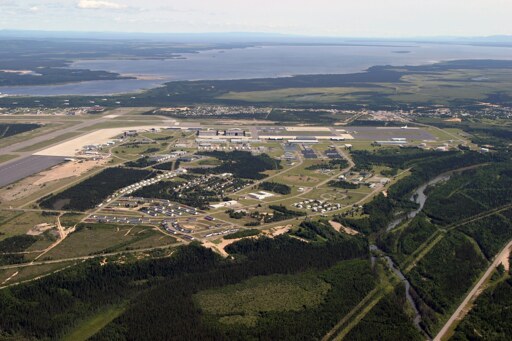
In the 1940s, parts of traditional Innu land were annexed from south central Labrador, creating an airbase for the North Atlantic Treaty Organization (NATO) after World War II. Initially a modest proposition, “Goose Bay” ultimately attained the status of the Western hemisphere’s largest airfield. In the late 1980s, more than 100 Indigenous land defenders and supporters were arrested as they re-occupied Goose Bay airfield and Minipi Lake bombing range.
Environmentally, there are extreme consequences; the deaths of land animals, fish, insects, and birds; the contamination of land and water; toxic pollutants, explosives, and discarded munitions. It is difficult to pinpoint the precise environmental impact of Canada’s domestic military bases; however, Canada’s Department of National Defence acknowledges that its annual emissions from its National Security and Safety (NSS) fleet total 878 kilotons of CO2. Without military bases, shipyards, ports, and airfields, Canada’s emissions would be cut drastically, at a time when Canada intends to abandon its commitment to cap oil/gas emissions, roll back federal greenwashing legislation, and ramp up subsidies for liquefied and natural gas.
The Canadian government has stated its intent to employ accelerated extractivism, “fast-tracking” projects that circumvent environmental protection regulations for “critical mineral projects,” which directly support the manufacturing of components and materials for military purposes. Unsurprisingly, such projects have fueled the growth of war industry stocks.
2) Perpetuating Militarism and Threatening Canadians
The very nature of a base’s presence makes it a military target. Despite being labeled “defensive”, their existence leads to arms races, mutual aggression, and overall instability. Canada’s 85,000 troops could be subject to U.S. “use” at any given time.
As briefed to the Canadian House of Commons in May 2022, 5 threats would face Canada in the near future: economic, arctic “sovereignty”, humanitarian crises, increased domestic conflict, and “human security.”
Increased militarism in the north is often justified based on the spectre of climate threats, which is a circular argument; the threat is exacerbated by increased militarism. Military operations, and their associated industries, directly contribute to the climate crisis. Our government refuses to address actual climate harm. Further, this type of disaster relief could be civilian-led, without bloating the number of Canadian soldiers on domestic soil.
U.S. President Donald Trump has announced intent to weaponize space through constructing the “Golden Dome,” a missile defence system that is technically dubious, politically destabilizing, and potentially strategically dangerous. Critics argue that rather than acting as a deterrent for nuclear missile attack, it may provoke one. Trump has floated the idea that Canada contribute $71 billion towards the program, inevitably requiring Canada to further entrench itself in domestic military infrastructure.
3) Austerity and Canadians’ Quality of Life: Theft from Future Generations
On November 4th, 2025, Canadian Prime Minister Mark Carney unveiled his 2025 war budget, which will cost Canada an additional $33.5 billion CAD annually, nearly doubling the current military budget. Carney, cynically and with little empathy, declared that Canadians will need to make “sacrifices,” as the government plans to cut $60 billion from non-military programs over 5 years. By 2028, the government estimates 40,000 job losses; as of the time of this writing, 10,000 jobs have already been slashed. Other cuts will include, but are not limited to:
- Pension benefits for disabled RCMP personnel
- $800 million annually in international assistance
- The Canada Greener Homes Grant (full reduction not yet disclosed)
- Decade-long program for planting 2 billion trees
- Canada Public Transit Fund
- Scope of eligibility for immigrants’ economic integration programs
Part of the budget has been committed to massive “infrastructure” projects that are centered around military functionality and readiness – although purported to be “dual-use.”
Could we be building something better? A future for Canadians and Indigenous peoples is a good start
In 2024/2025, there were an estimated 60,000-67,000 Canadians experiencing “absolute homelessness”, with “hidden homelessness” and precarious housing estimated between 235,000 and 450,000 people annually. According to the “Build Canada Homes” proposal, an annual investment of $40 billion would fund the construction of 80,000 affordable housing units per year. Canada could permanently solve homelessness in 5 years. To put that in perspective, the Department of National Defence spent $34.5 billion in 2024. Carney’s 2025 war budget will see new spending of $81.8 billion over 5 years, or an additional $16.2 billion annually – nearly a 50% annual increase. Our ruling class makes its intentions clear when it would rather spend $50 billion per year on bombs, and not $40 billion per year on beds.
What is security without life and liberty?
Expanding the Canadian military means contracting the day-to-day security of Canadians, all under the premise of an amorphous “foreign” threat that has never materialized, while the material conditions of Canadians degrade daily.
The beneficiaries of militarism are not Canadians, but weapons manufacturers and their investors. Canadians are not kept safe when yet another arms race cycle begins. The civil liberties of Canadian citizens are not upheld when military weapons, spy, and surveillance technologies are turned upon them.
Canadians must pressure their government to close its domestic military infrastructure, divert funding back to social welfare programs, and stand in solidarity with Indigenous peoples in the collective struggle for security and liberation.
When ports are built, warships will fill them. When airfields are manufactured, fighter jets will line them. When mortars are crafted, troops will fire them.
We can have a world beyond war, and it must start at home.
The post Canada’s Operates a Web of Domestic Military Bases and Secretive Foreign Bases appeared first on World BEYOND War.
From World BEYOND War via This RSS Feed.