

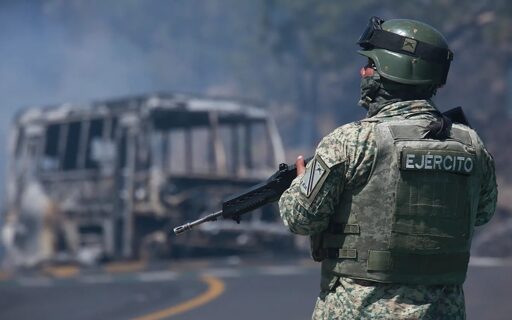
Images of burning buses, blocked highways, plumes of smoke, and people fleeing in terror from airports and markets in Mexico were plastered across the front pages of the world’s largest newspapers and news sites on Monday. Mexican states such as Michoacán, Guanajuato, Nayarit, Colima, Zacatecas, Tamaulipas, Guerrero, Aguascalientes, and Oaxaca reported disruptions, road blockades, and violent actions. The scenes followed the federal operation that culminated in the killing of Nemesio Oseguera Cervantes, leader of the Jalisco New Generation Cartel (CJNG).
In response to this violence, much of the international press reproduced the false narrative of Mexico as an ungovernable territory dominated by all-powerful cartels. But this narrative obscures the fact that the security policy of Claudia Sheinbaum’s government toward the cartels is part of an imperialist hemispheric architecture promoted by Washington under the banner of the “war on drugs.”
The War on Drugs as a Tool of Regional Domination
Since 2006, Mexico has formally adopted an internal war strategy aligned with U.S. guidelines. The so-called “Kingpin” strategy — focused on capturing or eliminating leaders of criminal organizations — was designed in coordination with U.S. agencies and implemented by the PRI, PAN, and — despite its nationalist rhetoric — Morena governments.
Far from strengthening Mexican sovereignty, this strategy only consolidated mechanisms of interference: intelligence sharing, operational presence of U.S. agencies such as the DEA, diplomatic conditions, and increasing security integration under trade frameworks such as the USMCA.
The result has not been the defeat of drug trafficking, but its violent reconfiguration. The fragmentation of organizations has led to bloodier disputes for territorial control. Meanwhile, international financial capital — including banks operating between Mexico and the United States — continues to absorb and launder billions of dollars from illicit economies.
The “war on drugs” thus functions as a device for social control and regional discipline, justifying military expansion, surveillance, and political subordination in the name of security.
But this dynamic cannot be separated from the new extractive cycle that is beginning to take shape in Mexico and Latin America. In recent months, strategic agreements on critical minerals — lithium, copper, and rare earth elements — have been announced and negotiated within the framework of the geopolitical dispute between the United States and China. Mexico appears as a key piece in the North American supply chain, especially under the USMCA and Washington’s new industrial policies.
In several regions of the country, the expansion of mining, energy, and infrastructure projects coexists with the presence of organized crime groups that control territories, extort money, manage precarious labor, or even participate directly in legal and illegal extractive economies. The relationship between mining, land dispossession, and criminal structures has been documented in states such as Michoacán, Guerrero, and Zacatecas.
Thus, the militarization of the “war on drugs” is part of a broader attempt to build and guarantee the stability of logistical corridors, megaprojects, and strategic mining areas for transnational capital. The cycle of violence and the extractive cycle are not separate phenomena: they are part of the same territorially dependent reconfiguration.
Permanent Militarization and the Working Class
For the Mexican working class, the militarization of the U.S.-backed “war on drugs” has meant the normalization of checkpoints, permanent patrols, and a constant expansion of the power of the Armed Forces in civilian tasks. At the same time, they are forced to live alongside shootouts and patrols by cartel cells vying for control of the territory and fighting against state forces. In the states and areas where the Mexican National Guard is deployed, a regime of “exceptionality” is established in which democratic rights are subordinated to military logic.
In Mexico there have been more than 300,000 homicides and tens of thousands of missing persons reported since the start of the war on drugs in 2007. The victims overwhelmingly come from among the working class and poor, while the business and financial structures that sustain the cartels remain untouched, as do the pro-business politicians associated with organized crime groups.
The roadblocks and fires following the operation are not proof of an “absent state,” as liberal analysts have repeatedly claimed. They are evidence of the consequences of a profound militarization (demanded and imposed by imperialism) that has devastated entire regions, combining illegal economies, extreme job insecurity, and military violence.
Against the Imperial Narrative: an Internationalist Perspective
Reducing the situation to a struggle between the state and the cartels obscures the fact that Mexico’s security policy is inseparable from its structural dependence on imperialism. Economic integration under the USMCA and security cooperation are part of the same mechanism that subordinates Mexican domestic policy to Washington’s strategic interests.
From a socialist and internationalist perspective, the solution lies neither in further militarization nor in increased imperial oversight. Experience demonstrates that the “war on drugs,” while failing to substantially address the drug trade, has served as a means to promote militarization against the peoples of Latin America, strengthening repressive apparatuses and weakening democratic rights.
In response, it is necessary to build an alternative independent of the parties of the bosses, based on the organization of the working class, international coordination, and the struggle against imperialism and financial capital that sustains both the legal and illegal economy.
Only an emancipatory perspective, which questions structural dependency and aims for a socialist transformation of the region, can confront the economic and political roots of this permanent militarizing offensive.
Originally published in Spanish on February 23 on La Izquierda Diario, Mexico.
Translated and adapted for Left Voice.
The post U.S. Imperialist Policy Driving Violence in Mexico appeared first on Left Voice.
From Left Voice via This RSS Feed.
You must log in or # to comment.