

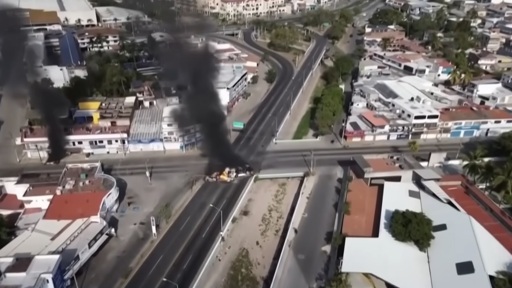
Mexico faced a “wave of violence”, following the death of “Mencho” the leader of Jalisco New Generation Cartel (CJNG). This cartel is, according to the Mexican government, the most powerful in the country since it surpassed Sinaloa Cartel in 2018, another organization that controls major drug and arms trafficking routes and whose conflict with the CJNG has caused thousands of deaths.
The CJNG has been declared one of the five most dangerous criminal organizations in the world by the US government, which offered a reward of USD 15 million for information leading to the capture of its top leader. In addition, the US State Department declared the CJNG a foreign terrorist organization in a statement on February 20, 2025: “The CJNG is a transnational organization with a presence in almost all of Mexico. In addition to trafficking fentanyl, the group is involved in extortion, migrant smuggling, oil and mineral theft, and arms trafficking.”
The assassination of “El Mencho”
On Sunday, February 22, the Mexican government reported that they had detained the top leader of the CJNG, Nemesio Oseguera Cervantes, alias “El Mencho,” 59, one of the most wanted fugitives inside and outside the country. The operation to arrest Oseguera and several other members of the group took place in the municipality of Tapalpa, Jalisco (about 130 kilometers from Guadalajara). Government forces were met with significant gunfire, leading to a confrontation in which several members of the CJNG were killed and the top leader was wounded. El Mencho succumbed to his injuries after his arrest.
White House spokeswoman Karoline Leavitt reported that the US government “provided intelligence support to the Mexican government” in the operation aimed at capturing “El Mencho.”
According to Ricardo Trevilla Trejo, Mexico’s secretary of national defense, a military intelligence group followed a “trusted associate” of one of El Mencho’s partners. After the meeting between this woman and the CJNG leader, it became known that the latter remained in the mountainous area where they met.
After the operation, involving ground and air forces (including six helicopters) began, Oseguera and others attempted to flee through the forest, where they encountered federal forces and another confrontation ensued. After being wounded, “El Mencho” was transported by helicopter to a military facility in Jalisco, but died en route, Trevilla Trejo said.
Authorities reported finding high-caliber weapons, ammunition, and two rocket launchers, one of which was used in an attempt to shoot down one of the Mexican military helicopters, however, it was able to dodge the attack and transfer to a nearby base.
The blow to the CJNG was not only against its top leader, but also against its second-in-command. On February 22, Hugo H, alias “El Tuli,” the cartel’s right-hand man and head of its finances, was also killed. His death was confirmed about 100 kilometers from where “El Mencho” died.
“El Tuli” was coordinating roadblocks, vehicle fires, and attacks on military installations, the National Guard, businesses, government facilities, etc. He also offered 20,000 pesos [USD 1,160] for each soldier killed by members of this criminal group,” said the secretary of defense.
The beginning of widespread violence
Despite the assassination of the CJNG’s second-in-command, the response seemed to have been planned long ago. Many feared that the assassination of one of the world’s most important cartel leaders could lead to a dangerous situation. Such suspicions were confirmed when, following the death of the CJNG leader, a series of attacks, blockades, fires, shootings, etc., broke out in various parts of Jalisco and other areas of the country. The state capital, Guadalajara, home to some 5 million people, is completely paralyzed due to the dangerous situation.
Several embassies in Mexico, including Spain, the United Kingdom, France, Canada, and the United States, have notified their citizens about the dangerous situation and recommend that they remain in their homes following the outbreak of violence unleashed by a cartel that has demonstrated its presence not only in Jalisco but throughout the country.
According to some media outlets, at least 16 of the 32 states in Mexico’s vast territory have suffered attacks by alleged cartel members. Mexican President Claudia Sheinbaum has repeatedly called on people to remain “informed and calm” and reported that in many places law and order has been restored.
At this time, some media are reporting that at least 30 alleged CJNG members have been killed in clashes with federal forces, which have suffered more than 25 casualties, although many suspect that these figures will rise in the coming days. In addition, classes have been suspended in several schools, and all mass events have been put on hold for the time being. The airport in Puerto Vallarta, one of the country’s most popular tourist destinations, had canceled flights in response to the threats.
What will happen now?
For now, the federal government has tried to show that it is addressing the security situation in the best way possible. On X, President Sheinbaum stated: “The Ministry of National Defense reported on the operation carried out this morning by federal forces, which led to various blockades and other reactions. There is full coordination with the governments of all states; we must remain informed and calm. The Security Cabinet’s social media accounts are providing ongoing updates. Activities are proceeding normally in most of the country.”
She also thanked the security forces: “My gratitude goes to the Mexican Army, National Guard, Armed Forces, and Security Cabinet. We work every day for peace, security, justice, and the well-being of Mexico.”
However, some security experts have reported that the assassination of cartel leaders can cause much more violence than it seeks to stop. And not necessarily because of the wave of violence it caused in the short term, but because of the violence that could be unleashed in the coming months over control of illicit businesses.
According to David Mora, an analyst and researcher on organized crime, this assassination could backfire on Sheinbaum, who had aimed to pacify the country: “Organizations do not simply disappear by removing their leaders. In fact, they tend to destabilize, generate more violence, and create opposing factions. And that has led to the proliferation of criminal groups in Mexico … Because what we are going to see is internal tension within the Jalisco cartel structure, possibly greater clashes with local groups, who may begin to see that the cartel is weakened and that this is an opportunity to advance their territorial control against Jalisco.”
Furthermore, Mora asserts that the decision to target the CJNG leadership should be viewed as an issue that goes beyond internal tensions: “There is pressure from the White House for joint military action with US forces. And President Sheinbaum and the Mexican government reiterate that the formula they are proposing to the US works. What is that formula? Let’s cooperate, share information, share intelligence, but Mexico is in charge of actions on the ground.”
For now, the federal government must demonstrate that it is capable of controlling the immediate situation generated in response to the assassination of the top leader of Mexico’s most powerful cartel. After that, it must demonstrate its strategy for controlling a predictable and bloody succession or division of business interests without Mexico becoming embroiled in a bloodbath, as has happened on other occasions.
The post Chaos and then tense calm follow death of Jalisco cartel leader appeared first on Peoples Dispatch.
From Peoples Dispatch via This RSS Feed.