

In the popular imagination, Iowa represents the American Heartland, with sweeping fields of corn and soybeans tended by farmers who also act as bellwethers for national politics.
But it’s much harder to imagine the corporate, political, and cultural forces shaping which crops these farmers plant, or how they grow them, or why industrial hog facilities now fill the horizon, or who, exactly, benefits from it all.
These are the very issues that Art Cullen has been writing about for more than 30 years at the Storm Lake Times Pilotin Storm Lake, Iowa*.*
Cullen, a native of Storm Lake, is the editor; his brother, wife, and son are also all on staff. And while the newspaper exists mainly to serve the town of about 11,000 people in Iowa’s northwestern quadrant, Cullen’s columns have found a broader audience because the topics he covers have national significance.

Art Cullen, editor of The Storm Lake Times, on stage at the Heartland Forum in Storm Lake, Iowa. (Photo credit: Lorie Shaull/Flickr)
In 2017, he won a Pulitzer Prize for editorials that “successfully challenged powerful corporate agricultural interests in Iowa.” He’s also written two books; his latest, Dear Marty, We Crapped In Our Nest: Notes From the Edge of the World, a collection of his columns, was published last year.
As the country heads into a pivotal election year, many of the food and farm policy issues Cullen knows best are rising in political and cultural prominence: water pollution from industrial animal agriculture, illnesses linked to farm chemicals, the impacts of continued consolidation, and others.
We spoke with Cullen to find out more about what he’s seeing and hearing on the ground and which party he thinks will be able to respond to a growing populism that includes a focus on corporate power in the food system.
Immigration operations in Minnesota have been front-of-mind right now for much of the country, including farmers. How have Storm Lake residents reacted to these federal operations and the protests?
Storm Lake is majority minority; that is, majority Latino. So people here feel very threatened and fearful. They’re laying low. They are not downtown.
But there is a kind of a tacit acknowledgment here that meatpacking plants owned by the majors are not getting raided, because I think they figured out from the pandemic, when they shut down the Storm Lake and Waterloo pork slaughter plants for Tyson and meat prices shot up 50 percent in about a week, they realized, “Oh, we can’t really deport all these immigrants because they’ve got to cut meat.”
Now, that doesn’t mean that if [White House Deputy Chief of Staff for Policy] Stephen Miller wakes up with a bad cup of coffee, things couldn’t change. But I think they recognize that they have to keep the meat churning.
In Dear Marty, so many of the chapters represent topics that are entering the national conversation in a bigger way right now, like immigration, cancer, and more. Does this feel like a pivotal time or a turning point for Iowa?
Yes, in a lot of different ways. This is the first time since 1968, for example, that we’ve had open U.S. Senate and governor’s races. So, there’s going to be a big political turning point in Iowa. This has been an entirely Republican congressional delegation and an entirely red state government, led by Kim Reynolds, who’s not running for reelection as governor. And [Republican Senator] Joni Ernst is not running for reelection.
Democrats do have a real opportunity to pick up those two seats, which would change the whole political atmosphere in Iowa. We’ve raced backwards in time in terms of acknowledging our history with African-Americans and Native Americans, smothering all that, shaming gays, etc. It’s just been awful for the past 10 years.
“Democrats do have a real opportunity to pick up those two seats, which would change the whole political atmosphere in Iowa.”
There’s a lot of other changes that are taking place that are not necessarily controlled by us, but nature is making some pretty big changes in the way livestock are raised, for example. Disease is rampant, and cattle are running out of water in the Great Plains. There are beef plants closing and opening. So agriculture is really in a great state of flux right now, and obviously that’s vital to Iowa.
We’ve tried this 50-year experiment in supply-side economics, and it hasn’t worked. It hasn’t worked for agriculture. It certainly hasn’t worked for rural communities. It hasn’t worked for our political culture. It’s polluting the water. And so there’s another inflection point. They’re all related to each other.
Let’s tease out some of the things you mentioned. Water quality is a big one. In your new series, “What’s Eating Iowa?,” you have an episode on water quality. Are you hearing from Iowans when you’re traveling around the state that this is a really big concern? And are people linking it to agriculture?
Yes and yes. What we’ve done is we’re producing a series of four medium-length documentaries, 16 to 20 minutes, on water quality, cancer, and agriculture resiliency in an era of climate change and rural consolidation. Again, they’re all related. They all point to each other.
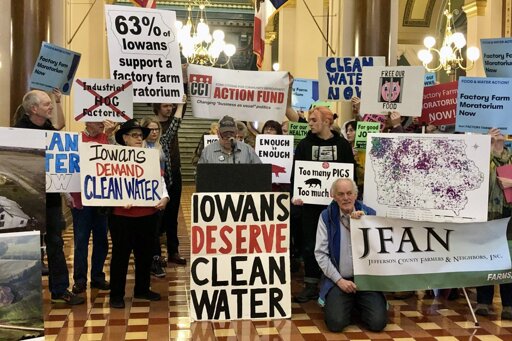
Last summer, a thousand people showed up at Drake University to talk about anhydrous ammonia [fertilizer] on a beautiful summer evening. Iowans just don’t do that, right? There are 500,000 people in the Des Moines metro area, and a thousand of them show up to discuss nitrate levels in the Raccoon River. That’s pretty remarkable. People are upset about water quality in Iowa.
But there’s this Republican legislature that’s funded by the agribusiness cartel that won’t allow a real discussion of regulation of agriculture, regulating drainage districts that are fouling these rivers, and they certainly won’t allow a discussion about what the root causes of cancer are in Iowa. We don’t really know.
We know that we have the second highest cancer rate in the country, next to tobacco central, Kentucky. And we have a very high rate of youth cancer here. We have the highest rate of breast cancer and prostate cancer in North America, right where I live, which is where we also have the highest concentration of livestock.
People there also smell hog shit in the air every day when they open up the door. So they are making connections between environmental influences, industrial practices, and cancer. They’re making the connections very slowly about how these agribusinesses actually ruined rural communities.
Do people feel like they can ask those questions or speak out? Because generally in Iowa, making those connections can get you labeled as anti-farmer.
That’s exactly what’s happening. In fact, there is a Democrat research scientist named Chris Jones, a water researcher who is running for Iowa Secretary of Agriculture. Kind of a quixotic mission in Iowa, a Democrat running against an incumbent Republican; that’s really a tall task. And the first thing out of the incumbent’s mouth is that Chris Jones is “anti-farmer,” because he favors clean water. [You have to be] pro-pollution to be pro-farmer.
Of course, it’s bullshit. You can have prosperous agriculture and clean air and water. They’re not mutually exclusive. But it’s really a long campaign of disinformation that’s been occurring. Propaganda. Cropaganda, we call it.
The current state agriculture secretary, Mike Naig, previously worked for Monsanto. The thing that has always interested me is the sense among farmers that corporations—especially, chemical corporations, the pesticide companies and seed companies—are on the side of the farmer. How did that happen?
It’s on every ad you see on TV during girls’ basketball games, which is the major cultural event.
It’s just pounded into your head that fertilizer companies and herbicide companies are your partner in yield, and yield is everything. And because you can’t get the price you want, you have to have the yield. So, [farmers are] locked in to maniacally chasing that pot at the end of the rainbow.
“It’s really a long campaign of disinformation that’s been occurring. Propaganda. Cropaganda, we call it.”
And then the banker gets involved and says, “You know, we really need to be doing it this way.” And the landlord is reading Successful Farming magazine and says, “We should be doing it this way.” And then the tenant farmer says, “Well, yeah, I guess I better do it your way.”
So there really isn’t a lot of room there for the farmer to actually act as steward, and they get locked in by this dominant culture in Iowa that says you must plant every acre in corn and soybeans and then feed it to hogs.
Do you think that the pesticide immunity laws that Bayer has been pushing for—which would make it harder for individuals to sue over claims pesticides caused their illnesses—might change that? Are people seeing that those companies might not have their best interests in mind?
Yeah, it’s coming at a very interesting time in Iowa, when there’s also an attempt to lay CO2 pipelines across the state. So a lot of very conservative, libertarian, property-rights Republicans are split with the more traditional, corn-ethanol Republicans over property rights and libertarian ideals. So, it’s come at a very bad time for Bayer to be the big, bad corporate player, because they’re getting lumped in with the CO2 players, the ethanol boys.
There’s kind of an anti-corporate populism rearing its head right now in the Republican Party. It presents a real opportunity for Democrats, and they appear to be blowing it, of course, by siding with the pipeline companies in a vain attempt to hang on to the Pipe and Steam Fitters Union.
The pesticide immunity bill is surfacing again in the Iowa legislature this session. They’re pushing it again, just because it’s so important in Iowa. If it goes in Iowa, it’ll go in Illinois, in Indiana.
In agricultural spaces, politicians often ignore the opportunity to speak more about corporate consolidation, including hog farms, the hollowing out of rural communities, and rural Iowa towns that no longer have grocery stores. Which party do you think is going to win on that issue?
Well, in Iowa, there’s only one party, that’s the problem, Especially, in western Iowa, I think one Democratic senator lives west of Interstate 35, which bifurcates the state east and west. There is no Democratic Party where I live, functionally speaking. The whole disagreement is between the libertarians and the Farm Bureau Republicans. That’s where the contest is.
But it may allow a Democrat to slip in as governor. Because [Republican U.S. Congressman] Randy Feenstra is considered to be a tool of the Farm Bureau. It might allow [Democrat State Auditor] Rob Sand, who’s armed with about $13 million, to slip past Randy Feenstra, because I think libertarian turnout could be suppressed by these disagreements over pipelines. Plus, there’s a lack of enthusiasm for the Trump administration, and shooting people dead in the streets doesn’t play well with libertarians.
Are there farmers and farm groups that you see pointing Iowa in a better direction?
I guess I can draw some optimism from the Practical Farmers of Iowa and secondarily, the Iowa Farmers Union, which would be the alter ego to the Farm Bureau. The Farmers Union is very small, but they’re getting very active politically.
“There are a lot of really smart guys who understand the weather. They realize they just can’t go on doing what they’re doing.”
The Practical Farmers of Iowa are interesting in that they were considered, you know, Birkenstock kind of people, and they would get 10 farmers at a field day. Now, they’ll get over 100 farmers, or even a thousand, at a field day. They have a huge convention that that goes on for three days now, and it all revolves around sustainable, regenerative, or resilient agriculture—whatever you want to call it. That really is something that the conversation is changing in Iowa. It’s just very slow.
There are a lot of really smart guys who understand the weather. They realize they just can’t go on doing what they’re doing mining the surface, growing in a petrochemical base. They just know it’s not working for them. And [they know] that cover crops are working for them, and other conservation techniques, and that they do save money, a lot of money.
Trump came to Iowa recently and spoke in front of a crowd. He talked a lot about ethanol, among other things, and I know there were some protesters outside. What did that recent visit, reveal, if anything, about, agricultural politics going into the midterms?
Well, first of all, it was widely reported that there were about 700 people inside the event center and [thousands] outside protesting.
It was also reported that the enthusiasm inside was fairly muted for Trump, because his base in Iowa is not real happy with the whole trade war with China. Farmers are having a hard go of it because there is no soybean market.
They vote for him, but they don’t trust him. I don’t know what they thought they were getting out of him. It just sort of mystifies me.
You’ve been on a book tour, and you’ve said that everywhere you went, one message emerged: “We want our good old Iowa back.” What is that Iowa?
They want independent growers. They want civil conversations. They want strong schools. And I really don’t think they are that crazy about chasing off immigrants. What people want is that “Iowa nice” that we used to know. It’s become “Iowa nasty.” When you’re shutting out trans people and saying they don’t have civil rights protections or disavowing Black history, that’s not in the spirit of George Washington Carver, an Iowa State alumnus.
The post How Farmer Concerns Are Shifting Iowa’s Political Landscape appeared first on Civil Eats.
From Civil Eats via This RSS Feed.