

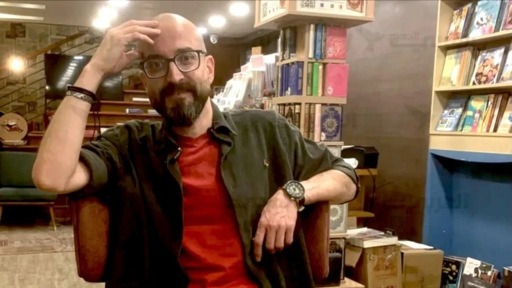
Palestinian writer and freed prisoner Basem Khandakji (born 1983) was arrested in 2004 and spent 21 years in Israeli occupation prisons. During incarceration, he produced several literary and academic works, while also taking part in the struggles of the Palestinian Prisoners Movement, including collective hunger strikes.
Alongside prisoners such as the martyr Walid Daqqa, Marwan Barghouti, Kamil Abu Hanish, Wael al-Jaghoub, Nasser Abu Srour, and Abbas al-Sayyid, Khandakji came to represent a combative cultural and intellectual front. Together, Palestinian prisoners forged new concepts related to the production of anti-colonial knowledge, generating a counter-knowledge of the prison that transcended its walls and reached the world.
Among Khandakji’s published works are two poetry collections: “Rituals of the First Time” (2009) and “Breaths of a Nocturnal Poem” (2013), and six novels: “Musk of Sufficiency: Biography of the Lady of Free Shadows” (2014), “Narcissus of Solitude” (2017), “The Eclipse of Badr al-Din” (2019), which the poet and critic Abdul Rahim al-Shaikh described as a creative literary work in which a Palestinian prisoner managed to imagine events in the fifteenth century while living in the twenty-first century inside a zionist cell.
In addition to “Breaths of a Betrayed Woman” (2020), “A Mask the Color of the Sky” (2023), which won the International Prize for Arabic Fiction (Booker) in 2024; and “The Ordeal of the Madmen” (2024).
His forthcoming novel, “Butterflies of Maryam al-Jaliliya,” was written in prison before his release in 2025 as part of a deal between the Palestinian resistance in Gaza and the Israeli occupation. He is currently awaiting his subsequent deportation to Egypt.
I met with him for an interview on militant culture, writing, occupation, and, certainly, Palestine.
Al-Akhbar: You are beyond introduction, from a journalism student at Al-Najah National University in Nablus, to a prisoner, writer, and national leader, and now a released prisoner exiled to Egypt. Within this complexity, how do you describe the life of Bassem Khandakji across these three stages?
Bassem Khandakji: I see my life in its multiple stages – before arrest, during imprisonment, and now in exile – as a skin-to-earth life. It is a search for freedom, a striving for existence, and an ongoing effort to reshape the contours of humanity, the one that the Zionist colonizer seeks to strip us of. Each of these stages has its own specific context, yet they all converge on one essential foundation: priority of the struggle against this colonizer. This was true during my studies at Al-Najah National University, which took place during the Second Intifada, it was true in prison, and it remains true here in exile. The common denominator binding these three stages together is that, for me, it remains a life of arduous pursuit, an urgent and relentless search for the desired freedom, and for a form of human existence intrinsically linked to the full liberation of the homeland.
AA: In your work, you often speak about the concept of militancy through literature. How do you explain this concept?
BK: Militant literature is rooted in resistance literature and emerges from it. The main difference is that militant literature arises from within the colonial context and seeks to answer a central question: how do we produce anti-colonial literature when living in the colonial reality?
This notion primarily rests on exposing the contents and epistemological foundations of the Zionist system. As such, Palestinian and Arab intellectuals and writers directly confront the Zionist intellectual backbone in all of its manifestations, from the cultural, and the literary, to the epistemological, the philosophical, and the political.
Feminist and class perspectives are central to militant literature. It’s concerned with embodying women’s struggles and their ability to directly engage with the dominant patriarchal reality, whether at the level of literary and cultural discourse or within the tangible social reality of Palestinian and Arab women.
Likewise, militant literature addresses the universal dimension of the Palestinian cause, and exposes how this pain is no longer borne by Palestinians alone. This produces a dialectical relation between the personal and the universal: how to move the Palestinian cause from the realm of individuality into the universal sphere, not through a stereotypical framing, but through a new approach that highlights the relationship between margin and center, and between the core and the periphery within the Palestinian experience.
Militant literature also highlights the importance of identity politics and politics of knowledge in writing and research practices. It dismantles the myth of neutrality, affirming that there is no neutrality in literature, culture, thought, or even sciences. The modern Western cultural and intellectual framework introduced to the East was not neutral; it was organically tied to the system of European colonial power. For this reason, engaged literature rejects this false academic “neutrality” that portrays the writer working with surgical precision to avoid direct contact with the subject. On the contrary, it insists on deep engagement with the material at hand as well as the objectives the writer seeks to accomplish through this work.
AA: The novelist and militant Walid al-Houdali has described your Booker Prize–winning novel “A Mask the Color of the Sky” as the novel that the “Iron Dome” failed to intercept. Now, outside prison walls, you are working on several new projects, including Butterflies of Maryam al-Jaliliya and a novel about the martyr prisoner Walid Daqqa. Can you tell us about them? And what do anti-colonial writing and the humanization of the other mean in Palestinian literature?
BK: Walid al-Houdali’s expression is truly a beautiful one. With “A Mask the Color of the Sky” I did not only “win,” we prevailed for the Palestinian people during the peak of the genocide. This stands as one of the decisive blows against the zionist colonial system that fears Palestinian competition in narratives and on the cultural front.
As for my novelis, Butterflies of Maryam al-Jaliliya is scheduled to be published next March by Dar al-Adab. I wrote it before the genocide in Gaza.
My next project, however, is a novel about my friend, the martyr and my late comrade Walid Daqqa. I wrote it six months before my release. No pen or notebook, I committed the novel to memory.
Every day in prison, as deprivation peaked, I would wake up and write mentally. I trained myself to write mentally on a daily basis. I felt both comfort and pride because I was prevailing over the jailer who confiscated my pen and notebook but could not deprive me of my mind, my intellect, or that inner fervor through which I seek to challenge him.
As for what anti-colonial writing and the humanization of the other mean in Palestinian literature, this is one of the central pillars of militant literature: writing to dismantle the colonial system. In other words, writing becomes a cultural front.
We open this cultural front toward the “other” through humanization. Humanization here does not mean normalization. It means posing a fundamental question: How does a soldier wake up in the morning, kiss his children before they go to school, and then, in the evening, kill children in Gaza?
There is a human dimension to this soldier. Shedding light on the social fabric of the Israeli experience, and on its cultural fabric and comprehensive epistemological and cultural determinants, gives the Palestinian a point of superiority over the Zionist other and the ability to dismantle this system from within. This is what is meant by humanization.
I cannot defeat a dinosaur as long as I imagine it as a dinosaur, nor can I defeat a monster as long as I treat it as a monster. The Israeli is neither a monster nor a dinosaur. His practices on the ground are brutal and inhuman, but they emerge from a human dimension, from human beings, from the children of Adam.
For this reason, we must humanize this other in order to defeat him within our Palestinian narrative, and also to move beyond the stereotypical image long embedded in Arab literature – an image that is largely miserable, traditional, and deeply limiting.
AA: One of your fellow prisoners has noticed that Arab writers such as Hanna Mina, Abdul Rahman Munif, and Ghassan Kanafani are always present among prisoners. You have even been described as “Hanna Mina’s youngest reader.” What’s in the prison library?
BK: My culture as a reader, and perhaps my transition toward a more professional form of reading, was shaped inside prison. Cultural life in detention has its own particular characteristics. It is an intensive and highly focused practice, especially when it comes to reading.
Inside prison, my reading was largely concentrated on intellectual and theoretical works in sociology, history, mythology, and philosophy. This had a direct and positive impact on my literary writing and on the development of my narrative capacity.
The prison library, I can say, is a distinct space, liberated from routine. Each prison is divided into several sections, and each section contains its own library.
Before October 7, 2023, prison libraries constituted a genuine intellectual treasure for Palestinian prisoners. Books reached us fresh from outside – not as a gift from the jailer, but something we wrestled away through long hunger strikes.
As such, prison libraries played a decisive and foundational role in developing prisoners’ culture in general. Writers, men and women, were truly present in our discussions. These notorious writers, theorists and philosophers participated in our daily debates inside prison. Through their books and articles, which we often memorized by heart, they helped protect us and safeguard our ideas.
AA: During the genocide, the enemy destroyed museums, killed artists, and demolished universities, schools, and cultural institutions. Is this cultural genocide similar to the Zionists’ efforts to target the cultural structure of the Palestinian prisoners’ movement?
BK: After October 7 and with the launch of the most horrific genocide against our people in Gaza, the Israeli Prison Service administration, together with its extremist settler minister Itamar Ben Gvir, exploited the moment to carry out the extermination of Palestinian prisoners.
One of the major manifestations of this was cultural genocide. The jailers stripped away all the achievements of the prisoners’ movement in the cultural and literary spheres. They confiscated books, references, pens, notebooks – everything connected to cultural, literary, intellectual, research, and academic production. From the very first days, they seized all the books and even burned them.
This affected me deeply, not only as a prisoner and a militant, but also as an intellectual. To wake up in the morning and live your daily life inside prison surrounded by papers, books, and pens, and then suddenly, in a single moment, to have all of that taken away, it was extremely difficult. There was a clear and systematic policy aimed at striking the entire cultural and literary structure of prisons.
Unfortunately, we lost many handwritten drafts and notes that prisoners poured a lot of time and effort into developing. Everything I had compiled and written was confiscated and burned. Still, some texts and drafts survived the brutality of the Zionist jailer, whose aim is to kill every aspect of the Palestinian prisoner’s humanity by stripping him of his achievements inside detention.
AA: “I will continue to love, for it is my modest victory over my jailer.” In his writings, martyr and intellectual Walid Daqqa grants love a central role in transforming the prisoner’s time and moments, describing his relationship with Sanaa as the beginning of a new temporal horizon. How do you describe love inside prison? And regarding your forthcoming work on Walid, do Sanaa and Milad appear in the novel?
BK: Before being an intellectual in prison, the intellectual is first a militant – and a militant who does not love is not human. Love can, at times, be a revolutionary practice, especially when we see how it protects. This immortal sentence by my martyred friend Walid Daqqa is profoundly precise. Love protects inside prison, safeguards the self, and contributes to the restoration of humanity.
As for the time of love, it is a time liberated from the burden of the cell and from the details of imprisonment.
For me, however, prison cannot truly express the full meaning of love. Prison is, in the end, a distorted reality, one that imposes and perhaps produces distorted emotions. I believe that genuine love is realized outside. In prison, there is a longing for love, a borrowed love, a metaphorical love, except in rare cases such as that of Walid and Sanaa. Their relationship was not merely a love story, it was a relationship of freedom. Walid searched for freedom and for certain details that he found in Sanaa. I have always said that I see Sanaa as “another Walid”. Perhaps Sanaa is Walid’s true self, or his other face that completes him.
As for the novel about Walid, it’s not biographical. For this reason, Sanaa and Milad may appear indirectly, but the spirit of the novel is Walid’s.
AA: In Abdul Rahim al-Shaikh’s study of the martyred intellectual Walid Daqqa “The Parallel Space: Mapping Time in Walid Daqqa’s Thought” (Palestine Studies, Issue 135, Summer 2023), drawing in prison is described as a means of transcending walls and an attempt at visual liberation. In a previous interview, you spoke about the density of colors outside the prison compared to life inside. Can you tell us more about this visual and chromatic dimension? Or, if we were to describe freedom visually, how might we do so?
BK: Drawing inside prison is, in many ways, similar to writing inside prison. Yet drawing, in this sense, moves from the prison outward, just as words or literature pierce prison walls to become universal and transcend prison literature. I see the colors of freedom as imagined colors, not colors that can be easily described or spoken about. In this sense, the colors of prison are neutral and limited.
A prisoner can create using multiple colors, but life outside prison – this explosion of color, if we may call it that – is sometimes more than the eye can absorb all at once. After more than 21 years, the prisoner steps into a world saturated and vibrant with color, and begins searching for his own colors. An intense pursuit to draw his freedom using these new hues.
AA: One of the issues prisoners often point to is the complex relationship that develops with technology. You went to prison in 2004, at the dawn of the mobile phone era, and came out into a world now saturated with artificial intelligence. Has this complex relationship with technology found its way into your literary work?
BK: Perhaps the greatest challenge for me is artificial intelligence and technology. It’s even more disturbing than the Israeli security challenge itself. To this day, I refuse to install artificial intelligence applications on my phone or computer. I refuse to engage with them altogether.
When I began using a laptop, I did so only after reaching a personal reckoning with myself: can I write or type on a keyboard made of letters and numbers? Can I do so after having been accustomed to paper, ink, and the tactile experience of touching the page?
I still confront this challenge today. Yet I try to deal with technology in a different way, as if it were a mandatory passage I must cross without immersing myself in the details of artificial intelligence, which I regard as the most foolish human invention, given the inequality and violence it carries.
Its clearest and most horrific manifestations were evident in what this so-called “artificial intelligence” perpetrated against our people in Gaza and Lebanon during the most recent war.
This interview was conducted by Ahmad Mofeed and first published at Al Akhbar.
The post Bassem Khandakji: a cultural front that transcends captivity appeared first on Peoples Dispatch.
From Peoples Dispatch via This RSS Feed.