


Bullets:
Gallium Nitride semiconductors are crucial for advanced radar and missile guidance applications.
China has a monopoly on gallium processing, and export bans on gallium for military use.
Pentagon contractors cannot build radars for the F-35, among other platforms, because of supply chain issues related to gallium supplies. So they are delivering these aircraft with “ballast” in place of radar systems.
Inside China / Business is a reader-supported publication. To receive new posts and support my work, consider becoming a free or paid subscriber.
Report:
Good morning.
It’s now obvious to everyone that China has monopolies in the key materials and metals that make everything go. China has dual-use export bans on many of those metals, and Western supply chains are quickly breaking down. Gallium and gallium compounds are critical in defense systems, especially for radar and missile guidance systems, and in the communications and automotive industries.
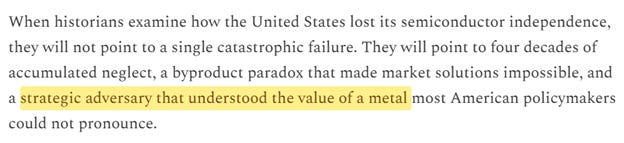

This is a great point on Substack, that the United States has lost its ability to build the technologies of the future, that China understood before anyone else how important these metals are to build those technologies, and so now China gets to decide where the future is built.
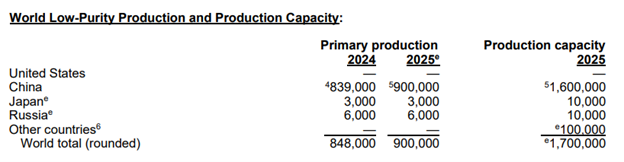
The Chinese control over gallium production is total, may as well say. This is from the US Geological Survey: In 2025, Chinese firms produced 900,000 kilograms of gallium. Japan and Russia kicked in another 9,000 kg. China is 99% of the world total, then. It follows that the United States is 100% dependent on imports for gallium, and has been for years.
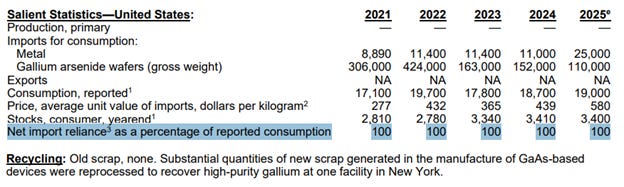
Weapons makers for the Pentagon then are entirely reliant on China for the gallium they need to build advanced radars that go on fighter jets, and those gallium supplies are now cut off. As a result, they can’t build new radars, and so are delivering aircraft without them. The Pentagon signed contracts to buy F35’s with the newest radars, but contractors can’t build them. Several defense media outlets reported that planes recently delivered don’t have radars on them at all, and Pentagon officials and Congressmen are saying that the whole situation is classified, while admitting that the radar situation is a challenge.
F35’s without radars are functionally useless, operationally. They may be used for training purposes, or in other limited roles. And this is all a reminder that if one link in the supply chain breaks down–or isn’t there at all–the effects cascade, and in this case the Air Force is getting planes they can’t use. Delivery dates keep getting pushed back, and aircraft with the agreed-upon radar systems might get delivered in two years, with the next lot of deliveries. Maybe. This was a problem known to the Pentagon early last year, by the way—a letter was sent to the Air Force Chief of Staff that the newest radar risked delays, but doesn’t say why.
We’re left to guess, as to the reasons for all these delays in producing a radar that needs gallium. But a rational person might conclude that the Chinese have monopolies on gallium, and refuse to ship it to Northrup Grumman to build F35’s, or to Raytheon to build their new radars. So now US Air Force weapons contractors are delivering aircraft that have “ballast” where the radar systems are supposed to be.
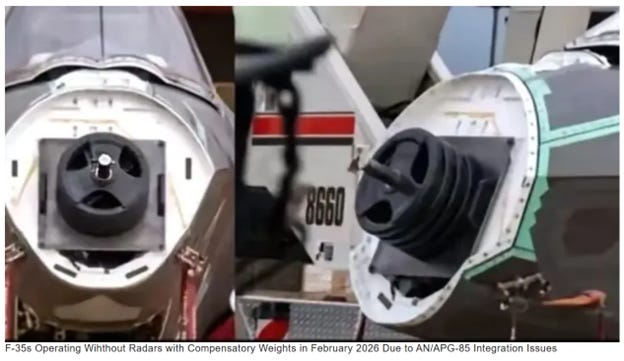
It looks like they went down to Gold’s Gym and picked up some free weights and a barbell and welded them onto the noses of $100 million jets, so they don’t somersault in-flight.
And going back to Mr. Perera, who reminds us again that China now decides what gets built, and where: These are Chinese J-20A fighter jets, and we notice right away they do not have weightlifting equipment glued to their planes.
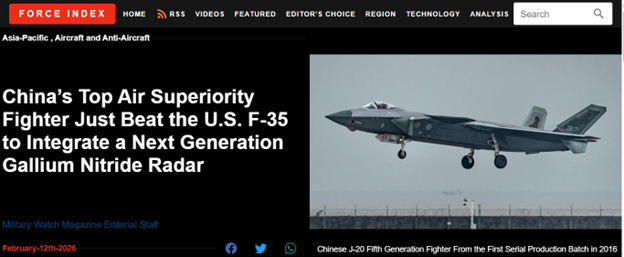
They have domes that analysts—our analysts—say are indicative of radar upgrades. The US Armed Forces can’t build or integrate new radars, China’s armed forces can, and so it’s the Chinese Air Force that already fields the newest generation of gallium nitride radars. China’s monopolies in gallium nitride, in this case, is a strategic advantage everywhere across the defense sectors, and anywhere radars are used.
Be Good.
Resources and links:
China’s ‘silent sanction’ on US semiconductors creates a weapons generation gap
https://www.scmp.com/news/china/science/article/3324489/chinas-silent-sanction-us-semiconductors-creates-weapons-generation-gap
China’s Top Air Superiority Fighter Just Beat the U.S. F-35 to Integrate a Next Generation Gallium Nitride Radar
https://militarywatchmagazine.com/article/china-fighter-beat-f35-next-radar
Current F-35 Configuration Complicates Fielding Of APG-85 Radar
https://www.defensedaily.com/current-f-35-configuration-complicates-fielding-of-apg-85-radar/air-force/
Reports Suggest F-35s Are Being Delivered Without Radar Amid APG-85 Delays
https://theaviationist.com/2026/02/12/reports-suggest-f-35s-delivered-without-radar/
US Geological Survey, 2026 Report, Gallium
https://pubs.usgs.gov/periodicals/mcs2026/mcs2026-gallium.pdf
The 99% Monopoly: The Chip Metal America Cannot Buy
[ Shanaka Anslem Perera
The 99% Monopoly: The Chip Metal America Cannot Buy
By Shanaka Anslem Perera…
Read more
2 months ago · 14 likes · 1 comment · Shanaka Anslem Perera](https://shanakaanslemperera.substack.com/p/the-99-monopoly-the-chip-metal-america)
EXCLUSIVE: Eyeing risk of radar ‘delays,’ Lockheed proposes new F-35 fuselage design
https://breakingdefense.com/2025/06/exclusive-eyeing-risk-of-radar-delays-lockheed-proposes-new-f-35-fuselage-design/
RTX unveils new APG-82(V)X radar enhanced with gallium nitride
https://www.rtx.com/news/news-center/2025/09/23/rtx-unveils-new-apg-82vx-radar-enhanced-with-gallium-nitride
China’s ‘silent sanction’ on US semiconductors creates a weapons generation gap
https://www.scmp.com/news/china/science/article/3324489/chinas-silent-sanction-us-semiconductors-creates-weapons-generation-gap
Inside China / Business is a reader-supported publication. To receive new posts and support my work, consider becoming a free or paid subscriber.
From Inside China / Business via This RSS Feed.