

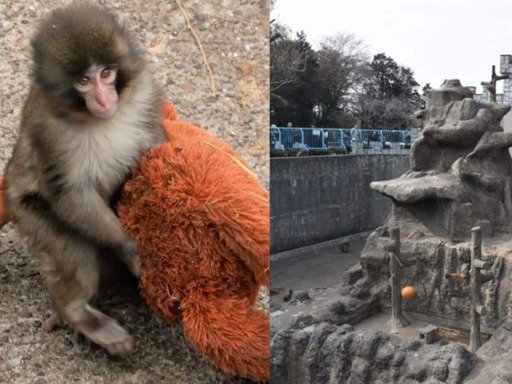

A baby Macaque monkey in Japan, named Punch, has gone viral for finding comfort in a stuffed monkey after his mother abandoned him.
The world has been swooning over him, ignoring however, that monkeys belong in the wild, swinging from trees – not in concrete enclosures for human entertainment.
Zoos breed animals, including monkeys, solely for entertainment and profit. They will never release them.
View this post on Instagram
Now, people are flocking to Ichikawa City Zoo in Japan to catch a glimpse of Punch. However, PETA is warning that what they’re seeing is not cute, and that normalising it is dangerous.
The reality is that a baby monkey is having to cope with loss, rejection, and painful isolation.
According to PETA:
Our fellow primates are intelligent, deeply social, and emotionally rich. In their native forest homes, macaques live in large, tightly knit groups, forming intricate social bonds through grooming, play, and cooperative foraging. Infants stay with their mothers for about a year, learning how to survive and establish lifelong relationships. These behaviors are essential to macaques’ emotional and psychological well-being, not optional extras for humans to gawk at.
PETA have previously talked about how internet fame is bad for captive animals. Zoos use animals such as Punch, or Moo Deng – the pygmy hippopotamus that rose to fame in 2024, to boost ticket sales.
However, the increase in visitors, noise, and cameras creates far more unnecessary stress. For Punch, this extra stress could make it even harder to integrate with the other monkeys.
Increased aggression
Captive animals often exhibit unnatural behaviours. This is far more common when the environment fails to meet the species’ needs or adds additional stress. For example, a concrete enclosure – like what we see in the videos of Punch – is the exact opposite of what a monkey needs in the wild.
Additionally, having a constant stream of people – who are often noisy – watching over the enclosure will no doubt create additional stress.
Sometimes, this can even lead to zoochosis. This is when animals display highly repetitive behaviour, such as rocking, pacing, over-grooming, or biting bars. These behaviours stem from the animals being unable to take part in the same behaviours they would in the wild.
This little one was born in captivity, abandoned by its family. Sadly, this is common in captivity due to altered behavior… A stuffed toy is its only companion. Let them live free. #monkey #zoo #freedom #punch pic.twitter.com/oRXWFfcJYw
— Sr37 (@Sr373639) February 22, 2026
Researchers have observed an increase in aggression among captive animals toward zoo visitors. In total, 80% of the animals studied displayed behavioural changes in the presence of zoo visitors. This ranged from increased hyper-vigilance to aggression.
Studies have also found that the louder the visitors, the greater the difference in the animals’ behaviour.
Learning that Punch the monkey could’ve been rejected by his mom for a number of factors including the stress of being a new mom in captivity. Idk man unless the animals are going extinct or truly suffering, zoos and aquariums shouldn’t exist.
— Sarah Moore (@sdmoore) February 21, 2026
The con in conservation
Sadly, captive animals usually cannot be released into the wild if they were born in captivity. They would not know how to survive. However, animals like Punch should be transferred to a reserve where they can live out their lives in more natural surroundings, without being ogled at by people.
Zoos are capitalist enterprises – even when they claim ‘conservation’.
Of course – this monkey has pulled on the world’s heartstrings. Anyone who has ever felt alone, misunderstood, or abandoned has found hope in watching Punch find comfort in a soft toy. However, we cannot forget the bigger picture – the systems and the money-making which allowed this to happen in the first place.
Featured image via HG
By HG
From Canary via This RSS Feed.