

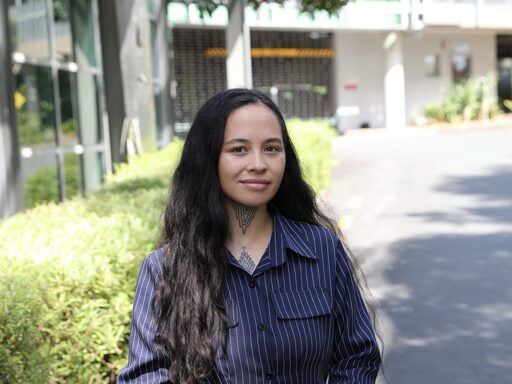

Te Aniwaniwa Paterson. (Photo supplied)
Behind the marae gates, there’s a deeply uncomfortable conversation going on, writes rangatahi Te Aniwaniwa Paterson, who’s part of a group working to end sexual violence within Māori communities.
At Waitangi, sovereignty is often spoken about. But what does sovereignty mean if we can’t openly speak about harm within our own communities?
I’m the rangatahi representative on Ngā Kaitiaki Mauri, the Māori caucus of a national network to end sexual violence. In this role, I serve alongside kaumātua Russell Smith and Joy Te Wiata. When I ran into them at Waitangi this year, it was a chance to catch up on our kaupapa.
Matua Russell Smith told me that the first time he stood at Waitangi to speak about sexual violence, in the early 2000s, he was unsure whether his kōrero would belong in a space dominated by discussions of whenua.
It was Rangimārie Naida Glavish who steadied his nerves. “She turned to me and said: ‘They’re talking about the rape of our land, and you’re talking about the rape of our people. Your kaupapa absolutely belongs here at Waitangi.'”
The conversation reminded him that while the Crown has obligations under Te Tiriti, which might dominate the kōrero at Waitangi, Māori also have responsibilities to each other.
“We have He Whakaputanga and Te Wakaminenga, which guide the kōrero that happens inside the marae gates of our hapū,” he explains.
And within the marae gates, one conversation comes up time and time again: What should we do about sexual abusers, including paedophiles and intimate partner abusers, who want to speak on the paepae tapu?

Joy Te Wiata and Russell Smith with Dame Rangimārie Naida Galvish (centre) at Waitangi this year. (Photo supplied)
Joy Te Wiata says this can be a deeply uncomfortable conversation. But a good way to approach it is to think about “sexual violence” through the kupu Maōri “mahi tūkino”. That wording, she says, makes the abuser’s breach of mana and tapu quite visible.
“Cultural platforms like the paepae are not places to support people who have perpetrated harm. If our marae really want to be places of safety, then they need to uphold tikanga by ensuring that mana and tapu are upheld,” says Joy.
“We’ve got to be careful we aren’t colonised in our own sacred spaces. If we’re saying that it’s okay to allow these things without going through our processes, without hohourongo, that’s not tikanga Maori.”
Russell puts it like this — when people come forward saying their kaumātua abused them, he says: “Kaumātua do not sexually abuse. If someone has done that, we need to remove that status from them. They are not practising kaumātua tikanga.”
This does not mean those who cause harm are cast out entirely or disowned.
Through their clinical and kaupapa Māori work, Russell and Joy have worked alongside many whānau as they navigate the long and difficult process of healing. They have seen that restoration is possible.
While restoration means someone may remain part of their whānau and community, it doesn’t always involve a return to positions of cultural authority. In some cases, the paepae may no longer be an appropriate place for them, Joy says.
And that applies too, she says, to numerous positions across the marae, not just the paepae: “Are we remembering, there’s as much mana in picking pipi, washing dishes, and digging the hāngi pit?”
The pair’s kaupapa Māori approach to healing differs from clinical models that focus on the individual. Instead, their work considers the wider environment in which the harm occurred — the whānau, hapū, and the spaces and systems around that person. It then addresses the conditions that allowed the harm to occur, with supervision, boundaries, and restrictions on alcohol use.
“Our tūpuna left us tikanga for a reason, for safety,” says Joy. “We’re not calling our people to something different — we’re calling them back to their own tikanga.”
“Whakamua whakamuri,” adds Russell. “The way back is forward.”
But kaupapa Māori services like this remain under-resourced.
Late last year, the government moved to redirect $1.7 million from sexual violence support services. Some contracts were extended for six months, but that came with clear warnings not to expect more.
Joy says such funding cuts affect kaupapa Māori services more deeply, because their available resources must support entire whānau.
“We’re whānau-centred, which means that each dollar must expand to cover the whānau approach,” she says. “If we discontinue services, there is a breakdown in trust with whānau, and it takes years to build trust in the first instance. So, it’s not just the end of programmes, it’s a discontinuation of that trust and reliability.”
For Russell, the ability of Māori to sustain our own healing systems is an issue of tino rangatiratanga. “The problem we have today is we don’t have full autonomy over our own resources, and that includes our own mātauranga,” he says.
He describes this as part of a longer pattern: “The Tohunga Suppression Act is still active by the way they prevent our people from accessing us, through not giving us the resources that belong to us, and that’s the biggest Tiriti issue.”
For both, Te Tiriti affirms not only a partnership but also the Crown’s responsibility to ensure Māori can exercise their own pathways to healing. Without that support, Joys says, the obligation remains unmet.
They’ve seen some tauiwi services decline to work with whānau whose needs are complex, leaving kaupapa Māori providers to carry the responsibility. But there are very few kaupapa Māori services across Aotearoa that feel equipped to work directly with people who’ve experienced sexual harm.
“We’re in dire straits, and that has a knock-on effect for our people who are wanting and needing support,” says Russell.
Still, there’s work happening at a national level to strengthen Māori capability.
Ngā Kaitiaki Mauri of Te Ohaaki a Hine is developing tools and resources to support other Māori social services to build confidence and competence in dealing with sexual violence. Rather than centralising a single national model, the focus is on strengthening local Māori providers who already have relationships with their communities.
Over time, they hope to help Māori services expand their own capacity, so whānau don’t have to seek help in systems that are not designed for them.
“Our tūpuna gave us these tools. They are breathed quite deeply into us,” says Russell. “We are basically giving back to our people what belongs rightfully to them.”

Joy and Russell at Te Tii marae, Waitangi. (Photo supplied)
Te Aniwaniwa Paterson (Ngāti Porou, Ngāti Rangitihi, Ngā Paerangi, Ngāti Kahungunu) is a journalist and digital producer for Te Ao Māori News based in Tāmaki Makaurau. She represents rangatahi on Ngā Kaitiaki Mauri, the Māori caucus of TOAH-NNEST (the National Network Ending Sexual Violence Together), which operates as a Tiriti o Waitangi-based partnership. She serves alongside Russell Smith and Joy Te Wiata.
The post A deeply uncomfortable conversation appeared first on E-Tangata.
From E-Tangata via This RSS Feed.