

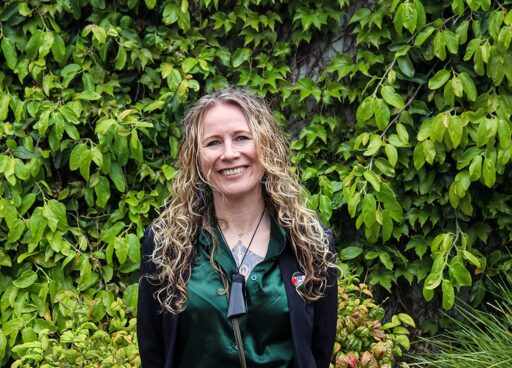

“I wanted to be drenched in the colour of kawakawa. I wanted it to whoosh through my eye sockets and into my brain and give the bone bowl of my skull a good clean out,” writes Becky Manawatu about working on her novel Kataraina. (Photo: Kararaina Pene)
Last year ended with a bang for Westport writer Becky Manawatu. In the space of a week, she won two of Aotearoa’s leading literary prizes: the Sargeson Prize for an unpublished short story, The Vase, and the Keri Hulme Award for her novel Kataraina — the sequel to her celebrated first novel, Auē*, which won the Jann Medlicott Acorn Prize for the best book of fiction in 2020 and has sold over 30,000 copies.*
Here, Becky reflects on the challenge of writing Kataraina — and how an uncle, a tangi, and a dream brought clarity.
When Kataraina won the Keri Hulme award, it made me think about the book’s whakapapa. It made me reflect on those early months of working on the manuscript, sometimes writing for days and days on sections that wouldn’t make the cut. Screeds of false starts. My process is very uneconomical, but no writing is pointless, I tell myself.
When I set out to write Kataraina, it had a different title altogether. I named it Papahaua, after the mountain range that runs the length of Birchfield and beyond.
Birchfield is a little place five minutes north of Waimangaroa, where I spent a lot of my childhood. You could see the mountain range through the front windows of our small wooden house, and at the back, there were some paddocks, and then there was a swamp.
I loved that swamp. It had this huge broadleaf tree which bowed over the dark water and had heavy flat branches which you could scramble across, like they were a friendly giant’s fingers that wouldn’t let you fall.
What I loved most, or what I love most in my memories, was the colour. The deep green of kawakawa pounamu. Glossy, rich, and bright with life. After Auē was published, I had a craving to be surrounded by this colour like a woman who’s hapū and finding they have a craving for kaimoana, or a bloody steak. Dirt, even.
I wanted to be drenched in the colour of kawakawa. I wanted it to whoosh through my eye sockets and into my brain and give the bone bowl of my skull a good clean out.
The colour of a vibrant forest, a swamp, was the only thing that could help me, I thought. The need was feverish at times. I wanted to go bush, pull up some sphagnum moss and press it to my head and let the colour of ngahere cool me through.
While I was writing Kataraina, I needed to have a full hysterectomy. During the recovery, I slept in our sunroom alone, the windows all framed with bright vegetation. I couldn’t write during the recovery, but I could read and sleep, read and sleep.
Finally, the day came when I felt up to an outing, and again I craved the feeling a place could give me, its colour, and so we drove to the Nile River, another place of my childhood, another shadowy green place, with deep, cold water.
Our life was very busy when I was writing Kataraina. I didn’t even have the time or attention span for the two, maybe three, false starts. It was going to be a sci-fi time-travel book in which I restored all the people who were killed in Auē to life. It was going to be written from the third-person point of view. It was going to be written as meta-fiction by Kataraina herself. Even *Auē’*s lovable but murderous Beth got a look in at telling the whole story at one point.
Whatever my original idea was for the book, it didn’t stand a chance against the spiritual thirst I had for kawakawa green to spill across my life and work, which was the desire to respond to the deaths and violence of Auē. The need to whakanoa.
The small scene at the end of Auē in which a group of the Te Au whānau sit and eat was a start, but I knew more was needed. More kai — fill their bellies! More stories — fill their hearts! More context — fill their minds! More waiata and karakia. Tihei mauri ora!
I wanted Kataraina to feel like a hākari and a poroporoaki, and I wanted the water to ooze up out of its pages and into the minds of its readers, because, I hoped, many of those readers might be readers of Auē, and many of those readers might still need the milk bottle tied to the gate.
My husband’s uncle, Victor Manawatu, died while I was writing Kataraina, and we went to Kaikōura to farewell him. Sleeping in the annex of the wharenui with all the young ones, I had one of the best dreams of my life. In the annex, there are low windows — a smart addition for a room where you sleep on mattresses. You can open your little window without even getting up and let in cool air. You can gaze out at the harakeke.
I had a dream that I was sleeping there on my mattress with the little window, and that I woke in the middle of the night and needed some fresh air, so I opened the window. Outside, a thick blanket of snow covered the ground, which glowed bright in the night.
I looked with wonder, and my whole being felt pure and content and okay with myself and who I was and what I was and how I spent my days, for what felt like the first time in forever.
Who else should I thank for that but Uncle Vic? Kia ora, Uncle!
While writing Kataraina, my husband, Tim, and I went on a research trip to Ōkārito so I could spend some time in the place where Keri Hulme once lived and see the kūkūwai. We spent a whole afternoon kayaking, and we walked the Trig and Wetland walks.
The lagoon is large, about 3,240 hectares, and home to a ton of native birds, including the kōtuku. One morning, I walked down to the beach, and a kōtuku was stalking about the lagoon as it filled with the incoming tide.
I watched the bird for a long time before it flew away. It was in the dawn sky and reflected on the lagoon — I could hardly tell which was real — an image which made it into the final draft of Kataraina. Sometimes research trips aren’t just for facts, but images too: taoka!
I felt extraordinarily contented by the honour of being named a finalist in the Pikihuia Māori Literature Trust’s Keri Hulme Award alongside Steph Makutu and Tina Makereti. I was so happy. When I shared the news on Facebook, Uncle Vic’s wife was one of the first people to message me. Are you coming to Rotorua, darling? she said.
Aunty Tarn was there to pick me up from the airport and took me to her home in Ngongotahā, where my room was decked out for manuhiri, with Polynesian tapa cloth hung on its walls and a big, cosy bed. Aunty Tarn is a tour guide, and manaaki is her gift.
She and her friend Paula had been busy all day, giving the house Aunty Tarn’s generous and colourful vibe, every room alive with brilliant details. Making kai. She’d only moved in a few weeks before.
For the awards the next morning at Te Puia, Aunty asked me what taonga I was wearing. I’d travelled with none, and I felt too shy to wear the korowai my sister and niece had given me. I was a bit embarrassed, but then Aunty had the solution: I should wear Uncle Vic’s obsidian toki, to ground me.
When I heard my name called out — the winner of the Keri Hulme Award! — a current of pure aroha for Kataraina flowed through me. I walked up to receive it, comforting myself with a little strange noise. “Aw,” I kept saying. Then, “Aw man!”
I was now to speak in front of so many incredible te reo speakers, so many incredible storytellers. I had to read from a piece of paper. I had to apologise. I always do, but maybe one day I won’t feel that need.
I was humbled and overjoyed when Robyn Bargh, the chair of the Māori Literature Trust, spoke about Kataraina, because I believed she felt love for this book, that she cared. It was as beautiful to feel this as kawakawa green rushing into my skull. It was as cleansing as snow. Aunty Tarn whooped for me.
I read a poem I’d written for the occasion, following the example of essa may ranapiri, who had shared one as the 2023 inaugural winner. My poem was a response to Keri’s poem “Ngā Kēhua”.
Ngā Kēhua
Did I know tears?
I thought I did. Indulged the prayers.
But that’s not truer than the truth.
That is a delusion.
Because here is a picture of me and you, my silent cousin, lying in the grass and I am smiling the smile of the lucky one.
You knew tears, my silent cousin.
What will happen if I let you be
free of the weight of me, e tama?
Will we weigh nothing at all?
Like in the photo,
like on the grass,
like in the bed when you peeled the thin skin from my back
after I had been sunburned,
and we went to the window and watched my skin float up into the night.
Like a ghost, weighing nothing at all.
Weighing nothing at all.
As if those that might hurt
the people
we love
had never been born.
I love writing very much. The trouble of it, the mistakes, even. I love watching the original idea fade away from view, as if you’ve set sail from that point and now you find yourself unmoored and alone in a sea of possibility.
What I feel when I read Keri Hulme’s the bone people — as if I’m grasping with no success at a school of silver fish, hoping to catch, gut, bone and skin them, instead being humbled into only watching the bright shimmer beneath the water’s surface — is wonder.
I am now working on the manuscript for a third novel. It’s had its share of false starts already, frustrating at the time, but I accept them as part of my slow process. The original idea is already a dot on the horizon, but I hope to navigate the journey from there for a while longer.
With some of the prize money I won from the Keri Hulme and Sargeson awards, I bought new things for hiking and booked myself to walk the Paparoa Great Walk here on the West Coast, traversing the ranges that cross from Punakaiki to Blackball. I spent three nights on the trail alone in the last month of 2025. There was plenty of green.
I had a pen and paper in my backpack, of course. I prayed for cool, clear weather and to find a fresh string of kupu to bring back home.
Becky Manawatu (Ngāi Tahu/Pākehā) was born in Nelson and raised in Waimangaroa on the West Coast. Becky’s first novelAuē won the Ockham prize for fiction in 2020. This year, Becky is a University of Canterbury Ursula Bethell Writer in Residence.
The post Becky Manawatu: Kataraina and beyond appeared first on E-Tangata.
From E-Tangata via This RSS Feed.