


By Elaine Aznar
Bulatlat.com
Every year since the fall of the dictatorship, the anniversary of the 1986 People Power Revolution is marked with ceremonies, speeches, and familiar images of a nation said to have rediscovered itself. The story is often told in broad strokes: a peaceful crowd of masses caused the downfall of the dictator, in
which democracy was restored. Yet beneath the ritual of remembrance lies a question that refuses to fade. Who is the true hero of EDSA? The uncertainty is telling. Four decades later, Filipinos still debate as to who or what truly brought down Ferdinand Marcos Sr., and what exactly we are honoring when we celebrate EDSA.
Political scientist Samuel Huntington wrote that “democracies are created not by causes but by causers.” His point cuts against the comforting version of People Power as a pure and spontaneous miracle. Revolutions do not happen by causes alone. They are driven by people with names, motives, and limits. They involve planning, negotiation, ambition, and compromise. Seen this way, EDSA was not just a moral awakening shared equally by all. It was a struggle over leadership and ownership: who acted at the crucial moment, who steered events, who benefited from the result, and who later shaped the narrative that entered our textbooks.
Anniversaries encourage reverence, but they should also demand honesty. The revolution left behind an unresolved argument about its hero. Was it the mass of citizens who filled the avenue and risked violence? The political figures who assumed power after the dust settled? The institutions that survived the transition? Or the ordinary Filipinos who continue to live with the promises and failures of the democracy that followed? To raise these questions is not an act of disrespecting the revolution. It is a reminder that EDSA is not black and white. It is a political event whose meaning is still contested, and whose heroes are still being negotiated in the present.
There were narratives that point to the late Juan Ponce Enrile as the unlikely hero of the revolution. A longtime Marcos ally and then defense minister, he broke with the regime and helped lead the military split that enabled the revolution. Supporters frame his refusal to unleash full force against civilians as an act of courage that prevented bloodshed. But that view deserves scrutiny. Enrile’s break came at a moment when the regime was already weakening, and public anger was impossible to ignore. His move was not simply a moral stand in a vacuum. It was also a calculation about survival in a political order that was clearly shifting. The question, then, is whether restraint born in crisis should be remembered as heroism or as a late adjustment to a tide he could no longer control.
Others locate the hero in the figure of Ninoy Aquino, whose assassination in 1983 shocked the nation and shattered any illusion of stability under the regime. His death is often framed as the spark that awakened public anger and pushed the opposition into motion. In this telling, Ninoy’s martyrdom gave the revolution its moral center. The grief that followed did not stay private. It turned into a political force that gathered people who had long felt powerless and gave them a symbol around which to rally. That symbolism later flowed into the rise of his widow, Corazon Aquino, who became the face of the opposition and was eventually installed as president after EDSA. To many, her victory represented the triumph of sacrifice over dictatorship. Yet even this narrative invites a harder look. The revolution did not belong to one family alone, and the hopes placed on her leadership revealed how quickly a mass movement can narrow into a struggle over personalities. If Ninoy’s death stirred the nation and Cory’s presidency gave it direction, the question remains whether heroism should rest on individuals at the top, or on the citizens whose pressure made their rise possible in the first place.
Some Filipinos also believe in the heroic act of Cardinal Jaime Sin, whose role during those tense February days placed the Church at the center of the uprising. Through Radio Veritas, he urged civilians to protect the rebel soldiers and gather along EDSA, a call that transformed fear into mass action. For many Filipinos, his voice carried moral authority at a moment when trust in political institutions had collapsed. The Church did not command tanks or ballots, but it commanded belief, and belief proved powerful enough to draw families, students, workers, and nuns into the streets. Still, placing the hero’s crown on a religious figure raises its own questions. Cardinal Sin did not create the anger that fueled the revolt, nor did he control the millions who answered his appeal. His intervention showed how deeply faith and politics were intertwined, but it also highlighted how revolutions often depend on institutions seeking to protect their own influence in uncertain times. To credit him alone risks turning a broad civic uprising into a story of clerical rescue. The larger truth may be less tidy: his call mattered because people were already prepared to act, and the Church became a channel for a movement that had been building long before his broadcast.
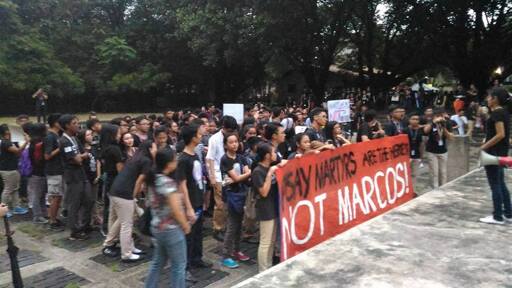
In the end, the strongest claim belongs to the masses who chose to act together. The true heroes of the revolution were the ordinary Filipinos who stood in the streets, locked arms with strangers, and refused to move. The figures often highlighted in history books may have pushed events forward, but influence is not the same as action. The turning point came when citizens stopped being spectators and became participants. They placed their bodies between weapons and power, and in doing so forced the regime to confront a reality it could no longer control.
Hence, we need to give credit where credit is due. Without the crowd that filled EDSA, the Marcos family might not have fled to Hawaii. Without the visible force of millions refusing fear, the dictatorship could have endured behind the language of order and stability. The masses did not simply decorate the revolution. They carried it. Their solidarity turned private anger into public pressure and made repression too costly to sustain. Remembering this is more than nostalgia. It is a reminder that democratic change does not descend from above. It rises when ordinary Filipinos, composed of the working class and students who are all hoping for a better government, decide together that enough is enough.
Indeed, democracies are shaped not by causes but by causers. We recognize that there were catalysts in making the revolution possible. However, in 1986, the decisive causers were the masses who chose to stand together and force change. The revolution did not deliver a perfect system, and the democracy that followed has remained elite-dominated, which makes it fragile and contested. But the people’s action proved that power can bend when ordinary citizens act in a common purpose. To commemorate EDSA, then, is not only to remember a victory. It is to measure the present against that moment of courage. The anniversary asks whether we are merely honoring history, or whether we are willing to live up to it. Hence, the struggle for genuine freedom certainly did not end on February 25, 1986. It continues wherever Filipinos insist that democracy must be genuinely defended and practiced in everyday life, as time passes by. (DAA)
The post The True Heroes of EDSA appeared first on Bulatlat.
From Bulatlat via This RSS Feed.