


By the mid-1950s, the regional water conflict entered a new and far more volatile phase. Where earlier decades had been defined by Zionist frustration over losing the Litani, the 1950s and 1960s witnessed the emergence of an organised Arab response — an attempt to prevent Israel from exploiting the headwaters of the Jordan River. Lebanon, despite its political fragility and chronic marginalisation of its southern districts, was thrust into the centre of this struggle.
The country’s strategic position — home to the Hasbani, one of the Jordan’s three principal tributaries — placed it at the heart of a hydropolitical confrontation that would contribute directly to the outbreak of the 1967 Arab–Israeli war.
For Israel, Lebanon was no longer merely a passive obstacle preventing access to the Litani. It was now part of a wider Arab front seeking to deny Zionism the water resources upon which its agricultural colonisation and demographic project depended. For Lebanon, the challenge was existential: how to appear committed to Arab solidarity while avoiding a confrontation it was ill-equipped to fight — all while protecting what remained of its sovereignty.
The Johnston initiative and Israeli objections
After forcing Israel to halt its unilateral diversion scheme in 1953, the Eisenhower administration sought to transform the water crisis into an arena for regional cooperation. Washington’s envoy, Eric Johnston, carried a comprehensive engineering proposal known as the “Main Plan”. It included a dam on the Hasbani within Lebanese territory but explicitly excluded the Litani from any international arrangement — recognising Lebanon’s insistence that the river was a national resource, not an Arab bargaining chip.
Israel objected vehemently. What troubled the Zionist leadership was not engineering feasibility but the political symbolism: excluding the Litani meant accepting its permanent loss. To counter the Main Plan, Israel produced the “Cotton Plan,” which argued that Lebanon needed barely half of the Litani’s water and should sell the remainder to Israel.
In essence, Israel sought to revive the logic of the 1943 joint survey — water for power — while ignoring the transformed regional reality: Lebanon could not, under any circumstances, be seen supplying vital resources to a Zionist state expanding through military force.
Why Lebanon could not compromise
Any Lebanese concession would have been perceived as a betrayal of the Palestinian cause and an abandonment of the Arab consensus. Domestically, the political elite feared the reaction of their own population, particularly in the south, where Shi‘a farmers lacked irrigation water and would not tolerate seeing ‘Lebanese water’ diverted to shore up Zionist settlement.
Israel’s legal case was non-existent. The Litani lies wholly within Lebanon’s borders, and international law recognises no right of a hostile neighbour to a country’s water. Even if Lebanon had wished to negotiate, it could not trust Israel to respect any agreement. Israel’s long-standing hydropolitical ambitions, coupled with its expanding military capabilities, made cooperation both risky and politically impossible.
By early 1955, Israel quietly dropped its claim to Litani water and limited its demands to the Hasbani. The gesture was tactical. Israel hoped that progress on a regional water-sharing deal might eventually pave the way for a bilateral arrangement with Lebanon. But when the Arab League refused to sign any agreement with Israel in October 1955, the last diplomatic opportunity for Zionist access to the Litani evaporated.
Lebanon’s strategic shift
In 1954, a report by the U.S. Bureau of Reclamation transformed Lebanon’s hydropolitical future. American engineers concluded that Lebanon could use almost the entire flow of the Litani for both irrigation and hydroelectric power. This finding undermined the foundational assumptions of Zionist plans. If Lebanon developed the river fully, there would be nothing left to divert southwards.
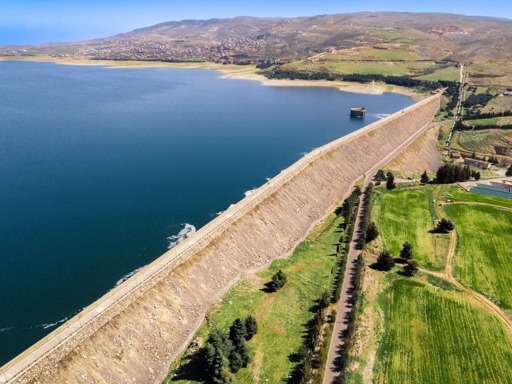
Beirut responded decisively. Motivated by the desire to secure energy for its booming capital and to deny Israel a pretext for intervention, Lebanon approved a massive hydroelectric scheme based around the Qaraoun Dam. When construction began in 1957, the Litani entered a new phase: it became the backbone of Lebanese development and the final obstacle to Zionist hydropolitical ambitions.
Phase I of the project was completed just before the 1967 war. Its consequences were profound. Instead of the 400 million cubic metres Israel had hoped to take from the Litani, barely 100 million remained in the lower river. The key hydrological diversion point was moved deep into Lebanese territory — far from anywhere Israel could realistically capture in peacetime.
In short, Lebanon’s decision to develop the Litani was a rare strategic success: it both accelerated the country’s urban modernisation and closed the door on half a century of Zionist designs.
The Arab League’s counter-diversion scheme
While Lebanon secured the Litani, the broader Arab world turned its gaze to the Jordan headwaters. In 1961, the Arab League adopted a plan to divert the Hasbani and Banias away from Israel. Lebanon’s role was substantial: it was to reroute part of the Hasbani into the lower Litani. Syria would redirect the Banias to the Yarmouk. The combined effect would be to deny Israel a significant share of the Jordan’s upper flow.
Israel reacted with fury. It claimed that Lebanese and Syrian diversion would deprive northern Palestinian villages of traditional irrigation sources — ignoring the fact that those ‘villages’ were by then largely depopulated or under Zionist control. Far more alarming for Israel was the potential impact on its National Water Carrier, which depended on the Jordan’s inflow to feed agricultural settlement in the Negev.
Lebanon backs away under threat
Lebanon, despite supporting the Arab plan in principle, knew that implementing it would provoke Israeli military action. The Lebanese government refused to allow Arab troops into its territory and continued work alone. But in July 1965, after clear warnings from Tel Aviv, Beirut suspended the Hasbani diversion. Lebanon had demonstrated its Arab solidarity, but it could not risk war. The imbalance of power was unquestionable.
Syria pushed forward nonetheless, and Israel responded with force. Israeli attacks on Syrian diversion works intensified through 1965 and 1966.
By 1967, water had become a central catalyst in the escalation that led to war.
By the eve of that year, hydropolitics had become inseparable from regional conflict. Israel viewed Arab diversion as an existential threat; the Arab states saw Israel’s water projects as colonial consolidation. Lebanon, caught between solidarity and vulnerability, managed to secure the Litani but could not escape the geopolitical storm gathering around the Jordan headwaters. Water, once a shared resource, had become an axis of confrontation.
The next stage — examined in Part III of this series — would show how this struggle transformed into open war and reshaped Israel’s attitude toward Lebanon for decades to come.
Featured image via Litani.gov.lb
From Canary via This RSS Feed.