

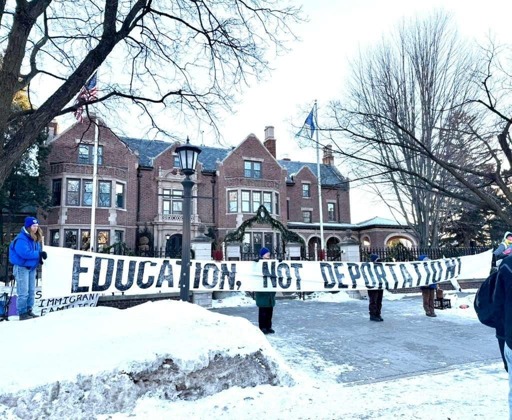
“You came at a good time; it was below zero for weeks.”
Those were the words I heard most often during my mid-winter break in the Twin Cities, as I, along with two of my comrades, spoke with workers, educators, and activists whose lives have been upended by months of ICE terror and who have led the way in the struggle for immigrants’ rights.
With unseasonably warm 50-degree weather melting the snow, the metaphor felt almost too on-the-nose. Just as the ice began to thaw, the retreat of thousands of DHS agents was announced, marking the end of Operation Metro Surge. After weeks of raids, kidnappings, intimidation, and the fatal shootings of three community members, federal forces appear to be drawing down.
But no one we met was celebrating.
Neon-vested patrols still stand on corners. Rapid response networks remain activated. Grocery deliveries continue. Rental assistance funds are still being raised. The Mni Owe Sni camp stands firm outside the Whipple Federal Building. Immigrant families remain indoors, waiting to see what comes next before stepping back into whatever version of “normal” is possible after months of state terror.
Most Minnesotans we spoke with refused to say they felt relieved. Many spoke to the national nature of the fight: if federal agents retreat from Minneapolis, they will just move on to target other cities. Some are skeptical that ICE will leave, insisting they are simply changing tactics — moving into suburbs where networks are weaker or operating more covertly. An unknown number of the thousands who were arrested remain detained both in the state and in detention centers as far as Texas. The trauma of losing neighbors, family members, and friends — whether through the deportation machine or cold-blooded murder — has left an indelible mark on the fabric of the Twin Cities. As one community patroller put it, “There is no “unseeing” our neighbors being ripped from their cars and homes, dragged, chased, beaten, tackled, shot… and sent to concentration camps.”
And yet, something undeniable has shifted.
The community response — from the mass mobilizations led by workers and students in the streets to the painstaking, daily organizing that sustained the community — forced a retreat in what is nothing less than a victory for the movement. It’s one with painful casualties — but it is proof that organized, collective resistance can blunt the machinery of the Trump administration and its racist attacks.
The lessons we can draw from this experience have reverberations far beyond Minnesota.
Educators on the Frontlines
As a part of the sanctuary team that my coworkers and I have been organizing at our school, I wanted to learn as much from Twin Cities educators as I possibly could. From teachers to education support professionals to counselors, educators have been at the heart of the resistance against ICE.
Every teacher, educational service professional, and counselor we spoke with had stories of students detained, families debating whether to self-deport, children logging into remote classes because they were too afraid to leave their homes. Some educators we spoke to had more than half their students joining classes from home.
After ICE targeted Roosevelt High School, many educators scrambled to prepare for the worst. One therapist described converting her office into a potential safe room—stocking non-perishable food and even preparing a makeshift toilet. “We don’t know how long they might have to be there,” she told me. “We need to be ready.”
Another teacher told me about a student who was detained on their first day of work, a job they took to help pay for their father’s medical treatments after he could no longer work.
One education support professional — an immigrant herself — was overcome with emotion describing her love and fear for her students. She was not only worried about her students’ safety, but her own. While students had the option to do remote learning, teachers did not have that option and also risked abduction by ICE every day going to work, too. Her love for her students collided with the exhaustion and fear she carries for her and her own family’s safety.
A school bus driver shared that he was instructed not to speak directly about ICE operations with students, but that the impact of Operation Metro Surge was enormous and impossible to ignore. Neighbors on his bus route told him that one child’s family had been taken—but he is still legally required to stop at that address. Each day on his route to school, he sees their car still parked in the driveway, her photos taped to the window, her snow boots on the porch.
In school after school, educators described organizing rental assistance funds and food deliveries. Schools are already in many ways the centers of community life, and educators play a social role for students and families far beyond pedagogy and content knowledge even when there isn’t an invasion of federal agents. In the Twin Cities, educators demonstrated how far those community ties extend; how much solidarity for their communities pumps through their veins.
But they also spoke about the limits of mutual aid networks stretched to the breaking point — powered by underpaid workers and families already struggling to survive. On top of the constant organizing, many teachers and paras spoke about the imminent budget cuts that had been announced by principals and district officials that are coming down the line, where the most highly-needed educators who serve the most vulnerable communities are expected to face cuts: from bilingual programs to teachers of English as a New Language.
There is rage at the federal government, but also immense anger at the unwillingness and failure of local and state authorities in the Democratic Party to meet basic demands: rent relief, eviction moratoriums, food security. Many conversations led back to the role that the Democratic Party and union leaderships have played in trying to demobilize the workers’ movement fighting to go beyond deescalation to kick federal agents out altogether and abolish ICE.
Educators are visibly exhausted. After months of crisis mode, many described not knowing how to process what they’ve lived through. The emotional toll has become physical: persistent neck pain, sleeplessness, and chronic stress. Teaching is already overwhelming under capitalism; add the responsibility of shielding students from state violence, and the weight becomes almost unbearable.
And yet they continue — carried by the community they’ve built through shared struggle. As Luigi Morris and Sou Mi wrote about their conversations with Twin Cities educators in January:
First, there was the Covid-19 pandemic, before being faced with new struggles mere months later in the face of the murder of George Floyd and a city in revolt against racist and police violence. It’s a community that was reinforced and strengthened by dancing together in the cold at the picket lines during the 18-day-long teachers’ strike in March 2022 — the first in Minneapolis in 50 years. At the time, fighting against racism and for more resources for their students, they emphasized that their teaching conditions were their students’ learning conditions. Far before Operation Metro Surge, they were already mobilizing to defend immigrant students.
As the state exposes its cruelty and its willingness to sacrifice the most vulnerable workers and protect the iniquitous ruling class, the bonds of the working class are only strengthening.
Collective Decision-Making and Workers’ Power
On Sunday evening, we attended a workers’ assembly of over 300 workers, union members, and members of the community. Many in attendance were educators, including a strong showing of those in the Educational Support Professionals chapter of the Minneapolis Federation of Educators, which was one of the three union locals and 20 left and community organizations that endorsed the assembly.
For many attendees, this assembly represented something they lack elsewhere: genuine democratic decision-making. In a labor movement steeped in business unionism, most decisions are made by a small bureaucratic leadership behind closed doors and there are few if any real spaces for discussion or debate. But rank-and-file workers, especially immigrant workers and those who have been on the front lines of the struggles, should have the right to bring proposals, debate ideas, and determine next steps collectively and independently from the class that exploits us. And as the attacks deepen, and the strategy of cooptation reveals itself more openly, such spaces will become more and more important.
From the energy in the room, I could tell how much having this space meant to attendees — folks were sitting at the edge of their seats, listening attentively, clarifying misunderstandings, taking notes. It was clear that people took to the space with a profound seriousness, with an almost sacred acknowledgement of its rarity and importance. The hovering thought: why don’t we do this more often?
As a community patroller said, “We cannot pretend our society doesn’t need to be rebuilt.” Across Minneapolis, communities — with educators at the center — have taken on tasks the state refuses to guarantee: rent, food, safety, care. If workers and community members are able and willing to take these tasks into their own hands, why shouldn’t they be the ones reorganizing the city — in a way that is not based on profit, but rather based on working-class solidarity? In the midst of crisis, why shouldn’t there be open assemblies — not limited to union members, but inclusive of the entire community — organized in workplaces, schools, and neighborhoods? Why shouldn’t those who sustain the city be the ones charting its future?
The reality is that there are massive interests working against working-class self-organization. History has shown us how the ruling class and its representatives fear the independent power of the working class far more than it fears right-wing authoritarian advances, and how union bureaucracies are adapted to and complicit in this reality.
Union leaders across the country have an obligation to call assemblies in workplaces, places of study, and anywhere else possible. If they do not, we have to organize these democratic spaces ourselves despite them. We need to strengthen and develop unity between unionised and non-unionised workers, holding assemblies and meetings for the whole community, like the open assembly held at the City College Gaza solidarity encampment in 2024, where workers voted unanimously to endorse the five demands of the students and to hold a sick-out to defend them.
The question is no longer whether we have the power — the Twin Cities have shown us a glimpse of that; it is whether we will fight to wrest that power back into our own hands.
Shared Memory of Struggle
As we stood at the memorials for Alex Pretti and Renee Good, we were profoundly aware of the long-lasting impact that Operation Metro Surge will have on the Twin Cities.
But Minneapolis is no stranger to class struggle.
At George Floyd Square, we remembered how the Black Lives Matter uprising of 2020 transformed global consciousness about the links between police violence and the ongoing struggle against racism. At the Say Their Names Cemetery just a few blocks away, we read the names of those murdered by police.
We visited the Mni Owe Sni camp outside the Whipple federal building where tribal members along with community members set up yurts and fires to stand in solidarity with those detained by ICE, protesting the ongoing state violence on stolen land. The land — heavy with history — is a sacred site for several Indigenous communities including Dakota and Lakota. It’s also the site where the U.S. government killed hundreds of Dakota people and imprisoned more than 1,600 in a concentration camp in the 1800s. Minneapolis is also the birthplace of the American Indian Movement and the camp embodies the legacy of the resilient and ongoing struggle of Indigenous people against dispossession and settler-colonialism.
We visited the Bloody Friday Memorial, honoring the legacy of the Minneapolis Teamsters Strike of 1934, when workers shut down the city and reshaped the U.S. labor movement.
The people of Minneapolis and Saint Paul understand that these struggles are connected. The fight against deportations, the fight against police violence, the fight for Indigenous sovereignty, the fight for workers’ rights — they are not separate battles. They are expressions of a conflict between a ruling class that depends on exploitation and the working class and oppressed who survive through solidarity.
The more we take each struggle as our own, the stronger we become. Defending immigrants’ rights today reinforces every other fight. Just as we say “Palestine frees us all,” the defense of immigrant communities here opens the doors for our collective liberation.
Lessons I’m Taking Home
The thawing of the ice may be temporary; as I’m writing this, a fresh blanket of snow has fallen over the Twin Cities. Punxsutawney Phil did see his shadow, after all, and winter is not over. But the collective political experience that these cities have had — the community ties, the political conclusions, and the belief in collective resistance — will outlast any single federal operation or cold spell.
As I return to New York City, I am teeming with stories that I want to transmit: educators turning their schools into sanctuaries, school bus drivers stopping at empty houses, an assembly where rank-and-file workers are beginning to reclaim a tradition of working-class democracy that almost a century of anti-worker attacks had nearly buried.
In New York, we have important questions to ask ourselves: how can we activate the networks we’ve been building in our immigrant defense committees, sanctuary teams, and neighborhoods to become open, democratic spaces where we can make collective decisions about the struggles ahead of us? How can we fight for class independence in the face of the forces that seek to contain our movement? How can we organize ourselves to make demands on our union leaderships to go beyond the limits that the Democratic Party and anti-worker bourgeois legality? And how can we unite in defense of our democratic rights and in that fight, build the strength to go on the offensive for more?
What my time in the Twin Cities has shown me is this: we don’t have to fall into despair. We can fight back. When we do, we are powerful. If we organize, we can defend our communities, give ICE hell, and kick federal agents out of our cities. The fight is far from over, but the Twin Cities gives me hope that in the fight to abolish ICE, we can free ourselves, too.
I hope you’ll join us at our event on Friday, February 27 at 6:30 at the CUNY Graduate Center to hear some of our conclusions that we hope will help contribute to these discussions.
The post The Fight Isn’t Over: A Teacher’s Reflections from the Twin Cities appeared first on Left Voice.
From Left Voice via This RSS Feed.