

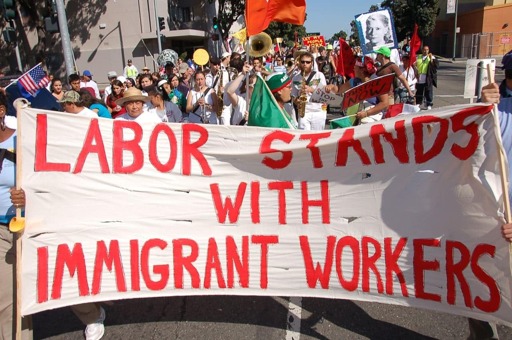
As the movement for immigrant rights and against ICE is growing throughout the country, Left Voice asked workers from four cities across the country what role they think labor can play in strengthening the movement. Below are their responses.
We’re committed to having our press reflect the ideas, protests, organizing initiatives, and debates of the rank and file of the immigrant rights movement. If you’re a worker, student, or community member organizing for immigrant rights and would like to contribute, please email contact@leftvoice.org or fill out our Get Involved form.
~
Karl Schwartz, member of North NJ DSA and Vice President of AFSCME Local 2298 which represents Newark Public Library Workers
It’s important that we connect the violence from ICE at home to Trump’s imperialism overseas in places like Gaza, Venezuela, Cuba, etc. The mainstream media fails to make these connections so it’s very important that independent leftist outlets show that the same tactics being used overseas are being used against immigrants and increasingly U.S. citizens here. ICE and Venezuela are not separate issues.
In terms of connecting different movements, in my own union, we’ve tried to prioritize participation in the social movements in Newark. As a small union of library workers, we don’t really have economic leverage compared to sectors like dockworkers, hospital workers, airport and transit workers, etc., but we are beloved by the community and that is the real source of our power. Most people like public libraries and thus like us and we can leverage that goodwill for radical purposes. It’s also in our own interest to participate in these movements because when we need support on our picket lines, people from other groups will remember that we showed up for them. It’s like the labor version of the famous Yogi Berra quote: “You should always go to other people’s funerals; otherwise, they won’t come to yours,” but replace funerals with protests.
Labor Eyes on ICE is an initiative by several unions to organize labor against Delaney Hall, the ICE detention center in Newark. We also want to bring other unions in to see if we can make a space for greater collaboration between different locals in the area. It’s all a kind of structure test right now to see who from our own membership and what other unions will come out, but I think it definitely opens a space for greater collaboration and strategizing.
A United Federation of Teachers chapter leader
As a chapter leader at my school, I believe we need to make the connection between workers rights and what is happening in Venezuela, Minneapolis, and Gaza. All of these are connected issues even though on the surface they seem to be distinct. I often feel reticent to bring certain topics up because I’ve been met with “that’s not a union issue” feedback, but I disagree. An attack on one of us is an attack on us all, and we have the obligation to also be aware of these attacks because of how they affect our students.
It was a huge step for the UFT to endorse an action in solidarity with Minneapolis at the delegate assembly in January. Because this was an official union sponsored event, it empowered me to get the word out to staff members and it was gratifying to see how they responded. It’s also prompted me to set up a “Know your rights” teach-in, and to get word out about labor struggles that we should support. I think it’s important to remember that an attack on one union is an attack on all unions and if we’re not going to stand up for our fellow people who will? I look forward to seeing solidarity from the UFT moving forward.
Anonymous healthcare worker and member of the Detroit People’s Assembly
As a community member and healthcare worker, I echo the calls for coordinated direct actions, mass mobilization, and relational organizing between social movements and labor to kick ICE out of our cities and abolish ICE. We must also recognize the movement against ICE as part of the broader fight against criminalization, policing, and imperialism. We must fully confront and dismantle the systems and culture that reinforce the ever-shifting line of criminalization to get free. This is not just one moment, but a movement for liberation and freedom of all oppressed people.
Healthcare workers are supposed to be healers, and we must fight to keep our patients and healing spaces safe from ICE. In this fight, there are so many roles we can play. We must talk to our coworkers about ICE and other political or social issues, identify those who share our values, and organize together. Although the moment is urgent, we must build relationships, establish norms and shared values, and move at the speed of trust. We do not need watered down hospital policies to tell us what to do, we can self-organize and train together to prepare for raids and put into action “best practices” for caring for patients in ICE custody that facilitate connections to community and legal support. We can find creative ways to care for our communities and make sure our neighbors have what they need to survive, and we can identify points of intervention and leverage our power as healers to strategically organize to abolish ICE.
Veena K, member of SEIU, DSA-LA, and Labor for Palestine Los Angeles
To build a powerful national movement against ICE, we must connect and unite our struggles. This is a time to deepen our solidarity because we cannot confront these challenges alone. I believe we need to expand beyond any single issue and collaborate across sectors including labor, public health, education, immigrant rights organizations, and other community organizations. Even with smaller membership today, I think organized labor still holds influence stronger than a political class, so often in the pocket of wealthy donors and special interests. It’s important that we continue to remind even non-union members that our basic rights like the 40-hour workweek and anti-discrimination laws were only won through union power. I think it is only by helping more people recognize this power and feel compelled to join a movement or organization, that we can build a force strong enough to meet this moment.
As a dietitian in public health, I think it is important to speak up in defense of the programs and services at serious risk under this administration and make clear how connected these are to other assaults on our rights like violent and illegal ICE violence in our communities. It is terrifying to see the dismantling of critical infrastructure, including the CDC, HHS, USDA, and cuts to SNAP, SNAP-Ed, Medicaid, HIV prevention, and disease surveillance. These systems are true “public safety”. Weakening them is yet another attack on working people that puts us all in danger, as it severely weakens our ability to track outbreaks, prevent disease, and ensure access to food and care.
As a union member, I also see the connections between domestic attacks on workers and immigrants and global oppression in Gaza, Venezuela, and Cuba. I am part of the international Disarm Genocide coalition, which connects union members and workers across the U.S. and internationally taking action in solidarity with Palestinians in Gaza. Organizing with coalitions, whether locally or internationally, has given me hope that through collective organizing, we can confront immense power and build the strength we need to withstand what is ahead and fight for the better future we deserve.
The post Open Forum: Workers Share Thoughts on Labor’s Role in the Immigrant Rights Movement appeared first on Left Voice.
From Left Voice via This RSS Feed.