

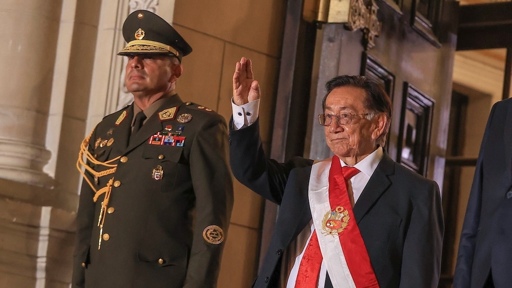
The acute political instability continues in Peru, and it would seem that chaos is a way of doing politics in the Andean country. On February 17, former congressman José María Balcázar was automatically elected as the new president of Peru after being elected president of Congress in a brief contest, in which congressmen Héctor Acuña, María del Carmen Alva (who many thought would be the winner), and Edgard Reymundo also participated. The decision was made by Congress itself.
Balcázar thus becomes the successor to center-right José Jerí, who was in office for just four months and was removed from office due to scandals that tarnished his government, including alleged influence peddling and corruption. Jerí, in turn, was the successor to Dina Boluarte, who was removed from office on October 10, 2025.
A cycle of repression and political collapse
Boluarte headed an administration whose main mission was to suppress the protests that erupted across the country after the traditional and right-wing political parties removed leftist President Pedro Castillo (who came to power with the Peru Libre party) when he attempted to convene a Constituent Assembly.
Boluarte, who had been elected Castillo’s vice president in 2021, ordered the repression of the mass protests demanding Castillo’s release and reinstatement as president. During these demonstrations, which lasted from 2022 to 2023, more than 50 people were killed and more than 1,500 were injured. Castillo is currently in detention and says he is a political prisoner.
Balcázar thus becomes Peru’s fourth president since the country’s last democratic election (2021), averaging one president per year. But the political crisis predates this. Balcázar will be the eighth president in 10 years, reflecting a political system that clearly shows signs of exhaustion and a seemingly endless crisis of legitimacy.
Thus, it seems almost inevitable that the elected president will be deposed, and that the vice president will also be removed from office and replaced by the president of Congress, who in turn will be replaced by the new president of Congress. This is what happened with the president elected in 2016, the right-wing Pedro Pablo Kuczynski, who was replaced by Martín Vizcarra, who was replaced by Manuel Merino de Lama, and whose presidential term would be concluded by Francisco Sagasti.
Who is the new president of Peru?
José María Balcázar became president at 83 years of age. He was a member of the judiciary, where he was investigated for alleged influence peddling, although he denies such accusations and describes them as persecution against him.
The Peruvian right wing has already launched attacks on Balcázar for allegedly being a leftist due to his affiliation with Perú Libre.
Former presidential candidate Keiko Fujimori, daughter of former far-right dictator Alberto Fujimori (1990-200), said Balcázar’s election jeopardizes democracy: “They have allowed the radical left to return to power … We warned about this on Sunday. The chaos is greater than before. They should never have opened this door.”
However, Balcázar himself has declared himself independent and promised that Perú Libre will not form part of his government, although it was this party that nominated him as a candidate: “I want to make it clear that I am an independent man, I do not belong to any political party. The Perú Libre caucus nominated me, but (you) saw last night’s vote, it came from all the caucuses,” said the country’s new president.
The truth is that, even if he wanted to make a radical change of course, Balcázar will have very little time in office. In fact, his government will last less than 180 days before the new president-elect takes office, provided that Balcázar is not removed by the Congress that has just given him its support, which is not unthinkable considering Peru’s recent history.
Indeed, Peru’s most radical right wing is already promoting a series of corruption allegations against the new president for his past, which has not been free of controversy, such as when he criticized a 2023 law that banned child marriage.
Balcázar, for his part, has said that he will seek to ensure that his government allows for a peaceful transition and that he will strive to guarantee free and democratic elections, with a runoff scheduled for June of this year.
However, the minuscule support for the 36 potential candidates who have expressed interest in running for president reveals a public apathy toward the Peruvian political system, which seems unable to function properly. The candidate who appears to have the most support is the conservative Rafael López Aliaga, who, for now, has the meager support of 12% of the electorate, according to the latest polls.
The post Balcázar sworn in as Peru’s eighth president in 10 years appeared first on Peoples Dispatch.
From Peoples Dispatch via This RSS Feed.