

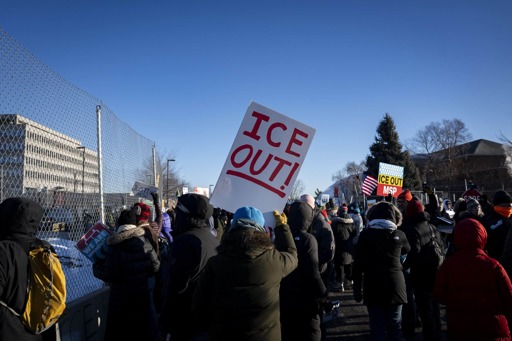
On February 15, more than 300 unionized and non-unionized Twin Cities workers across sectors — teachers, bus drivers, airport workers, Starbucks workers, and more — and members of left groups crowded into a room in the United Labor Center Building for a Workers’ Assembly, the first since the beginning of the movement against ICE. As a main resolution, the attendees voted for a “no work, no school, no shopping” action on May Day with a series of protests in the lead up to build momentum.
The audacious self-activity of the movement — vast mutual aid networks, rapid response groups, neighborhood patrols, and massive days of action that have transformed the city — has been its most novel aspect. The assembly marks a qualitative and much-needed development, providing a model for the collective and democratic organization of this self-activity. This step forward for the movement shows that workers and community members understand that more direct coordination of working people and labor is needed to defeat ICE.
In the assembly, the fierce passion of the workers to defend their neighbors was expressed publicly, in opinions, ideas, and strategies. Seeing all of these efforts and energies together, with working-class Minnesotans uniting around bold initiatives, it is clear that this kind of initiative could have strengthened the movement against ICE from the start and will be decisive going forward. Collective debate and decision-making is the foundation of true worker democracy and should guide the future of our movement.
The assembly comes at a pivotal moment. Last week, border czar Tom Homan announced the end of Operation Metro Surge, and now a thousand agents have been withdrawn from the cities. But hundreds of officers remain, and the people of Minneapolis understand that their fight is not over. Organizers on the ground are skeptical about the reality of the retreat, and aware that the damage to their communities will far outlive the presence of agents in their city. From neighbors who are now in immigration detention or deported and children who have suffered an enormous emotional toll and lost their classmates, to families who have been torn apart and those who risk eviction and food insecurity because they have not been able to go to work out of fear of ICE abduction, the struggle continues.
The question is: what happens next?
How can the movement stay mobilized, force ICE out of the city completely, take care of the communities that are still suffering as a consequence of Operation Metro Surge, and develop lasting organizations to defend working people against future attacks by the state? And how can the lessons from Minneapolis be transmitted to other cities that may be Trump’s next target?
Proposals and Demands: What Happens Next?
The assembly was organized by the Workers Solidarity Circle, Communication Workers of America Local 7250, Amalgamated Transit Union Local 1005, Minneapolis Federation of Educators Local 59 (Education Support Professionals chapter), Twin Cities DSA, Socialist Alternative, and more than a dozen other left groups. The room was packed — once the seats were filled, people sat on the floor and on tables or stood in the back. In true Minnesotan fashion, halfway through the assembly, those sitting down were invited to stand up and offer their seats to someone who had been standing.
The meeting opened with a discussion of the importance of building towards a mass strike, as one of the most powerful tools we have to fight Trump’s ICE offensive; the January 23 action, which a quarter of adults in the city reportedly attended; and the inspiration of general strikes past, from the Seattle Soviet of 1919 and the 1934 Minneapolis Teamsters strike to the mass protests in Wisconsin in 2011. The speaker called for a national movement against ICE rooted in the working class, and spoke to the need for union as well as non-union workers to get organized and make decisions collectively about how to do so.
From there, the agenda was organized by a series of proposals and demands that workers and members of left groups submitted ahead of time. During the discussion of each proposal, workers who were “for” and “against” the proposal came to the front of the room and gave their reasoning. Amendments were added and clarifying questions asked from the floor. In moments of confusion or disagreement, murmurs hummed in the audience as people discussed the point with their neighbors. When both sides had been heard, and amendments made, the room would vote — those in favor say “aye,” those against say “nay.” If the two were too close to distinguish a winner, hands would be counted.
The assembly ultimately passed resolutions on a series of coordinated mass actions and demands aimed at confronting ICE and advancing working-class solidarity.
The assembly endorsed a May 1 International Workers’ Day action of “no work, no school, no shopping,” aligning with a national day of strikes. Organizers committed to forming strike committees in at least 25 workplaces and reconvening in April.
Coordination with tenant organizing played a central role. In the first citywide tenant union meeting in the Twin Cities the previous day — which brought together 12 neighborhood unions and 200 tenants — tenants voted to organize a mass rent strike on March 1. The strike, which will move forward if 10,000 tenants commit to striking by February 28, will demand ICE out of the Twin Cities, an eviction moratorium, and rent relief. The assembly voted to organize a day of action on February 27 of the workers’ movement in solidarity with the striking tenants, and to organize for the rent strike within their union bodies. One of the participants in the assembly spoke passionately about the need for rent relief: “I’m tired of seeing everybody but the working class get a bailout.”
A March 20 National Day of Solidarity and Care for Youth was also approved, highlighting the impact of Trump’s anti-immigrant policies on children and Black and Indigenous youth, and connecting the workers’ movement to the student movement. Additional approved proposals included forming an outreach/training group to support non-union workers in their organizing towards the voted actions, and strategic action coordination across cities, as well as an international media strategy, for maximum impact.
Key demands adopted were: abolishing ICE and DHS; no state cooperation; free our neighbors; drop the charges on protesters; charge the killers of Renee Nicole Good, Alex Pretti, and all those who have suffered at the hands of federal agents; eviction moratorium and financial relief; and “land back” to return Fort Snelling land to Dakota and Lakota peoples, where the Mni Owe Sni ceremony camp currently stands.
Participants also brought a demand proposal for a workers’ party (a labor party initiated by the union leaderships breaking from the capitalist political parties), pointing out the bipartisan nature of the ICE offensive and the mounting unpopularity of the Democrats and Republicans alike. For the movement to express itself politically, the proposal argued, it should break from the Democratic Party.
This was a critical and timely discussion to bring, in a context where the crisis of the Republican Party is deepening and illusions in the Democratic Party are cracking, particularly locally where Mayor Jacob Frey and Governor Tim Walz have sought cooperation and compromise with the Trump administration during Operation Metro Surge.
Although the proposal was rejected, it was auspicious that the workers’ assembly space began a discussion on class independent politics — and points to the important role that the Left can play in intervening in the debates that arise as the movement develops.
There are broad sectors of society organizing against the billionaires, rejecting U.S. imperialism from Palestine to Venezuela, and taking anti-capitalist conclusions while the hunger for socialist ideas continues to grow. These fights can’t be advanced within an imperialist party that represents the interests of the ruling class. From Left Voice we have called on DSA to break with the Democratic Party as an important step forward in that direction and toward the construction of a working-class party that fights for socialism.
Class consciousness — the red thread connecting the COVID pandemic, to Black Lives Matter, to “Generation U,” to the Palestine Movement, to the fight against ICE — has made significant leaps in the last years. January 23 represented how far this collective radicalization has come: like in 2020, the masses filled the streets, but this time, they were motivated by the logic of and desire for a general strike.
All of these moments of class struggle, and those to come in the future, must be accompanied by democratic spaces where the working class can unite to discuss, debate, and agree on how to carry its struggles forward, independent from the capitalist parties that fight against our interests.
Democratic Organization from Below in the Fight Against ICE
The assembly demonstrated the potential for spaces of democratic decision-making to proliferate across workplaces and neighborhoods across Minneapolis. It also showed, in a small way, that we can decide for ourselves the world that we want to fight for, and how to fight for it.
What is opened by this incipient example of workers’ democracy is the idea that we can organize beyond the limits imposed on us by the parties of capital and the non-profit and union bureaucrats that attempt to contain our struggles. We saw in this assembly the organization of workers across sectors who may never have been in a room together, including teachers, bus drivers, healthcare workers, food industry workers, logistics workers, sanitation workers, postal workers, and many others. The assembly provided not only a space for discussing and making decisions about the broad struggles these workers are undertaking against ICE, but also a clear way of transmitting those ideas and decisions to the many different workplaces, schools, hospitals, and community spaces across the city.
This type of coordination from below could also force the hand of the indolent union bureaucracies to take action and to finally call for real strikes to shut down the city. The small but powerful example of the assembly we saw this weekend shows how little the union leaderships have done. The main unions of the Twin Cities and beyond could have organized spaces like this since day one. They could have put all their union resources towards strengthening the struggle and the mutual aid networks, and organizing self-defense in workplaces and neighborhoods. Of course, the union leaders chose not to call for assemblies because it would challenge their top-down strategy of maintaining peaceful relations with the bosses and the Democrats. The resolution passed to create strike committees ahead of the May Day action are an important counterweight to combat this passivity; they can serve as sites of organization for workers to discuss how to intervene.
Called from below, assemblies could have an enormous impact on the movement. Thinking beyond the one example we saw this past weekend, what if assemblies were organized in schools, bringing together not only educators but also students and families to make decisions about how schools can be spaces of support and sanctuary for immigrant community members? Or, for example, what if neighborhood-based mutual aid networks, ICE watch networks, and tenant organizations organized assemblies to discuss the March 1 rent strike and the future days of action? It’s estimated that at least four percent of the city is currently organized in an ICE watch chat — that could be turned into a mechanism not just to defend neighbors, but also to organize the way forward for the movement. Each neighborhood could elect delegates to a city-wide assembly, alongside delegates from workplaces: this is the infrastructure to mobilize a whole city.
In thinking of how to coordinate a national movement against ICE, such forms of democratic decision-making from below are going to be essential. In Detroit, for instance, community members have already created a “People’s Assembly” to organize the fight against ICE. This example shows that workers around the country are thinking with this same logic of self-organization and workers’ democracy. Should more assembly structures arise in other locations, the local assemblies could vote for representatives to attend regional and national assemblies that could have the power to connect our struggle across cities.
The democratic self-organization of the working class from below is the revolutionary alternative to the forces that try to de-escalate the movement against ICE and co-opt it back into the Democratic Party. It has the potential to bloom wherever a community decides it wants to discuss and decide openly — whether it be between workers, in one workplace, in one neighborhood, or in a school system. The Workers’ Assembly this weekend was a meaningful step in that direction. Such assemblies have the potential to deepen, and expand, the fight against the Far Right in Minneapolis that has inspired the world.
The post The Minneapolis Workers’ Assembly Is a Blueprint to Organize the Fight Against ICE appeared first on Left Voice.
From Left Voice via This RSS Feed.