


Shirley Sneve
ICT
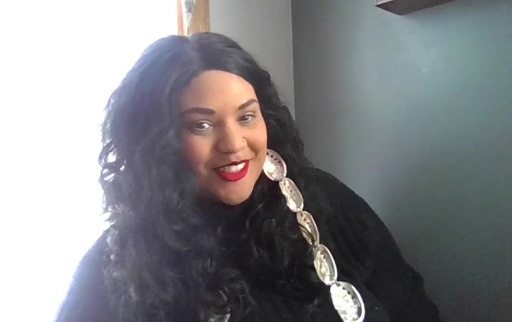
Marique Moss is an Afro-Indigenous educator and enrolled member of the Mandan, Hidatsa, and Arikara Nation, with Dakota roots in Saskatchewan. She holds degrees in Native American Studies and Indigenous Peoples Law. She is committed to reclaiming narratives, building equity, and uplifting communities through culturally grounded approaches.
With her husband, Theodore “Naawakweose” Marcil, she owns Mashkiki Studios in Minneapolis, Minnesota. It centers Indigenous knowledge and identity through workshops, consulting, and creative offerings that nourish both spirit and community. ICT’s Shirley Sneve caught up with Moss in celebration of Black History Month. The conversation has been lightly edited for clarity.
ICT: Why have you decided to take on this work?
Moss: I’m proudly Afro-Indigenous and I started this work because I saw a need for Afro-Indigenous voices within Indian Country.
I got a degree in Native American and Indigenous Studies. I thought, “this will be a breeze – I’m Native American.” It was the hardest thing of my entire life. But as I was studying and researching, I wanted to know more about myself. Are there more Afro-Indigenous people out there?
There’s a good amount of literature on mixed natives like Métis and things like that. So, I had to pull a lot of different references from a lot of different areas. However, it was still not representative of who I am. So, I saw a gap there. I wanted to know if people looked like me, if people felt like me, and so on and so forth.
So, in my journey, identity became important. I started teaching K through 12 American Indian education and that led into identity — Afro, Indigeneity and affirmations. I always had beautiful blue-eyed Osage babies in my classes, and I had Muskogee babies with beautiful Afros. And they know their songs, they know their dances, their traditions. And I just liked to reinforce and amplify those stories.

Marique Moss holds one of her published works, ‘Sweetgrass and Soul Food.’ She explains that the title is a “play on my identity. Sweetgrass for my mom’s side and soul food for my dad’s side. … The book is filled with grief, humor, joy and real experiences.” (Courtesy photo )
Then I thought that if I could wear my heart on my sleeve and just tell my story, maybe someone out there would be like, “My gosh, this is incredible. This is exactly how I felt at this exact age and the exact time. I’m so glad I’m not alone.”
That’s when my memoir came into being. It’s called “Sweetgrass and Soul Food.” It’s a play on my identity. Sweetgrass for my mom’s side and soul food for my dad’s side. And soul food is also born out of survival. I always overlap that with fry bread, oxtail, you name it. The book is filled with grief, humor, joy and real experiences.
I’ve gotten messages from all over – Wampanoag territory, Oklahoma and California – and they’re, like, “Hey, I’m 53. And I didn’t see myself until I read this book.” And it really hits you right in the heart. Because I thought that I was going to hit younger generations so that they didn’t have to go through that difficult period that I had to go through. But I’m so happy that it’s like hitting across generations. It makes me so incredibly happy.
ICT: It sounds to me like you grew up in a pretty secure, proud household.
Moss: Yes, I definitely did. My mom is a beautiful 6-foot 1-inch Hidatsa from North Dakota but she grew up fighting the headwinds of federal policy. She was adopted by a German father and a Scottish mother. My grandfather was very high in the Veterans Administration, so she hopped around a lot. My grandmother was a nurse. So, my mother did a ton of traveling. She was one of three siblings from the same tribe, MHA, who were adopted and never fit in. My mother has her own Oscar-winning story!
And then there’s my beautiful father, who is 6-foot 9-inches tall. He’s from Detroit – Motown. He’s my favorite person in the world. He’s a social worker. He works to bolster black male adolescent health and strengths. My mom is a nurse, a lawyer and an author. So I definitely had a strong system to look up to – physically and emotionally. I’m one of four siblings.
ICT: Did you face any racism or discrimination in school?
Moss: Oh my gosh, did I ever! In Catholic school, in particular, I internalized that I was Black. I’m a bubbly girl. I like my Lisa Frank (whimsical commercial products and school supplies.) I was watching Sesame Street online. I just saw myself as a curly haired girl who liked to get scratched up with her knees in the backyard. And I saw my dad, he was Black. My siblings are the same color. And I saw my Native mom, was like, “My gosh, this is just normal, right?” But when I started going to predominantly white school, I would get such weird questions. I write about this in my memoir. On the first day, it might have been the second day, the other students were like, “Hey are you guys here on a scholarship?” And I didn’t even know what that meant.
So, it was just sort of things like that popping up that we noticed. There a couple of instances – that I write about again – including the time I got my hair cornrowed for the first time. I called it my crown, my jewel, my beauty. I felt so awesome. And the next day I was called down to the principal’s office, and I was told I was out of uniform, and I had to take my hair out.
Getting your hair braided takes a minimum of, like, five hours, especially if you’re what you call tender headed like me. Any movement you just sort of pull your head and you hate getting your hair done, but it’s all worth it. It was from my auntie Lynette. I felt so beautiful and they told me I was out of uniform and I had to take it all out.
And then some white girls came back from Jamaica on spring break and had the same cornrows. They were allowed to wear them – with their scalps burned from the sun – until the beads fell out. It was definitely difficult.
ICT: You live in Minneapolis. What’s it like these days?
Moss: Living in Minneapolis right now is extraordinarily tough. I love Minneapolis. This is where I grew up. It is always going to be home base for me. It’s really difficult right now for any type of marginalized citizen with the ICE (Immigration and Customs Enforcement) occupation of Minnesota. What we’re doing as a community right now is we’re just trying to collectively heal and band together to try to feel we’re doing something.
Through Mushkiki Studios, my small business that I do run with my husband, we’ve created a mutual aid network. We usually operate as a storefront and we sell teas, tinctures, earrings. Our neighbors around us are immigrant small business owners. We couldn’t in good faith keep operating as a business and put them at jeopardy. That goes against everything in our mission and everything that we stand for.
We went into emergency response mode. We flipped our model completely and we just started taking donations through our storefront. We said, “If you have anything that you can provide, please drop it off at our storefront.” We were joyously overwhelmed when we ended up with 465 volunteers that signed up to help us with our mutual aid efforts.
And as of today, as of right now, we have 355 families that have signed up for mutual aid. Some of them have now been sheltering in place for six weeks. It can really get to you.
I have done a couple of deliveries that have been life-saving medications.I’m glad that I can be a lifeline for my neighbors.
I love Minnesotans so much. What’s happened is just so awesome. We couldn’t do it without our community and we wouldn’t be here without our community. So, we’re really happy to work with each other in this way. We are still taking donations and we’re going to do this until we can’t or until it’s not needed.
The post ‘I’m proudly Afro-Indigenous’ appeared first on ICT.
From ICT via This RSS Feed.