

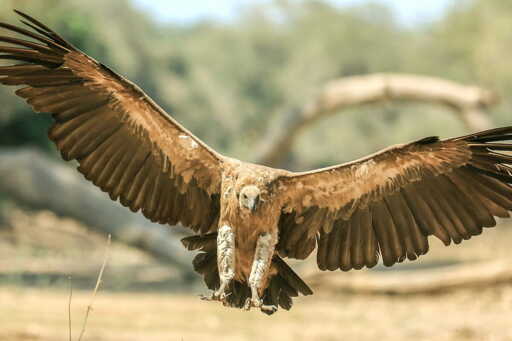
Protecting vulture populations in Africa presents some unique challenges for conservationists. These slow-breeding and ecologically vital scavengers range over vast territories and are vulnerable to poisons targeting other species and expanding infrastructure like power lines. Creating “vulture safe zones” has emerged as a way to address these broad and varied threats, but putting them into practice is proving difficult. South Africa’s oldest vulture safe zone is centered in Tswalu Kalahari Reserve, in the southern Kalahari Desert. Since the 114,000-hectare (282,000-acre) safe zone was established in 2019, on land owned by the wealthy Oppenheimer family, its managers have taken steps to protect critically endangered white-backed vultures (Gyps africanus) and endangered lappet-faced vultures (Torgos tracheliotos) nesting there. Establishing the reserve as a safe zone involved things like covering reservoirs with nets to prevent drowning, and halting the use of lead ammunition. Wendy Panaino, an ecologist at Tswalu Kalahari Reserve, told Mongabay that, ultimately, the aim is to make this 120,000-hectare (296,000-acre) reserve a safe haven for threatened species like the white-backed, lappet-faced and white-headed vulture (Trigonoceps occipitalis). “Tswalu was a massive success,” says Linda van der Heever, species project manager at BirdLife South Africa. “It really is, in many senses, a textbook vulture safe zone.” A vulture in Tswalu-Kalahari Reserve, South Africa. This reserve was designated as vulture safe zone in 2019. Image courtesy of Duncan MacFadyen / Tswalu-Kalahari Reserve. In the past decade, several safe zone projects of this kind have kicked off in Africa, each adopting a variety of measures…This article was originally published on Mongabay
From Conservation news via This RSS Feed.