

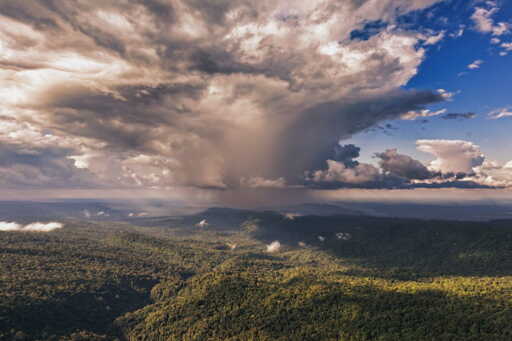
Rainfall is often treated as a gift of geography — a function of latitude, oceans, and atmospheric circulation. A growing body of research suggests that in the tropics, it is also a product of ecosystems. Forests do not merely receive rain. They help generate it, regulate its distribution, and sustain the conditions that allow it to persist. “Quantifying tropical forest rainfall generation”, a review paper recently published in the journal Communications Earth & Environment, attempts to measure a process long recognized but rarely expressed in concrete terms: how much rain forests themselves produce. By combining satellite observations with climate models, the authors estimate that each square meter of tropical forest generates roughly 240 liters of rainfall per year across the broader landscape, rising to about 300 liters in the Amazon Basin. Rather than treating forests as passive recipients of climate, the study depicts them as active participants in shaping it. The mechanism begins with evapotranspiration. Trees draw water from soils and release it into the atmosphere through their leaves. This vapor contributes to cloud formation and precipitation downwind. While the physics is familiar, the novelty lies in quantifying the effect at scale. On average, each percentage point of tropical forest loss reduces regional rainfall by about 2.4 millimeters annually, with larger effects in the Amazon. Satellite observations suggest even stronger impacts than most models, implying that current projections may underestimate the hydrological consequences of deforestation. Sunrise over the Pinipini river in the Peruvian Amazon. Photo: Rhett A. Butler Forests export…This article was originally published on Mongabay
From Conservation news via This RSS Feed.