

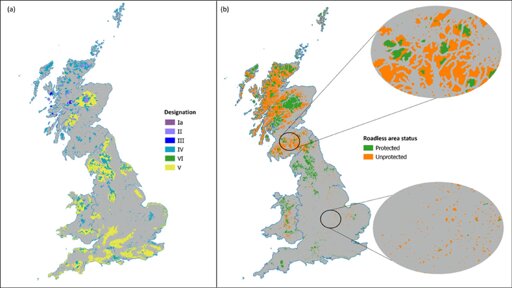
Britain’s landscape is highly fragmented by roads, with researchers from Cardiff University finding that more than 70% of the UK’s roadless areas are smaller than 1 km2. The researchers say that more than 60% of roadless patches in the UK are smaller than the typical area many common UK mammals need to survive, meaning species such as badgers and red foxes likely face a high risk of wildlife-vehicle collisions.
From Biology News - Evolution, Cell theory, Gene theory, Microbiology, Biotechnology via This RSS Feed.
My first thought was “that sounds bad,” but then my second thought was “wait a second, wouldn’t that be pretty much expected, statistically speaking?” The more roads you build, the smaller the fragmented area gets, but also the more fragments you create. I’m not convinced reporting on that number is actually meaningful rather than sensationalist. I feel like reporting on the relative percentages of total area that fits in different size bins might be a more reasonable measure.
On top of that, if “roadless areas smaller than 1 km2” really means something like “city blocks” as I kinda suspect it might, having the distribution skewed towards the smallest size class is good because it means the urban form is skewed towards well-connected higher density, as opposed to low-density sprawl. Ideal would be something like a bathtub-curve distribution, with a lot of small city blocks and then also a lot of large roadless areas, without a lot of low-density blocks too big for good urbanism but too small for good wildlife in between.