

Venezuela paid tribute to singer-songwriter, musician, poet and political activist Ali Primera with the traditional March of the Red Carnations on Monday, February 16. Marches were held in Caracas, as well as in other states of the country, in homage to the Venezuelan people’s musician on the occasion of 41 years of his passing.
The march, organised by the National Company of Music and the Culture Mission, coordinated by the Venezuelan Ministry of Culture, convened citizens and various social movements to honor the memory of the people’s musician.
The march in the capital started at 10:00 a.m. at the Casa de la Libertad y Cultural Ali Primera in the San Carlos Barracks. From this historic site, the participants began a march through the city center to Plaza Bolívar.
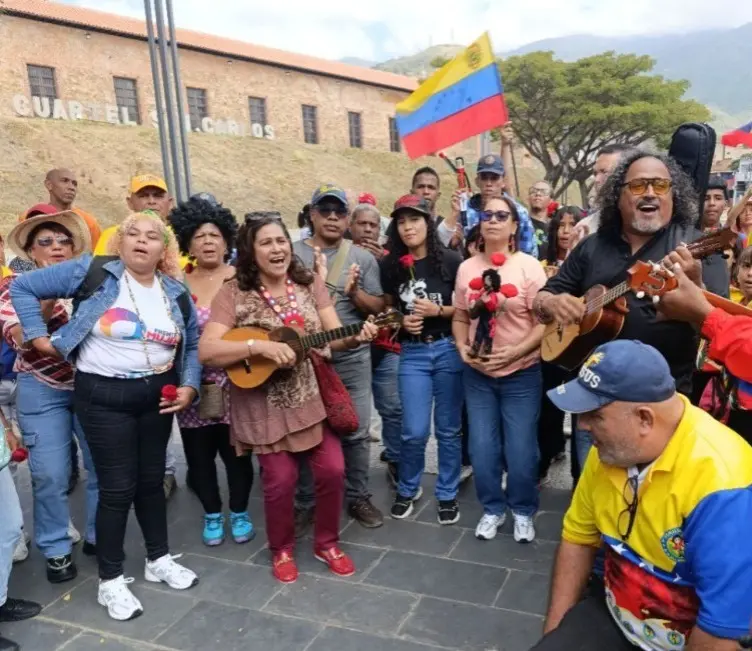
Part of the March of the Red Carnations in Caracas, February 16, 2026. Photo: Telesur.
Distinctive features of the march include the participants carrying red carnations and the collective singing of Primera’s emblematic songs such as Techos de cartón, Tin Marín, La Patria es el Hombre and Los que mueren por la vida. Through these songs, culture promoters, authors, artists, and other participants reaffirm Primera’s commitment to social struggles and his condemnation of injustices, elements that defined his professional career.
The composer’s work remains a fundamental pillar of Venezuelan culture, uniting various generations through his revolutionary legacy.
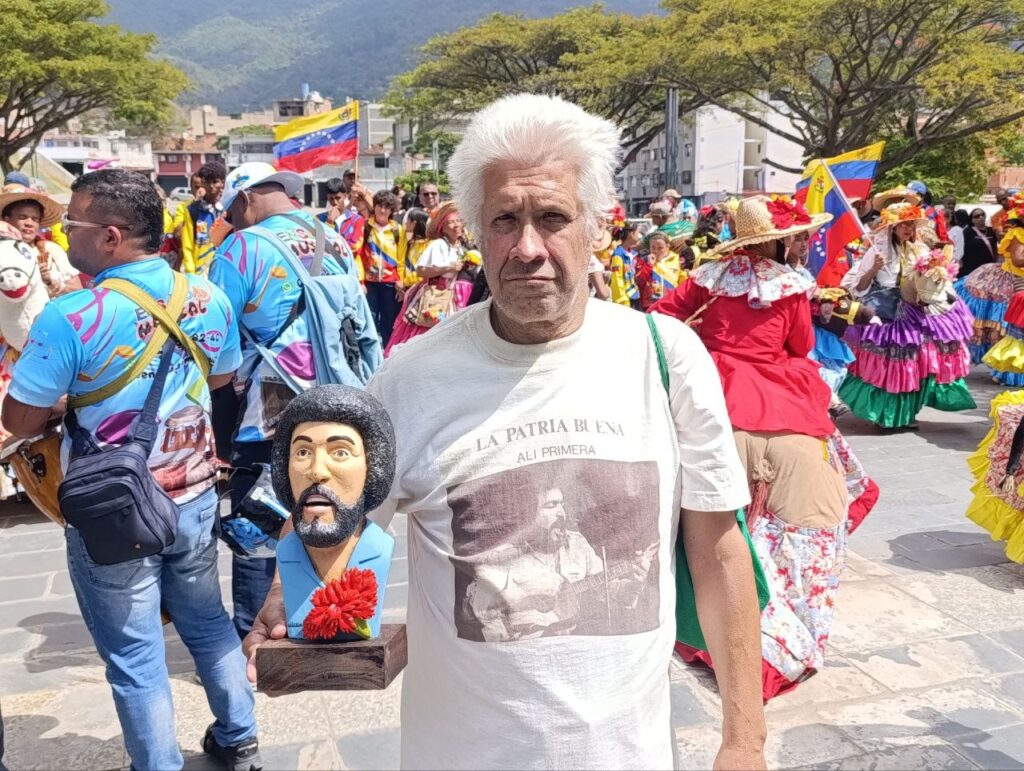
A marcher carries a bust of Alí Primera with a red carnation. Photo: Telesur.
**From classrooms to “Canción Necesaria”**Ely Rafael Primera Rossell, born in Coro, Falcón state, on October 31, 1941, was nicknamed by his relatives as “Alí” for the Arab origin of his grandparents. Despite losing his father, Antonio Primera, in an accident when he was just three years old, Alí forged a path of resilience with his mother, Carmen Adela Rossell.
In 1960, Primera’s arrival in Caracas marked the beginning of his academic and political training. After graduating from Caracas High School, he entered the Central University of Venezuela (UCV) in 1964 to study Chemistry. It was in the university corridors that his voice began to resonate, transforming what he began as a hobby into his life mission. Songs such as Humanidad and No basta rezar became his first protest anthems.
His education continued in Europe between 1969 and 1973, where he studied Petroleum Technology thanks to a scholarship from the Communist Party of Venezuela (PCV). However, when he returned to Venezuela, his professional title was left in the background. He found his true vocation in music and political activism.
Alí Primera’s music made him a reference of the Latin American protest music genre “Canción Necesaria.” With 18 record productions, he consolidated a style that mixed poetry with social denunciation.
Primera participated in numerous music festivals in Latin America and performed on several occasions in the Aula Magna of the UCV. He also took his message to where the struggle was: factories, high schools, unions, and working-class neighbourhoods. Politically, after his time in the PCV, he supported the cause of José Vicente Rangel in the Movement towards Socialism (MAS) party during the 1973 electoral campaign.
Passing and legacyOn February 16, 1985, Alí Primera lost his life in a car accident on the Valle-Coche Highway in Caracas when he was returning from a recording. However, his death did not silence his work. Decades after his passing, the songs of Ali Primera continue to show that his songs were not simply music, they are the reflection of the feelings and hopes of the majorities in Latin America.
To honor Primera’s legacy, Falcón state will hold the March of the Red Carnations on Sunday, February 22. This march in Punto Fijo will depart at 10:00 a.m. from the Alí Primera House Museum, in Paraguaná, following the historic route to the Santa Elena Cemetery where the musician is buried.
(Telesur)
Translation: Orinoco Tribune
OT/CB/SC
From Orinoco Tribune – News and opinion pieces about Venezuela and beyond via This RSS Feed.