

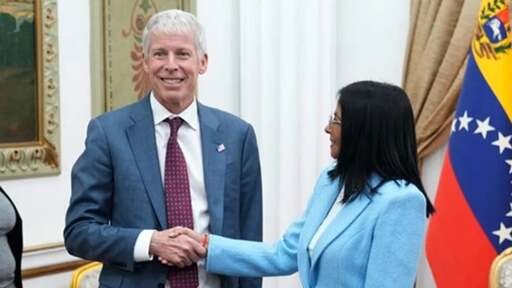
Last week, U.S. Energy Secretary Chris Wright visited Venezuela, focusing on meetings with acting President Delcy Rodríguez and business leaders, as well as touring oil fields. His actions made it clear that the U.S. government’s primary objective is to guarantee its energy corporations privileged access to one of the world’s largest hydrocarbon reserves. The rhetoric of Trump’s administration has centered on promises of increased production and modernization, yet it obscures a fundamental purpose: reconfiguring Venezuela’s energy structure and the country itself to align with the interests of U.S. imperialism and its corporations.
Wright’s statements clarify the scope of this strategy. He has emphasized the need to promote investment in oil, gas, and electricity production, framing it as an opportunity for the country’s “economic recovery.” As he stated to the media, “This year we can promote a dramatic increase in oil production, natural gas production, and electricity production in Venezuela, which will result in more jobs, better wages, and quality of life for Venezuelans.”
Nothing could be further from the truth. Wright, a fossil fuel tycoon, fracking industry entrepreneur, and enemy of the “green energy transition,” has not come to discuss cooperation agreements, nor is he concerned about the living standards or wages of the Venezuelan working class.
The economic sanctions imposed on the Venezuelan economy for years have severely impacted the working class and increased the country’s poverty rates. Wright’s comments after his first meeting with Rodríguez’s government make it clear that the objective is recolonization. “Venezuela’s resources,” he said, “must be integrated into the U.S. market to guarantee U.S. national security.”
Wright declared that sanctions are being lifted, but only so that the Department of Energy and the Treasury can directly supervise and control Venezuelan oil sales. He has openly confirmed that Washington will “govern” revenues for an indefinite period to ensure what they call “stabilization,” which will also guarantee debt payments, compensations, and benefits for oil corporations, as he himself noted. He stated that Venezuela must negotiate debt restructuring with companies whose assets were expropriated decades ago, although he acknowledged that “these restructuring agreements will not happen overnight.” The mechanisms for this are in place: much of the oil revenue is controlled by the United States through an account in Qatar, allowing for its discretionary and opaque management.
After the military attack on January 3 and the later establishment of a new power structure led by Rodríguez, the approval of reforms to fully open the oil sector to transnational corporations has accelerated. This process effectively constitutes a transfer of economic and political sovereignty, consolidating the country’s structural dependence on imperialist powers like the United States.
Rodríguez’s government, pressured by Trump’s administration, is swiftly moving to implement legal reforms designed to attract private capital by eliminating social, labor, and environmental rights to create opportunities for imperialist foreign capital.
Although Trump’s policies seek economic benefits for U.S. capital, they also aim to reorganize the Venezuelan state as a U.S. protectorate. The role of the current Venezuelan government in this reconfiguration is central. The handshake between Wright and Rodríguez symbolizes the consolidation of a policy willing to facilitate the penetration of foreign capital under the guise of “economic recovery.”
That is why, in an interview, Wright praised the “spectacular” collaboration of Caracas in its agreement with Washington to market crude oil. “We have been dealing with Delcy Rodríguez for five weeks. It has been an incredible cooperation,” he told NBC News in Caracas, claiming to have achieved a “historic” energy agreement.
Wright’s meetings with business leaders and his visit to oil facilities reinforced this dynamic. These meetings symbolize the Trump administration’s “transition” from direct military intervention to a phase of economic and political control. The establishment of a protectorate in Venezuela is meant to reaffirm U.S. influence in a region historically viewed as its area of geopolitical dominance, its backyard.
Thus, everything is part of a broader U.S. foreign policy strategy in Latin America. In a context of growing competition with China and Russia, control of Venezuelan energy resources takes on strategic importance for sustaining U.S. hegemony. Wright’s assertion that the U.S. seeks to prevent agreements that strengthen the presence of China and other powers in the Venezuelan energy sector is quite revealing, as Trump had already indicated.
Therefore, one of the most telling aspects of this U.S. strategy is its stance on agreements between Chinese companies and Venezuela. Wright stated that the United States “does not reject” legitimate deals with Chinese companies, as long as they are not “harmful agreements that Chinese companies have made in other regions.” Hypocrisy abounds, given that the energy secretary is more concerned with maintaining control over competition with China than with the potential harm of these treaties.
Wright’s visit, therefore, represents a link in a process of economic and political recolonization that deepens the country’s dependence and erodes its sovereignty. The neocolonial offensive promoted by the United States seeks to transform Venezuela into a strategic enclave subordinate to imperialist interests and to advance the imposition of a protectorate. In this scenario, the role of the United States once again reproduces historical patterns of imperialist intervention, where a combination of intense economic and diplomatic pressure, direct military intervention, economic conditioning, and alliances with local powers aims to consolidate a regional order favorable to U.S. imperialism’s strategic interests.
This article was first published in Spanish on February 12 in La Izquierda Diario – Venezuela.
The post Energy Secretary Chris Wright’s Visit to Venezuela Consolidates Trump’s Neocolonial Project appeared first on Left Voice.
From Left Voice via This RSS Feed.