

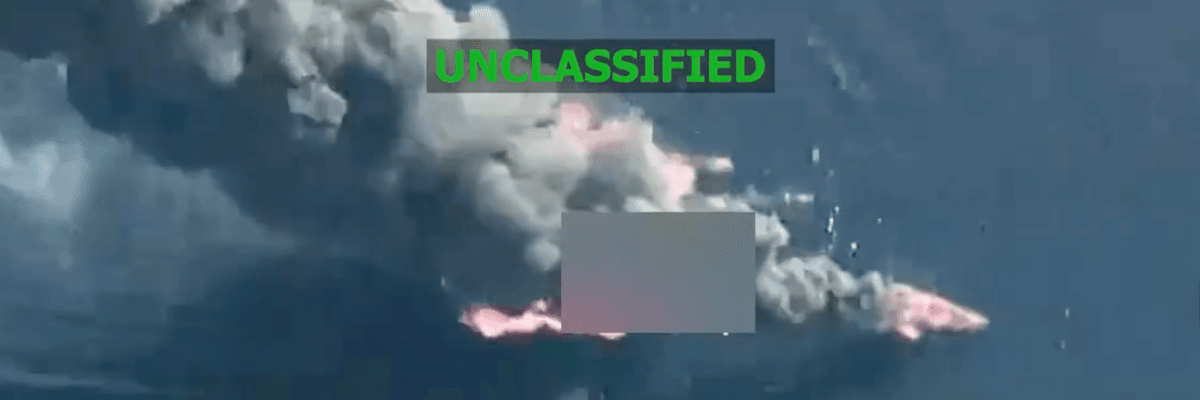
“No amount of terrorism talk renders this slaughter lawful,” said one policy analyst Tuesday after the US Department of Defense announced it had killed 11 people on three boats in the Caribbean Sea and the eastern Pacific Ocean—bringing the total number of people killed by the Trump administration in the region to at least 145 as the White House claims to be combating drug trafficking at sea.
The US Southern Command reported that Joint Task Force Southern Spear conducted “lethal kinetic strikes” on boats operated by “Designated Terrorist Organizations” that were “engaged in narco-trafficking operations.”
Two of the boats were in the eastern Pacific and one was in the Caribbean, and Southern Command reported that they were “transiting along known narco-trafficking routes.”
As with the other strikes the Pentagon has conducted since September, the Trump administration did not release evidence of its claim that the boats or passengers were involved in drug trafficking.
In the case of one bombed boat last year, evidence showed it had been headed for Suriname, not the US. Past victims have been identified as fishermen—including one whose family filed a formal legal complaint against Defense Secretary Pete Hegseth—and a bus driver who had agreed to ferry narcotics, leading one expert to compare the strikes to “straight-up massacring 16-year-old drug dealers on US street corners.”
Legal analysts have stressed over the past five months that when the US government has previously identified drug trafficking vessels in international waters, federal agencies have boarded the boats, confiscated illegal substances, and detained people on board for breaking the law.
The strikes on Monday evening, in contrast, were a continuation of “an extrajudicial killing spree,” said history professor Robert Crews.
The Washington Office on Latin America (WOLA) warned Tuesday that with President Donald Trump’s intensified threats against Cuba and continued mass deportation and detention campaign at home in the US, “the strikes are fading from public attention despite their illegality.”
“This normalization poses dangers: The justifications being used could extend to other victims in other contexts, and elements of the US military appear to be accepting unlawful orders,” said Adam Isacson, director for defense oversight at WOLA, and John Walsh, the group’s director for drug policy and the Andes.
Trump informed Congress in October, a month after his administration began bombing vessels in the region, that he viewed the US as being in an “armed conflict” with drug cartels in Latin America including in Venezuela, but international and domestic drug and crime agencies have not identified Venezuela as a major source of drug trafficking to the US—particularly not of fentanyl, which is responsible for a majority of overdoses in the US.
Isacson and Walsh emphasized Tuesday that despite Trump’s claims, “there is no congressional authorization for military force against drug traffickers. Under international law, the United States is not engaged in an armed conflict with drug cartels—designating groups as foreign terrorist organizations does not confer wartime authorities.”
Though the ongoing killings are being largely overshadowed by other news stories in the mainstream press, said Isacson, “February is on track to be the third-deadliest month of illegal US boat strikes, with 1.2 deaths per day so far, and 11 killed just yesterday.”
Both Democrats and Republicans in Congress have introduced war powers resolutions to stop the Trump administration from continuing the boat bombings and attacking Venezuela, but the vast majority of Republican lawmakers have blocked the efforts.
The human rights group Amnesty International, which said in December that Trump’s boat strikes “constitute murder,” called on Congress to “do more to rein in this administration’s lawless actions” and urged the public to put pressure on lawmakers.
“This murder spree,” said Amnesty, “is unconscionable and illegal.”
From Common Dreams via This RSS Feed.