

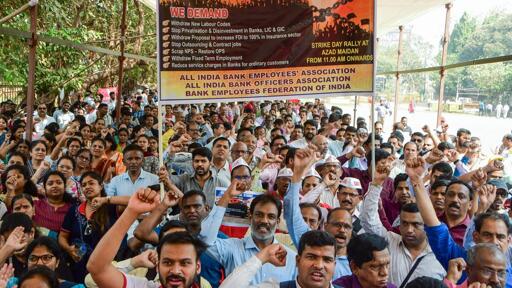
Last Thursday, February 12, India experienced one of the largest days of protest in its recent history: a nationwide general strike called under the slogan “Bharat Bandh” (Shut Down India) by an alliance of unions, peasant organizations, and grassroots groups. Various sectors of workers — from the private sector, public employees, bank employees, and farmers — paralyzed activities across the country, protesting labor reforms, the privatization offensive implemented by Narendra Modi’s government, and the consequences of the new interim trade agreement between India and the United States.
According to organizers, nearly 300 million workers participated in the day of action. The demonstration was spearheaded by major trade unions such as the All India Trade Union Congress (AITUC), the Centre of Indian Trade Unions (CITU), and the Indian National Trade Union Congress (INTUC), along with rural federations like the Samyukt Kisan Morcha (SKM) and the All India Kisan Sabha (AIKS). The convergence of urban unions and rural movements once again demonstrated the strength of the alliance between urban and rural workers, along with small-scale farmers who had previously led massive agricultural protests.
The strike affected banks, government offices, transportation, industries, and services across various states. Demonstrations and road blockades took place in several cities, while in rural areas, farmers organized rallies and protests against what they described as an economic policy serving the interests of large corporations.
The central issue in the conflict is the four new labor codes promoted by the Modi government. For the labor unions, these reforms unify and replace 29 previous laws, weakening workers’ long-standing rights.
The four labor codes are designed to undermine unions. Cancellation of union registration is made easier. Permanent employment will be replaced by temporary employment. Factory closures and worker dismissals will be facilitated. Organizing a legal strike is made more difficult, and the government can imprison those who strike illegally. Contributions to the pension fund are reduced, and the workday can be extended to 12 hours.
The unions argue that in a country with high levels of informality and precariousness, these measures will deepen the vulnerability of millions.
Along with rejecting Modi’s labor reform, the unions are questioning the advance of privatization in strategic sectors such as banking, insurance, and other public companies. They believe the sale of state assets and the liberalization of key areas will lead to job losses, wage declines, and the transfer of resources to private companies.
Farmers’ organizations added their own demands, warning about the impact of trade liberalization policies and the reduction of rural support programs. In particular, they expressed their opposition to the provisional trade agreement reached between India and the United States. They denounced the agreement, arguing that it could facilitate the entry of U.S. agricultural products at competitive prices, harming small and medium-sized local producers.
The organizations argue that the pact with Washington undermines the country’s food and economic sovereignty. Agricultural leaders maintain that greater openness without safeguards would deepen the debt and structural crisis affecting large sectors of the Indian countryside. They also question the lack of transparency in the negotiations and demand that any agreement be publicly debated.
The government, for its part, defends the reforms as necessary to modernize the economy, attract investment, and establish India as a manufacturing powerhouse. The official discourse mirrors that of governments in other parts of the world, such as Javier Milei’s in Argentina, which seek to downplay the regressive nature of the new labor laws that affect workers’ rights. In this context, the agreement with the United States is presented as an opportunity to expand exports and strengthen strategic ties. But for labor and peasant unions, it represents a further step in a policy of adjustment and liberalization that benefits large national and international business groups.
The scale of the strike highlighted the accumulated social discontent with precarious employment, the rising cost of living, and uncertainty in the agricultural sector. The events of February 12 were not an isolated incident but part of a broader resistance movement that combines demands for higher wages, the defense of labor rights, and the rejection of trade agreements deemed detrimental to working-class communities.
With hundreds of millions of workers and peasants mobilized, the general strike sent a clear political signal: broad sectors of Indian society are prepared to confront the government’s economic direction and adjustment policies.Originally published in Spanish on February 15 in La Izquierda Diario.
The post Millions of Workers and Peasants Are Shutting Down India appeared first on Left Voice.
From Left Voice via This RSS Feed.