

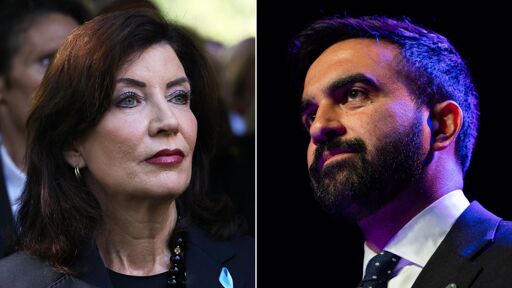
On February 10, Jacobin published an op-ed by contributing writer Liza Featherstone titled “Kathy Hochul Is a Good Problem for Zohran Mamdani to Have.” In the article, Featherstone — who frequently writes for Jacobin and has been a champion of the mayor since before his primary win in June — offers a pragmatic defense of his endorsement of Governor Hochul, claiming that such necessary concessions actually reveal the true power of Mamdani’s victory.
According to Featherstone, winning is hard, and the Left needs to learn to “govern with grace” and to strategically navigate the pitfalls of New York state politics so that the mayor can deliver on as many of his campaign promises as possible. And we mustn’t let any whining purists stand in the way.
As Featherstone explains:
The Hochul endorsement fulfills some leftists’ perpetual desire to feel betrayed and denounce whoever is in office. But it’s important to see the endorsement more clearly for what it is: a concession to a centrist governor who Mamdani needs to enact his agenda that is embedded in huge victories; a potential harbinger of more concessions that will also be embedded in more victories for the mayor and the city’s working class — a sign of how much power the Left has won suddenly, embedded in a rebuke that we haven’t yet won enough.
In other words, Mamdani’s endorsement, which came just days before the State Democratic Party Convention where Hochul trounced the left-leaning Lieutenant Governor Andrew Delgado, is just politics; and winning the game of politics requires concessions, strange bedfellows, and, it seems, lots of lobbying and electioneering. But, for Featherstone, it will all be worth it in the end (whenever that day comes) because the reforms that Mamdani plans to win as a consequence of these concessions will spur further enthusiasm for his politics, more organization, and supposedly lead to even greater victories, securing the future of municipal socialism in NYC and beyond.
Setting aside for the time being the fallacious and rather simplistic suggestion — that Mamdani’s mayoralty is just going to be (as Phillip Larkin put it) one “long slide to happiness,” building victory upon victory — there are several other serious problems with Featherstone’s arguments and the arguments of those that share her view of how Mamdani should lead and the larger strategy of municipal socialism he represents. People like Featherstone, who are apologizing for Mamdani’s endorsement, are either unwilling to admit or simply willing to accept that such political maneuvering can lead to real negative material consequences for the working class and oppressed they claim to support. Their arguments for the necessity of such compromises also downplay the degree to which they undermine the very kind of principled organization that has helped to make socialism a household name and brought self-proclaimed socialist politicians like Mamdani into office. But most importantly, and worst of all, they fundamentally misrepresent and misunderstand the real purpose of working class socialist politics, which is not merely to win elections or a few watered down demands, but to organize for real class power, without which every victory is temporary and every gain subject to the whims of the market and attacks from establishment Democrats and the reactionary Right.
Sleeping With the Enemy
Contrary to Featherstone’s rather pollyannaish analysis, endorsing Governor Hochul, whom everyone knows is a corporate Democrat and staunch Zionist, is not merely a political maneuver. It will have, and already has had, real consequences for working people and the Left. Even as Mamdani was penning his op-ed for the Nation, Hochul was actively working to undermine the massive nurses strikes in New York City by making it easier for hospitals to hire unqualified scabs to replace striking nurses. And she seems to have succeeded. Just days after Mamdani’s endorsement, the bureaucratic leadership of the New York State Nurses Association (NYSNA) successfully forced and passed a vote at four hospitals on a tentative agreement that failed to address any of the major demands of the striking nurses. While nurses at New York Presbyterian are continuing the fight for safer staffing ratios, higher wages, and guaranteed protections for immigrants, the settled contracts represent a real defeat that Mamdani could have fought to avoid. Rather than endorsing Hochul and allowing the New York Police Department (NYPD) to arrest striking nurses, Mamdani could have instead used his position and his bully pulpit to defend nurses against the police and to organize New Yorkers to demand that the Governor stop allowing hospitals to use scab labor.
It is also telling that Featherstone overlooks the fact that Mamdani, whose campaign was unabashedly pro-Palestine and anti-genocide, wound up endorsing one of the most pro-Israel governors in the country. Indeed, Featherstone’s article doesn’t mention Palestine once. Hochul has not only threatened to withhold state funds from institutions and organizations that support divesting from Israel, she dedicated $75 millon in new NYPD funding to repress those protesting Israel’s genocide at Columbia. She also forced CUNY to increase surveillance of students who support Palestine or are critical of Israel — a move that has also opened the door to attacks on CUNY faculty, whom Mamdani promised to defend, but has yet done nothing to address.
And of course Hochul has made it clear many times that she has no interest in significantly raising taxes on corporations or the state’s wealthiest residents to fund necessary programs for working people and the poor, and it’s unlikely that Mamdani’s endorsement will change that. This means that any money that is negotiated with Mamdani for social services will have to come from cuts to the state’s already existing budget, effectively robbing Peter to pay Paul.
Allowing the continuation of such attacks on working people and students in exchange for potentially greater access to childcare or free buses is not a victory, it’s a Faustian bargain with dire long-term consequences. And yet this is precisely one of the central problems with municipal socialism, which pragmatically seeks to win a raft of narrow populist reforms that do nothing to address the underlying problems of exploitation and oppression, without ever challenging or threatening the stability of the state that reproduces those problems.
Whither the “Insurgent” Left
While the DSA’s strategy of endorsing left populists like Bernie Sanders or using the Democratic ballot line to promote so-called socialist candidates is fundamentally flawed, and ultimately weakens the Left, it at least had the virtue of helping to elect some left-wing candidates and helped to expose a whole generation to the idea that socialism is an acceptable alternative to the liberal status quo. But now that Mamdani is in office, he and his supporters seem more than happy to close the door on those who want to follow in his footsteps.
Featherstone’s argument that Mamdani’s endorsement is somehow part of a long game of three dimensional chess overlooks the fact that his endorsement is also part of a broader pattern of protecting some of the worst Democratic politicians by undermining the campaigns of fellow Leftists. Mamdani’s and Alexandria Ocasio Cortes’s endorsements after all seem to have been pivotal to helping Hochul defeat Lieutenant Governor Delgado and his running mate and DSA member, India Walton, who were waging an insurgent campaign much like Mamdani’s own primary campaign against Andrew Cuomo. While Delgado seemed to have had little chance of winning the official backing of the New York State Democratic Party, an endorsement from Mamdani might have given him the boost he needed to wage an insurgent primary campaign that, even had it failed, could have raised a whole host of debates about the priorities of the state and the shortcomings of Hochul and the state Democratic Party, mobilizing New Yorkers to demand more and potentially pushing her to the left on key positions.
And this is not the first time that Mayor Mamdani has used his influence to protect Democratic politicians and throw fellow left-wing contenders under the bus. In November, just weeks after winning the election, Mamdani endorsed anti-socialist genocide apologist Hakeem Jeffries for House Minority Leader. At the same time, Mamdani played a pivotal role in ending DSA member Chi Ossé‘s primary campaign against Jeffries by ensuring that he did not receive the DSA’s endorsement. Even from the perspective of those who support an inside/outside strategy in the Democratic Party, providing cover for the worst Democrats while undermining leftist challengers is a demonstrably terrible way to build socialist power.
Socialist Power and Working Class Independence
But of all the things that municipal socialists like Featherstone get wrong, it is their fundamental misunderstanding of the purpose of socialist politics that is the biggest obstacle to working class power. For Featherstone and many Jacobin writers, politics is primarily about winning seats in Congress to achieve reforms, usually very limited reforms, where workers are merely voters rather than subjects of their own political agency. But politics is not just a program; it must also involve the laying out of a real strategy for power beyond elections. And for socialists this means the power of the working class to rule themselves free of the outsized influence and control of capital over production and the institutions of bourgeois society. Winning such power can’t be achieved solely with elections, or through alliances with representatives of capitalist stability like Hochul, but only through the independent organization of the working class and its true representatives as a class for itself, a situation that no amount of elections or reforms can achieve.
It is clear already that Mamdani has no interest in building such power. When he ran on the Democratic ticket, his supporters argued time and again, that this was merely a practical maneuver to win the election and that he would govern not as a Democrat but as a socialist. We have seen that this is not true. Rather than confronting the system head on, rather than convincing the millions who voted for him of the necessity of building working class power by directly challenging the power of capital, he has taken every step possible to defend, endorse, and prop up the worst Democrats in the hopes of winning some good favor for a limited and shrinking agenda of reforms. And now he is leading those same voters right back into the dead end of a lobbying strategy grounded in supporting the Democratic Party.
Lobbying Albany for higher taxes on the very wealthy is all fine and well but such tactics only sow illusions in the idea that the state can ever be a fair arbiter of class conflict. Hochul may pivot and eventually agree to some minor increases in taxes on the very wealthy just as she changed her position on immigration (Hochul used to be a staunch supporter of ICE after all), but any such policy changes are going to come with their own set of unaccountable problems and contradictions. Such political shifts, however, work both ways, and Mamdani is already coming up against the reality of the NYC budget and, right on cue, is shamelessly pivoting away from some of his core campaign promises, including his promise to expand housing vouchers for families at risk of eviction who would otherwise wind up on the street or in city shelters.
Real socialist legislators, on the other hand, such as Myriam Bregman and Nicolás del Caño in the socialist workers party (PTS) in Argentina, who wish to actually overthrow and transform the capitalist system, not merely tinker with it, do not lead like this. They do not backtrack on the needs of the working class or make excuses for why basic common sense programs are impossible. They do not apologize for the system by conforming to its limits and its logic. Instead, they use their positions to point out the contradictions and the absurdities of the capitalist system and seek to undermine and weaken it with independent working class power. These socialists don’t arrest striking workers; they don’t turn their backs on homeless families because of budget constraints; and they don’t endorse liberal politicians who are sworn to uphold the very system of exploitation and oppression that socialism seeks to destroy.
This is why working people need a party of our own completely independent of the influence of capitalist interests; a party built, formed, and led by workers and the oppressed, whose candidates are tribunes and organic representatives of the most important struggles, from the fight against ICE to the struggles for better working conditions, such as the fight by nurses in NYC. The DSA has the potential to be such a party, but only if it is able to develop a program beyond the limits of municipal socialism, and commits to completely breaking with the Democrats, including the ones in their own organization.
The post The Problem with Municipal Socialism: A Response to Liza Featherstone appeared first on Left Voice.
From Left Voice via This RSS Feed.