

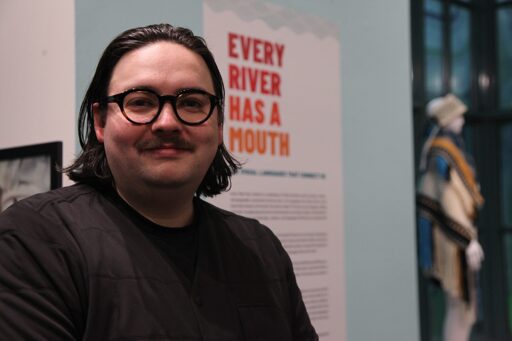

Eliot White-Hill, of Snuneymuxw Nation, guest-curated the newest exhibition at the Bill Reid Gallery of Northwest Coast Art in ‘Vancouver,’ which runs until February 2027. Photo by David P. Ball
Every River Has a Mouth, the newest exhibition at the Bill Reid Gallery of Northwest Coast Art, plunges deep into connections that flow between Salish artists on the province’s coast and its interior.
Guest-curated by Snuneymuxw artist and storyteller Eliot White-Hill, it’s his first collaboration with the acclaimed gallery in “Vancouver.”
“Salish art has its own total visual language, our own shapes,” White-Hill tells IndigiNews. “We use our own grammar.”
Too often, people assume West Coast “native art” is all the well-known northern Indigenous style known as formline, he notes.
“So really,” he says, “every opportunity we have to talk about that and to name it and to honor it in a way that people can learn through — that is really important.”
The exhibition opened Feb. 14 and features art from 11 creators in various mediums and stages in their career. It’s set to be on display for a full year.
The show considers the intergenerational ties between established Indigenous artists such as Angela Paul and Susan Point, White-Hill explains, and how their work has inspired the next generation of emerging artists.
Point, an acclaimed Musqueam artist, contributed a maple monoprint in the exhibition, and was credited with paving the way for many of today’s Salish artists across the province.
“Sometimes you have an idea for a work of Salish art, and it’s kind of like that meme of ‘the Simpsons already did it,’” he says with a laugh.
“Oh, Susan Point’s already done it.”

Revered Musqueam artist Susan Point contributed her 2005 maple monoprint piece Discover to the new exhibition at the Bill Reid Gallery of Bill Reid Gallery of Northwest Coast Art in ‘Vancouver.’ Photo by David P. Ball
White-Hill says what was interesting about putting on a show of only Salish art is that many people are still only just learning what it actually is.
One example he gives is how totem poles are not traditional in Coast Salish culture, and yet Stanley Park is filled with them.
Another motivation was that curators often specifically focus only on either Coast Salish or Interior Salish artists, says artist and Bill Reid Gallery curator Aliya Boubard.
There have been very few exhibitions that feature both cultural groups.
“Even though there are a lot of similarities culturally, through families, through linguistics,” she says, “there is a bit of a divide when it comes to showing their work within institutions or galleries.”
It’s also been almost ten years since the acclaimed institution has hosted a major Salish exhibition, and “there’s been so many amazing up-and-coming Salish artists who have been working in that time,” Boubard adds.
One example from the show is And It Was This Big, an oil and acrylic painting from emerging Snaw-Naw-As artist Grace Edwards.

Snaw-Naw-As artist Grace Edwards’ oil and acrylic painting And It Was This Big, is displayed at the Bill Reid Gallery of Northwest Coast Art in ‘Vancouver.’ Photo by David P. Ball
Her piece explores themes of keeping traditions alive and carrying art along in ways both new and old.
“What encapsulates all of these versions of keeping traditions alive is the multitude of fishing stories within my family, recalling past loved ones, the best fishing spots and who caught the biggest fish,” Edwards notes her artist statement.
Featuring a figure in vivid shades of dark purple, fuschia and pink, the piece also considers the importance of oral traditions and visual languages and the ways in which they flow “like our sacred waterways,” writes Edwards.
In a direct message, the artist tells IndigiNews,“I always learn new ways to re-enter and rethink how to perceive memories, stories and experiences through the formline language.”

syilx artist Taylor Baptiste’s 2025 installation, Continuum, is a twisting Möbius strip made from tule reeds and natural-fibre cords. The large suspended piece explores how in the artist’s words, ‘saʔtitkʷ — the river — is more than water. It is a living relation, an ancestor, and a teacher.’ Photo by David P. Ball
‘Culture travels and flows on these rivers’
Metaphorical rivers run throughout the show’s theme, and when thinking about its name, Every River Has a Mouth, White-Hill says there was one idea he kept returning to.
When learning Hul’q’umi’num he discovered that the word “qun” is added to a word to mean “language,” so his own dialect would be known as Snuneymuxqun.
But on it’s own, “qun” is the Hul’q’umi’num word for “throat.”
And the Stó:lō (“Fraser”) River is like a throat that connects the Coastal and Interior peoples.
“I took some liberties with the translation, in a way, by making it ‘mouth,’ but it’s still kind of the same,” White-Hill recalls.
As he learned more about the Hul’q’umi’num and Snuneymuwx languages, for example, and “far up the Fraser River in the Interior Salish world,” he said he found “so many things linguistically” held in common.
“From the coast to way inland, the culture travels and flows on these rivers,” he says. “And it’s what we share.”

Guest curator Eliot White-Hill discusses James Harry’s 2024 Welcome Gate, which is installed on the waterfront in Sḵwx̱wú7mesh. A photograph and carved model of the sculpture are displayed in the Bill Reid Gallery. Photo by David P. Ball
Líl̓wat artist Sydney Frances Pascal’s installation t̓iq i sts̓úqwaoz̓a | the salmon have arrived is made from more than 50 tanned salmon skins that fall from the venue ceiling like a waterfall.
Pascal was inspired by the memory of being at a fish camp in líl̓watǝmx with her family from Mount Currie in August when more than nine times the expected amount of salmon returned to the Fraser River.
“The river turned black because there was so much salmon, and that was only something I’ve heard told by family members as old memories from back in the day or written in books,” she says.
Pascal decided to create a new art piece to represent that memory.
“I’m holding on to it, because it’s so special,” she says.
“We never thought it would happen again, and also still — with how the environment in the world is going — I’m unsure if it will even happen in the future.”

Líl̓wat artist Sydney Frances Pascal created her installation ‘t̓iq i sts̓úqwaoz̓a | the salmon have arrived’ using dozens of tanned salmon skins. Photo by David P. Ball
Already familiar with tanning hides, she secured dozens of fish skins from her friend, fellow artist Janey Chang, who Pascal describes as the “fish skin guru.”
And then she began tanning them, using an extract from oak galls, sourced from growths on plants high in tannins.
But Pascal says it’s also possible to tan fish skins with successive soakings in concentrated black tea, too.
Pascal says she also wanted to include industrial materials alongside the natural ones as a reference to the modern world.
She cast cement salmon heads from her own mold, which peep out at the bottom of the cascading fish skins.
“It signifies the intervention of the modern world, and how that affects how our traditions, or how the numbers of salmon will either grow or dwindle, depending on if changes will be made.”
Every River Has a Mouth opened Saturday at the Bill Reid Gallery of Northwest Coast Art in “Vancouver” and runs until Feb. 14, 2027.

‘Coast Salish weavings hold that knowledge,’ notes Angela Paul, ‘in a way that is fluid and adapting like the river, to an ever-changing environment.’ The artist’s woven-wool fashion designs — Coast Salish Nobility Robe, Apron, Headband and Ceremonial Mat — are displayed at the Bill Reid Gallery until February 2027. Photo by David P. Ball
The post Exhibition explores ‘total visual languages’ binding Salish peoples together appeared first on Indiginews.
From Indiginews via This RSS Feed.