


The following is a repost of a piece by Areej Alghazzawi which Amnesty International published on 16 February.
Silent Traumas
Trauma follows us like our shadows during daylight. At night, trauma envelopes us until we feel like we are drowning.
Trauma also lives inside us like a disease. Good people in Geneva, New York, and The Hague say there is a cure, but we can’t inject their statements.
14-year-old Shorouq Thabet is the only survivor of her immediate family, who were all killed during Israel’s genocide. When I first asked her how she was, she simply responded with “nightmare”.
Adulthood is being forced on Shorouq, and she fights it by fantasising about being a young child again, when her only worry was wondering where her doll had wandered off to.
She longs to hear her parents’ voices; even their arguments could bring some comfort. They were killed in Deir Al-Balah following an Israeli attack on 17 March 2024. It was the last time she would sleep beside her mother and feel that special warmth. It was the last time she’d play with her younger sister, Shahed.
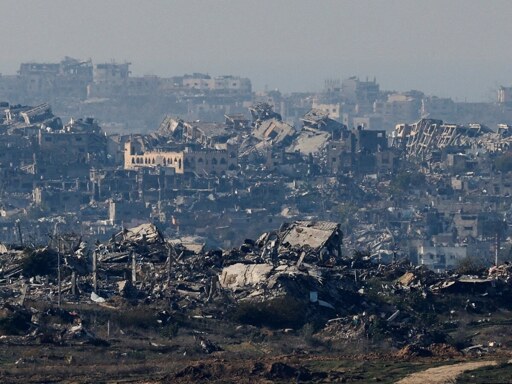
Destruction everywhere and in everyone in Gaza
Shorouq has been in therapy for some time now in the hope of learning to resist the darkness. Until now, there has been no relief. The smell and sight of destruction that is everywhere, and in everyone, in Gaza, open up the wounds again within seconds of leaving her therapy sessions.
On the night of the Israeli strike, she told me she had a strange feeling – that danger was in the room with them. She asked her mother to turn on a flashlight and hold her closely.
At some point, she said she managed to sleep, but when she woke, she was in a hospital. Her mother had survived the attack and was covered in blood:
She was frantically checking on me, my sister, and two brothers, Mohammed and Ahmad. I could see her but not feel her. I was going in and out of the darkness.
It was the first time she had seen her mother in such pain. Her mother’s face, covered in blood, is the last memory she has of her.
Her mother didn’t survive, nor did her father, little sister, or older brothers. The full details of her family massacre were only told to her when she was out of the hospital after seven days of urgent medical attention.
Everybody was crying. Nobody was talking.
Now she lives with her uncle Wael and his wife. I saw many people gathered at their home when Shorouq arrived. Everybody was crying. Nobody was talking.
A few days later, Shorouq told me:
At that moment, surrounded by so many unhappy people, I felt a change. I felt myself turning into an adult, with responsibilities. Now is not the time of dolls and dreams.
Try as she did to resist the pain, it was clear that young Shorouq just wanted to say a last goodbye to her sister and play together one more time.
Her lack of closure has been explored in her therapy sessions. The therapist asks her to draw what she feels. Sometimes, an empty paper expresses everything she feels.
She told me:
I used to love playing with dolls with Shahed. After the massacre, I lost my interest in everything. I actually still have a small piece of my doll that I found under the rubble.
In her free time, when she is not in school, she feels the pressure, and the flashbacks come back. She tells me she is consumed with uncontrollable thoughts. Now she is enrolled in an additional school. The time spent studying is an attempt to escape from her memories.
The detachment may be helping. Recently, Shorouq told me:
I hung a drawing on the door in my room. It’s a drawing of a warm home with open windows. Each morning, I look at that because it looks like peace.
Areej Alghazzawi is a junior accountancy student at the Islamic University of Gaza. She hopes to become a teacher and an accountant. She had one year left of her studies before Israel’s attack put her hopes on hold.
Alghazzawi is currently displaced but still in Gaza and, along with her family members, struggling every day to survive.
Featured image via the Canary
By The Canary
From Canary via This RSS Feed.