

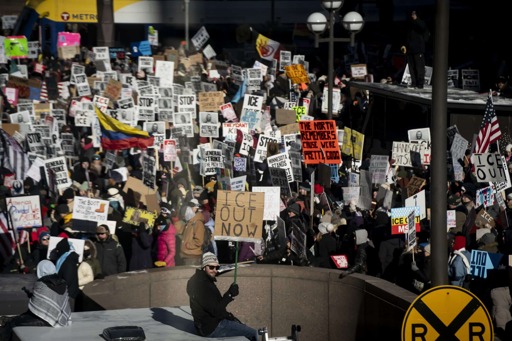
After over two months of federal immigration forces raining terror on the people of Minnesota, Donald Trump’s “border czar” Tom Homan announced the end of the Operation Metro Surge. Standing at Fort Snelling, where for months, hundreds gathered every morning to protest against the daily deployment of ICE agents who would terrorize their streets, Homan attempted to paint this withdrawal as a victory; a logical conclusion of a successful operation.
But we know that’s not true — it’s a retreat by the Trump administration, forced by the people of the Twin Cities, who have relentlessly mobilized in solidarity with their immigrant friends, neighbors, and coworkers.
Since the beginning of the operation in December last year, over 3,000 federal agents flooded the Twin Cities in what the Trump administration boasted was the “largest immigration enforcement operation in U.S. history.” They kidnapped people from the streets, out of their cars, or from outside their workplaces, gas stations, and stores. Afraid to be picked up, immigrant families stayed at home, keeping away from even work and school. In a press conference this week, Minneapolis Mayor Jacob Frey said that the Minneapolis workforce lost $47 million in wages, and local businesses and restaurants lost over $80 million in revenue in January.
ICE went after anyone they perceived as immigrants, coming down hardest on the region’s Somali, Latino, Hmong, and other immigrant communities of color, as well as those with pending asylum cases and even U.S. citizens. This wave reached its horrific peak with the brutal murders of Renee Nicole Good earlier in January and Alex Pretti less than two weeks later, who were both killed by federal agents while out to patrol and defend their neighbors and community. For a community that was already enraged, Good and Pretti’s deaths were a catalyst to their demand to have ICE out of their communities.
Since the very beginning, ICE’s terror did not go unanswered. From the very first weeks of the operation, people in the Twin Cities fought back. Thousands took to the streets and organized themselves to protect their neighbors. From neighborhood patrols and rapid response networks following ICE deployments organizing hundreds in each neighborhood, to vast mutual aid operations, Minnesotans mobilized to transform the cities into a fortress of solidarity.
Good’s murder radicalized people to mobilize even further, with all that rage culminating in a massive shutdown on January 23, termed a day of “no work, no school, no shopping,” where working people called in sick or walked off their jobs, and tens of thousands filled the streets of downtown Minneapolis in freezing cold weather. According to recent data, one in four Minnesotans participated in the shutdown. Indeed, such was its power that less than twenty-four hours later, when federal agents killed Pretti, thousands took to the street demanding to shut it all down again.
It was this force — a community in revolt, organized from below and unyielding in its solidarity — that made it politically untenable for the operation to continue. At every step, the strength of this solidarity dwarfed the violence ICE brought to their steps. But even as ICE withdraws, thousands are yet to be released from detention, and Trump’s deportation machine keeps churning.
As the fight against Trump’s anti-immigrant offensive continues, here are four lessons that we are drawing from Minneapolis.
- Minneapolis Marked Trump’s Weakest Moment So Far — And Showed that He Can Be Defeated by Class Struggle
The past month in Minnesota has marked one of the weakest moments so far in the second Trump administration. As Daniel Kovacs and Lila Walters wrote, what was at stake in Minneapolis was “nothing other than the glue that keeps his coalition together: immigration. And now that glue is cracking.”
Indeed, Minnesota exposed the tensions inscribed in the many factions that make up the Trumpist coalition. Where on one side, there is the maximalist Far Right, made of the likes of Stephen Miller and Kristi Noem, who put forward an agenda that stops at nothing to rid the country of immigrants using ICE as a paramilitary force, on the other side are mainstream Republicans and more moderate Trump supporters. These latter sectors share the anti-immigrant sentiment in principle but are perhaps more trepidatious about its most grotesque expressions, especially when there are federal agents militarizing the streets and brutalizing — even killing — people, especially U.S. citizens, which sours their voter base.
As Kovacs and Walters further explain, this tension passes through the very agencies that are enacting this anti-immigrant offensive, like the Department of Homeland Security (DHS). While united in their agenda, there is in-fighting over how to carry out its attacks. The Good and Pretti’s murders mere weeks apart landed like a grenade in the middle of that tension.
Pretti’s murder, in particular, pushed those tensions past the breaking point. Given the total impunity enjoyed by ICE agents who killed Good, Pretti’s murder at the hand of Border Patrol agents less than a day after the January 23 shutdown stood as a provocation and display of the continued unaccountability and violence imposed by federal agents. It was a moment that went beyond what even mainstream Republican opinion could easily absorb.
Noem’s response further illustrated just how badly the administration misjudged the political moment. In the immediate aftermath, she was quick to call him a domestic terrorist — a characterization that the White House parroted, but was immediately forced to walk back in the face of public outrage as video evidence confirmed the brutal circumstances of his murder.
The political costs following Pretti’s death piled up fast. ICE’s approval ratings, already declining, collapsed even further: over 65 percent of Americans feel that ICE has gone too far, and 53 percent disapprove of Trump’s immigration policies overall — a reversal from his first months in office. Most strikingly, nearly 20 percent of Republicans now say ICE has gone too far, and a recent YouGov survey found record support for abolishing ICE, including among Republicans.
The electoral warning signs were just as sharp. In Minnesota, a Republican candidate for governor, Chris Mandel, withdrew his nomination to distance himself from the administration’s conduct in the state. In a special election in the ultra-conservative county of Tarrant, Texas, the Republican candidate Leigh Wambsganss suffered a crushing defeat at the hand of Democrat Taylor Rehmet, a local union leader. It was the first Democratic victory in 36 years in a county which Trump carried by 17 points in the 2024 presidential election. Similarly, in a state House race in Louisiana, Democrat Chasity Verret Martinez defeated Brad Daigle, a Republican, by 24 points earlier this month in a district where Trump won by 13 points in 2024.
And looming over all of this are the 2026 midterms. Republicans hold razor-thin majorities in both chambers, and the electoral map offers little margin for error. A sustained collapse in support among moderate Republicans and independents, spurred by the images of federal immigration agents killing civilians and unleashing terror along with a party unable to rein in its own worst instincts, only threatens to overturn those slim advantages. Trump’s ability to carry out his broader program — on taxes, deregulation, and foreign policy — depends on his ability to hold Congress in November. Minneapolis, in other words, represented a challenge for the entire Trump project.
All of this only narrows Trump’s room to maneuver. Leaning into the maximalist position and doubling down on the immigration crackdown risked further hemorrhaging mainstream Republican support and accelerating the popular revolt. But retreating also risked inflaming the far-right base, for whom any concession on immigration is apostasy. The de-escalation the administration ultimately chose, replacing Bovino with Homan and initially pulling 700 agents before then announcing an “end” to Metro Surge, was an attempt to split the difference.
This matters strategically. Against a reality painted with despair, it shows that the Trump administration is not an unstoppable force. Minneapolis proved that there are real political costs tied to the choices he makes and that the pressure of the streets can shape the terrain of national politics in ways that no negotiation with Congress or the courts can replicate.
- The Most Novel Feature Was the Self-Activity Of the Working Class, Organizing for Immigrant Rights. The Task Now Is to Organize It
From below, taking the defense of their immigrant coworkers and neighbors into their own hands, workers and community members challenged the traditional methods of struggle imposed by the leaderships of the labor and social movements. They showed a new level of activity within the ranks of the working class: one that refuses to narrow their agency around “bread and butter” needs and takes up the demands of the communities and the immigrant labor force that is part of their daily life as coworkers, neighbors, and friends, pointing to early and incipient signs of direct democracy.
Indeed, since the beginning of “Operation Metro Surge,” working-class Minnesotans have been at the front lines of resisting the attacks on their neighbors and coworkers, mobilizing in great force to stop them from being snatched away. From giant days of mobilizations that brought tens of thousands to the streets clamoring to “shut it down,” to the rapid response and mutual aid networks that people came together across the Twin Cities to form to keep their neighbors, friends and coworkers safe, Minnesotans mobilized in force in these incipient bodies of self-organization to fight against Trump’s and ICE’s terror.
For months, protesters have been going to the places from which ICE deploys every morning to protest against their presence, and have surrounded the hotels housing immigration officers every night with cacophony to make sure that those who terrorize their streets by day, know no peace by night. Neighborhood watch networks have followed ICE vans and created early warning systems; community members have patrolled the streets in flying squads that respond to ICE spottings, using whistle networks to alert the community that immigration officials are in the area, and have documented every move made by them. They organized grocery runs for those who are too afraid to leave their homes, and shown up outside detention centers to meet those who are ultimately released with no resources in the bitter cold. Native American groups, including the American Indian Movement, began conducting their own patrols — an echo of the AIM patrol networks of the 1970s that were built because police offered no protection to Native communities in Minneapolis.
Schools, in particular, emerged as bastions of resistance. Teachers and school bus drivers have worked with students and parents to create safety corridors to ensure that no child or parent is taken from or during their commute to the schools. Educators have used their deep knowledge of their students and community to not only facilitate remote learning, taking on an extra burden of work, but have also coordinated grocery drops, as well as income and rental assistance for the families who wouldn’t risk leaving the house.
What is most striking about this is its immense political character. On the massive days of action, workers in Minneapolis walked off the job, not for a wage increase or a new contract, but in defense of their immigrant neighbors and coworkers, taking up a political fight against the most reactionary elements of Trump’s program. Minneapolis demonstrates a working class acting not just out of its own economic interests, but out of social and political ones, refusing to be divided along the lines that the Right insists upon inscribing among our class.
Even Alex Pretti and Renee Nicole Good embodied that very spirit of solidarity and resistance. Good was shot in the face by ICE officer Jonathan Ross while she was observing an ICE raid, and Pretti put himself between CBP agents and an immigrant woman they were attempting to corner before he was tackled to the ground, pepper sprayed, and shot multiple times. They weren’t passive observers to the brutality imposed by Trump’s forces, but a part of the fabric of a community up in arms. Tens of thousands of Minnesotans have been been organizing and putting up this fight for weeks, defending their communities and refusing to let their coworkers and neighbors be taken.
Minneapolis is the latest — and one of the most important — chapters in a rising arc of class struggle in the United States. The massive movement against racist and police violence that swept the country after the murder of George Floyd in Minneapolis itself left deep marks on how working people understand solidarity, state violence, and their own capacity to act, with many of those lessons paying immense dividends today. The teachers who are defending their students against immigration raids today are the same teachers who went on strike in 2022, who fought for smaller class sizes and against racism in education, who learned during the pandemic that their teaching conditions and their students’ learning conditions are inseparable. The rapid response and mutual aid networks drew on tactics developed in 2020 in the midst of Black Lives Matter, but have been revived in new and wider ways to defend a community under siege.
They are the rudiments of an alternative social infrastructure: one that has emerged to protect its own in the face of increased violence of the state, and that points toward a form of collective power the working class can exercise independently of both the bosses and their parties. When thousands of working people are organized into a citywide rapid response network, when food delivery and legal observation and street patrols are being coordinated across neighborhoods, and schools emerge as centers of struggle, when tens of thousands walk off their jobs and take to the streets, it points to a working class wielding its own power, not only in its ability to shut it all down, but also one that is thinking on how to use the fruits of its labor in service of the people. It displays a class that could govern itself, however tentatively.
- There’s No Substituting the Role of the Unions
What Minneapolis showed above all is that when working people use the tools they have, they can shake an administration to its foundations. But it also put the crucial role our unions have to play in organizing this struggle in the spotlight. To expand and radicalize the struggle, there is no substituting the role of the organized labor movement, with all its strategic power, its resources, and its institutional reach.
When the working class is on the move as they are now, our unions cannot remain on the sidelines. They have to join the fight. Rank-and-file workers are already showing the way. Our unions can’t just meet us with words of solidarity or encouragement anymore — it is urgent that they put the vast resources they commandeer behind the fight workers are already taking up, whether at their workplaces or in their communities.
Spurred by precisely the pressures from a rank-and-file on the move, unions endorsed the January 23 day of action. The Minneapolis Regional Labor Federation AFL-CIO, the St. Paul and Minneapolis Federations of Educators, SEIU Local 26, UNITE HERE Local 17, ATU Local 1005, and others endorsed the call of a day of “no work, no school.” Yet, most of these unions had little to give beyond words of solidarity and rage, and did little to actually mobilize their membership to actually strike and shut it all down, leaving the actual actions on the individual initiatives of rank-and-file workers.
Indeed, while union leaders shared symbolic words, rank-and-file workers were the ones who actually mobilized, organizing with their coworkers, walking off their jobs, organizing sick-outs, and spearheading some of the largest wild-cat actions in decades. In one CWA local, over 85 percent of union members didn’t show up for work. Bus drivers in Minneapolis — who, in solidarity, refused to transport police or arrested protesters in 2020 during the George Floyd protests — shut down the Minneapolis bus network. After federal agents killed Pretti the following morning, Minnesotans mobilized almost immediately. With the memory of the shutdown fresh, they clamored to stop business as usual all over again, calling for another day of action the following week. This time, however, unions even withheld their endorsements, or warned members against mobilizing in order to honor no-strike clauses.
This lack of mobilizations from the unions in this moment poses a fundamental question about what our unions are for and what they could — and should — become in the heat of struggle. The community networks, the patrols, the mutual aid operations: they all of represent new and important examples of organization from below. Yet, civilian action, however organized, also has limits. While it can defend a neighborhood, slow down operations and even shut down aspects of the city for a day or so, it is the role of organized labor that can transform this landscape. Labor poses the question of who actually runs society. From the logistics workers who move goods on the daily, to healthcare workers who run the hospitals, to transportation workers keeping the public transit system, to teachers who work with the community and its children everyday, the working class organized as a class holds the real levers of social power. To grow our struggles until we fight back every attack, we must wield that power.
Our unions can be the vehicles for precisely such action, but are constantly stymied by a union leadership that would rather negotiate with the Democratic party for crumbs than actual mount a reasonable fight. When unions limit themselves to endorsing marches without actually mobilizing with their forces, they only reinforce the divisions imposed on our class, relegating the political struggles to the realm of community issues instead of a class issue.
Imagine, however, if our unions using their massive infrastructure to actually mobilize our ranks. The millions of dollars that unions pour into the coffers of the Democratic party every election cycle, not to mention all the infrastructure at their disposal that they use to organize contributions, canvassing and lobbying, could go towards the actual defense of the community. It is money and resources that could have funded mutual aid operations, legal defenses, and for improving aspects of centralization and coordination that Minneapolis has needed.
The range of what organized labor can do is vast. Public works and transit workers could refuse to cooperate with ICE operations across the city, as Chicago workers reportedly did by using snow plows to block ICE’s vehicles, or in 2020 during the Black Lives Matter movement, bus drivers refused to transport those arrested or the police. Education workers, along with students and parents, already played a crucial role in transforming the city’s schools into bastions of solidarity. Teachers unions could help coordinate this information on a larger scale to understand the real needs of the community and allocate resources accordingly. Teamsters logistics workers, who ferry hundreds of thousands of packages every day could help coordinate grocery delivery drops or move other resources as necessary. Union halls could be opened and act as shelters and coordination centers, where workers and the community could gather to discuss and decide on a way forward.
When the organized labor movement throws its full weight behind the defense of immigrants, it does something that no community network, however broad and creative, can do on its own: it takes the embryonic forms of self-organization that have emerged in Minneapolis, and gives them the backing of the strategic power of the working class. It transforms this resistance into a demonstration of who actually runs this society, and who could run it differently. It can help pose the question of dual power, not as an abstraction, but as a living reality imposed by workers who refuse to move goods, drive transport, or continue business as usual while their neighbors are being abducted. The unions have it in their power to make that question real, and they must to stop every attack by this Far Right administration.
None of this is possible, however, without confronting a harder truth: the labor movement in the United States is objectively weak. At under ten percent nationwide, union density is near historic lows and organized labor is representing a shrinking share of the workforce, and those that remain, continue to tie their fate to the Democratic party. Yet, the self-activity in Minneapolis points to new possibilities for advancement among a generation being shaped by the end of neoliberalism: it offers the labor movement an injection of energy, creativity, and political possibilities that the fight for only “bread and butter” demands hasn’t generated in decades.
Rank-and-file workers are already showing what is possible when they act. The task is to turn that energy into a force that can not only reshape the terrain of organized labor, but also help it emerge as an independent, political force.
This is why the central political tasks that Minneapolis puts on the agenda for the labor movement are not just tactical but organizational: the recuperation and democratization of our unions for class struggle and class independence. Unions that are run by and for their members, that make decisions collectively from below, organized across shop floors, and fights for the interests of our class as a whole, instead of kowtowing to the Democratic party. These are the unions that could have not only mobilized to strike on the big days of shut downs, but also that could use the power of organized labor as a weapon to fight for the interests of the working class and oppressed across the country.
- We Need to Break with the Democratic Party and Fight For Class Independence
The brutal violence and the continued missteps of the Trump administration, combined with the response from below, has been a boon for a Democratic Party in crisis. The eruption of class struggle in the Twin Cities has been a political windfall for a party that hemorrhaged working-class support in the 2024 elections and has spent the time since then trying to find a way to overturn the “dealignment.” After years of managing the very same neoliberal order that has hollowed out working-class life, Democrats are now presenting themselves as the champions of immigrants and civil liberties because of the opportunity it presents to the party towards reversing their losses, especially towards the 2026 midterms.
The early signs have been encouraging for them, especially given Democrats’ over-performance in special elections held in the wake of the Minneapolis uprising. In Congress, Democrats have leveraged the outrage following the murders of Good and Pretti to force a renegotiation of ICE and DHS funding. Yet, despite their words of solidarity and support for the increasing demand to contain the agency, they’re only trying to contain its worst and most violent expressions and soften their edges.
Cuts to ICE funding that were made to avoid a shutdown (that is now underway) were not really cuts, since they were simply reallocated to DHS and other federal enforcement agencies. Democrats haven’t demanded an end to the raids, nor have they demanded the release of those abducted. Instead, they’ve concentrated on a package of procedural reforms: requirements that agents wear body cameras, prohibitions on masked arrests, new “accountability” mechanisms for use of force. The difference between the two parties on immigration is not one of program, but of degree.
The actions of Minnesota’s own Democratic leaders are a case in point. Despite positioning themselves as the face of the “resistance” from below, both Governor Walz and Mayor Frey negotiated with Homan since he took over from Bovino to deescalate tensions in Minnesota. This cooperation has had real consequences on the ground: Trump has touted that he and Walz are on a “similar wavelength.” Since the beginning of this coordination between Walz, Trump, and Homan, furthermore, state forces under Walz have repress demonstrators.
Other sectors of the Democratic Party have tried to contain and coopt the movement. Frey, facing his own lack of popularity, especially after losing significant prestige following the 2020 BLM uprising and nearly losing his seat to a progressive challenger, has been careful to give public credit to the movement from below for forcing the retreat. He has positioned himself not as an obstacle to the struggle, but as its ally and beneficiary, making the calculated bet that by aligning with the energy in the streets, he can rehabilitate his and the party’s standing as a party that will “fight” for the interests of working people. But this strategy carries a contradiction the Democrats cannot resolve: Every time they lean on class struggle to restore their credibility, they risk accelerating the very process they are trying to contain.
Moreover, even if the Democratic Party manages to channel some of the discontent into the ballot box, it is not entirely clear that the outcome would represent a rejection of Trump so much as a reinvigoration of a party in decline. Indeed, any short-term revival should not obscure their strategic fragility. Democrats remain the administrators of a neoliberal order in crisis — a party that has presided over decades of wage stagnation, declining union density, gutted public services, and the immiseration of the very multiracial working class that now floods the streets of Minneapolis. The 2024 electoral losses were not an accident; they reflected the accumulated rage of workers who no longer believe the party speaks for them.
And for many, the memory of 2020 is palpable. The Democratic party channeled the movement in the streets to abolish and defund the police toward the ballot box, only to then turn around and pass no federal legislation, restore police budgets across the country, and prosecute protestors fighting against racist and police violence. The class struggle in Minneapolis only deepens these problems. The more working people continue to discover their own power and their ability to win their demands change society, the less they put their faith in a party that negotiates with the very forces that oppress them.
The Fight Is Not Over
On the streets of Minneapolis, Homan’s announcement of the end to Operation Metro Surge was met with equal parts relief and skepticism. Many, who still see ICE agents on their streets, continue to stress that they’ll believe it when they see it.
For Minnesotans, furthermore, the fight is not over. Even as ICE leaves, thousands of people taken during Operation Metro Surge are yet to be freed and returned to their families. Many more immigrant families are set to deal with new realities in this aftermath, of lost income, of possible evictions, and other devastating blows wrought by this offensive.
Furthermore, while the Trump administration makes this tactical retreat from Minnesota, their deportation machine and the anti-immigrant agenda fueling it is still in full effect. As ICE leaves Minnesota, Trump and Homan are plotting to send those forces elsewhere across the country to target immigrants with less scrutiny. But as one teacher put it in an interview with Left Voice, “we don’t want them to go to other places; we want to defeat them here so they don’t do it elsewhere.”
Minnesota showed the way forward. Working people organized from below and found the power to move the brutal administration of the most powerful state in the world. The patrols, the mutual aid, the wildcat shutdowns, the massive days of action — they all showed what the working class is capable of when it decides to act. But as long as Trump’s attacks continue, the fight is not over. Now, as yesterday, it is still necessary to expand this struggle, for our unions to come off the sidelines and participate to help us actually win.
To guarantee the return of the thousands taken from their families, to kick ICE out of our schools, communities, and streets, and to demand full rights for all immigrants so that they can live with dignity and peace, we have to continue and expand this fight and hand this administration a resounding defeat.
The post Four Lessons from the Fight Against Trump and ICE in Minneapolis appeared first on Left Voice.
From Left Voice via This RSS Feed.