

Caracas, February 15, 2026 (venezuelanalysis.com) – US President Donald Trump is considering a visit to Venezuela, though he did not specify when the trip might take place or what agenda it would entail.
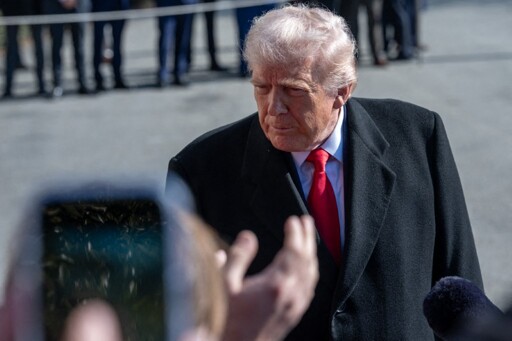
“I’m going to make a visit to Venezuela,” Trump told reporters outside the White House on Friday.
The US President addressed the press ahead of a trip to Fort Bragg, North Carolina, to meet soldiers who participated in the January 3 military attacks against Venezuela and the kidnapping of President Nicolás Maduro and First Lady Cilia Flores.
Questioned by a journalist, Trump stated that Washington recognizes the Venezuelan government led by Acting President Delcy Rodríguez as the country’s legitimate authority.
“We are dealing with them, and they have done a great job,” he stated. The White House refused comment on whether the recognition was the administration’s official stance.
In 2019, the first Trump administration recognized the self-proclaimed “interim government” headed by Juan Guaidó as the country’s legitimate authority, prompting the Maduro government to sever diplomatic ties. The US later transferred its recognition to the defunct opposition-controlled National Assembly whose term expired in January 2021.
Since the January 3 attacks, Caracas and Washington have fast-tracked a diplomatic rapprochement, with US Chargé d’Affaires Laura Dogu arriving in the Caribbean nation in early February. An official recognition of the Rodríguez acting government could pave the way for the restructuring of Venezuela’s sizable foreign debt.
In his Friday press remarks, Trump further described relations with Venezuelan leaders as being “as good as one could hope for,” and added that “the relationship with Venezuela today is a 10.”
Trump additionally highlighted progress in Venezuela’s oil sector.
“Oil is flowing, and other nations are paying a lot of money for it, and we are handling it. We are refining it,” he said. Since January, the White House has imposed control of Venezuelan oil exports, with proceeds deposited in bank accounts in Qatar before being partly rerouted to Caracas under US-set conditions.
Earlier last week, Venezuelan Acting President Delcy Rodríguez emphasized in an NBC interview that Maduro remains the country’s legitimate president. She also disclosed that she has spoken twice with Trump and has had “more frequent” contact with Secretary of State Marco Rubio, and expressed “gratitude” for the “respectful and courteous” nature of the talks.
Venezuela’s acting president went on to announce that she has likewise been invited to visit the US. “We are considering going once we establish cooperation and can move forward with everything,” she said.
The invitation reportedly arose during a recent visit to Caracas by US Energy Secretary Chris Wright, who was hosted by Rodríguez at Miraflores Palace on Wednesday.
Wright and Rodríguez later toured the Petroindependencia crude upgrader, a mixed venture between Venezuela’s state-owned PDVSA and Chevron, in the Orinoco Oil Belt.
The Trump administration official announced that Chevron would invest US $100 million to modernize operational facilities, with the goal of “doubling [Petroindependencia’s] productive capacity within 12 to 18 months and quintupling it within five years.” Petroindependencia has a current output of 40,000 barrels per day (bpd).
US issues new oil licenses
Following Wright’s Venezuela visit, the US Treasury Department issued two general licenses, 49 and 50, aimed at boosting conditions for Western multinational corporations to operate in Venezuela’s energy sector.
The first license allows for the negotiation and signing of future investment contracts, contingent upon the potential issuance of a specific license. The second waiver authorizes Chevron, BP, Eni, Shell, and Repsol to conduct transactions and operations related to hydrocarbon projects with PDVSA or any other Venezuelan public entity.
Repsol (Spain) and Eni (Italy), like Chevron, participate in oil and gas joint ventures in the South American country, whereas the UK-headquartered Shell and BP are set to lead offshore natural gas projects alongside Trinidad and Tobago’s National Gas Company (NGC) in Venezuelan waters.
However, GL50 requires that any contracts fall under US jurisdiction and mandates that all payments to “blocked” entities—as sanctions against PDVSA and Venezuela’s banking system remain in place—be made to accounts designated by the US Treasury.
It also explicitly prohibits transactions involving any person or entity linked to Russia, Iran, North Korea, Cuba, or China, as well as vessels sanctioned by Washington.
The Trump administration has loosened restrictions against the Venezuelan energy sector, including allowing the import of US diluents, inputs and technology, following a recent pro-business overhaul of the country’s Hydrocarbon Law. The reform granted expanded benefits for private corporations, including reduced fiscal responsibilities and expanded control over operations and sales.
Upon leaving Caracas, Energy Secretary Wright claimed that “structural reforms” would continue in Venezuela, with changes to “labor laws, the court system and the banking system.”
Edited and with additional reporting by Ricardo Vaz from Caracas.
The post Trump Announces Venezuela Visit as US Treasury Grants Licenses to Western Energy Giants appeared first on Venezuelanalysis.
From Venezuelanalysis via This RSS Feed.