

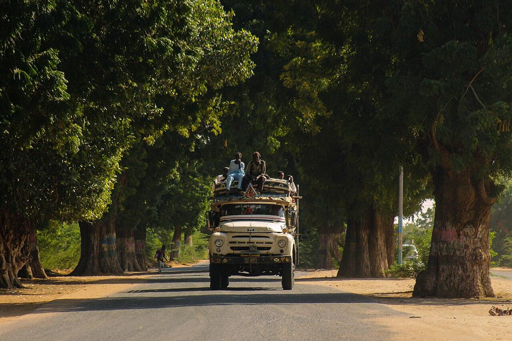
In Kordofan, war has not interrupted the economy, it has replaced it. Guns now govern markets, resources, and movement, turning land, gum forests, and gold mines into loot within an expanding war economy.
By Mohamed HilaliA Sudanese journalist and political analyst with a strong focus on Sudan’s current conflict, regional political transitions, and issues affecting East Africa, the Nile Basin, and the Horn of Africa. Internationally published work featured in The Guardian and Zenith Magazine.
When Fatima Mohamed Musa speaks about farming today, she no longer talks about yields or seasons. She talks about fear.
Fatima is a farm labourer from Habila, a border area between North and South Kordofan. She has been displaced three times since the war erupted. She lived under the control of both the Sudanese Armed Forces (SAF) and the Rapid Support Forces (RSF). During the war, her husband fell ill and died because they could not reach medical care.
What survived of her old life is not land, but memory. “We completely stopped growing cash crops like peanuts and hibiscus,” she says. “Now we only plant food crops. Selling food locally is possible. Moving cash crops to El Obeid is dangerous, expensive, and often ends in looting.”
Sometimes the crops were confiscated outright. Other times, armed men offered to buy them at prices that did not even cover production costs. Negotiations, she recalls, were handled by intermediaries tied to whoever controlled the area at the time.
Fatima’s story is not an exception. It is a window into how Kordofan’s economy has been reorganised by war, transforming farmland into contested territory and production into a survival strategy rather than a livelihood.

Conflict situation in Sudan as of 1 February 2026 – Thomas van Linge on twitter
From livelihood to frontline
Before April 2023, Kordofan was one of Sudan’s most productive regions, as South Kordofan alone has 35% of Sudan’s farming land. Its farms supplied food crops, sesame, peanuts, cotton, and gum arabic. Its rangelands sustained millions of livestock. El Obeid was a key commercial hub linking rural producers to national and export markets.
War did not simply interrupt Kordofan’s economic system; it dismantled civilian markets and replaced them with a militarised order. As armed actors expanded their territorial control, access to land, movement, and trade became governed by force rather than price or regulation.
Farming, once a means of survival, was recast as a high-risk activity tied to shifting frontlines, while production itself became secondary to control and extraction. In this new reality, land no longer functions primarily as a source of livelihood, but as a strategic asset within an expanding war economy…
According to Al-Ghali Saleh, a journalist and political analyst from Al-Nuhud in West Kordofan, the conflict intensified an old tension between farmers and pastoralists and then forcibly reshaped it. “The land itself became a site of violence,” he says. “The farmer no longer goes to the field with confidence. He goes with fear, or he does not go at all.”
Planting seasons were missed. Fields were abandoned. Entire communities disengaged from agriculture, not because they lacked land, but because access to it became lethal. In areas under RSF control, repeated security breaches undermined even limited attempts to stabilise daily life. In SAF-held areas, mobility was constrained by fighting and supply disruptions.
Agriculture, once the backbone of Kordofan’s economy, became collateral damage in a war where control matters more than production.
A divided region, a militarised economy
Today, Kordofan is fractured. The army controls parts of North Kordofan and key towns, while the RSF and allied forces, including the SPLM-N faction aligned with Abdelaziz al-Hilu, dominate wide rural zones in South Kordofan and border areas. This division is not merely military. It is economic.
Rich resource areas, agricultural land, gum arabic belts, and gold sites lie largely along these fault lines. Control over territory determines who taxes, who trades, and who extracts value.

Cultivated area in South Kordofan and conflict incidents recorded by ACLED from April 2023 to March 2024 – MercyCorps
Conflict and weather patterns are compounding the collapse of Kordofan’s agricultural base. A March 2024 remote sensing analysis by Mercy Corps, using satellite vegetation data, found that most cropland in South Kordofan faces unfavourable conditions for sustained production, a trend driven not just by erratic rainfall, but by displacement, lack of access to inputs, and market breakdowns that go hand in hand with ongoing fighting. With recent clashes around Dilling and Kadugli, there will be less chances of farming in the 2026 season.
Only limited localities such as Al Abasiya, Al Tadamon, and Habila hold modest potential to contribute vital food supplies, underscoring how war has fractured agricultural viability across the region.
Babiker Mohamed Madawi, an agricultural engineer from the eastern Nuba Mountains, explains that cash crops such as sesame and cotton have nearly vanished due to a lack of inputs and the impossibility of safe marketing. Even sorghum, the region’s staple food, has declined sharply.
Security, he says, is no longer provided by the state. Communities arm themselves to protect grazing, trade routes, and whatever economic assets remain. “People defend their livelihoods on their own,” Madawi notes. “They have been doing so for a long time.”
In Sudan, where about two-thirds of the population relies on agriculture for their livelihoods, a history of land grabbing and the militarization of the economy started decades ago, but have increased significantly since the war started in 2023. Within this context, a study in The Journal of Development Studies found the RSF most prominent in “capture” and “competition” strategies, despite its relatively recent emergence and more limited networks compared with the SAF.

Nuba face health problems as mining operations expand amidst Sudan war – Dabanga
Gold and the return of extractive violence
If agriculture reveals the collapse of civilian livelihoods, gold reveals the logic of war finance.
In South Kordofan, gold mining zones have long been contested. Awad Mohammed Adam, a mine worker in the area, explains that deposits are spread across zones controlled by different armed actors, areas under the Sudan People’s Liberation Movement–North, allied with the RSF, contain workable gold sites, while the richest reserves in the Eastern Nuba Mountains remain under Sudanese army control.
In the Eastern Mountains, production is formally taxed through the Sudanese Mineral Resources Company, alongside local levies imposed by provincial authorities, a dual system that blurs the line between state regulation and militarised extraction.
Adam recalls that until around seven years ago, several companies linked to political and security elites operated cyanide-based extraction across South Kordofan, provoking widespread opposition from local communities concerned about environmental and health risks.
These protests, which escalated into sit-ins across multiple localities from 2016 onward, eventually forced the suspension of such operations.
During Sudan’s transitional period, artisanal mining became dominant, offering communities limited but direct access to gold production. The war, however, reversed that trajectory.
“The same actors came back under new names,” Adam says. According to him, former company founders re-entered the sector after the outbreak of war, operating under new corporate identities and with protection from the Sudanese Mineral Resources Company itself.
Cyanide use resumed, he adds, while activists who previously opposed these practices are now routinely detained on security-related charges.
Adam alleges that senior figures within the mineral resources authority hold direct business partnerships in these ventures and command armed groups, militias aligned with the army, “whose primary role is not frontline combat but securing mining sites, transport routes, and the movement of gold”, According to Adam’s claim.
According to a Sudan Tribune investigation published in January 2026, Sudan produced an estimated 70 tonnes of gold during the war years, but only about 12.5 tonnes passed through official export channels. The rest disappeared into smuggling networks, draining state revenue while feeding armed economies.
Beyond smuggling, an investigative report by Al Jazeera has shown that Sudan’s gold now functions as a strategic currency in a wider regional war economy. Rather than entering formal markets, gold is increasingly used to secure weapons, fuel, and political alliances through informal cross-border networks, particularly in the Sahel and Horn of Africa.
In this system, control over gold sites is not only about revenue, but about sustaining armed authority itself, allowing commanders and their economic partners to bypass banks, sanctions, and state oversight altogether.
Gold’s value lies precisely in its mobility and opacity, making it one of the most effective tools for prolonging conflict.
Gold no longer functions as a national resource governed by civilian institutions. It has become a portable war capital, a tool for financing violence, securing alliances, and sustaining armed power beyond the reach of the state.

Gum arabic: from global commodity to war loot
Few commodities illustrate Sudan’s war economy as clearly as gum arabic. Before the war, Sudan supplied up to 90 per cent of the global demand. Annual exports ranged from 60,000 to 80,000 tonnes, generating over $110 million. Kordofan was at the heart of this trade; but today, that system has collapsed.
In 2025 a dramatic drop in production was caused by displacement, insecurity, and market breakdowns. Official statistics from the government have effectively vanished since the outbreak of war. No reliable national data exists on current exports, as smuggling has replaced formal trade.
Al-Fateh Ali Dimo, a gum arabic trader from El Obeid, says production continues unevenly. In SAF-controlled areas, gum can still be harvested and sold through local markets, albeit under pressure. In RSF-controlled zones, he says, the commodity is routinely confiscated or taxed heavily.
A source close to RSF leadership, speaking from Nyala on condition of anonymity, confirms that gum arabic has become a key source of funding. Shipments move through Chad and South Sudan, with smaller volumes passing through Libya. “Senior commanders know,” the source says. “This money is essential for the war.”
A Reuters investigation published in March 2025 traced Sudanese gum arabic smuggled through informal routes into global supply chains, supplying multinational food and pharmaceutical companies with little oversight.
For producers, the result is devastating. Value is extracted far from the farm, while risk and loss remain local.
The origins of Sudan’s militarised economy
The fighting over land, gold, and agriculture in Kordofan today is rooted in decades of militarised governance in Sudan. Under Omar al‑Bashir (1989–2019), state priorities heavily favoured defence and security over civilian development.
An analysis from February 2016 shows that a large share of the national budget was directed to military and security sectors, leaving health, education, and infrastructure underfunded while embedding armed institutions into trade, livestock, and mining.
Unfortunately, Bashir’s war economy was also a way to gain the loyalty of his security apparatuses. Sudan’s National Intelligence and Security Service (NISS), for example, was notoriously known for extreme repression, torture, and political intimidation. But NISS was also a major player in multiple economic sectors. NISS businesses such as the Sabika gold-trading company were Bashir’s way of letting the NISS engage in commercial activities so they don’t spend from the government’s central budget.
This environment enabled the Rapid Support Forces (RSF), which emerged from the Janjaweed militias, to grow as autonomous economic actors. Following the 2012 gold discoveries at Jebel Amer in North Darfur, According to a detailed report at Darfur24, in May 2015, the RSF consolidated control over the mine, using the revenues to fund fighters, acquire weapons, and build logistics networks largely outside formal state oversight.
By 2019, the RSF had transformed into a resource-backed armed force. This model of militarised resource capture allows armed actors to operate independently of civilian governance, blending economic and military power.
What is unfolding in Kordofan is not entirely new. Sudan’s economy was historically structured as an extractive system under colonial rule, designed to export raw materials rather than build internal markets. After independence, successive military regimes inherited and militarised this structure, allowing security institutions to dominate key sectors. The war did not invent this model. It unleashed it.
As economist Hassan Ali Sennahouri explains, today every inch of Sudan is under armed control of one kind or another. In SAF-held areas, resources are managed according to the interests of external backers. In RSF and SPLM-N areas, different networks dominate, but the logic remains extractive. Control replaces governance. Security replaces markets.

Former president Omar Al-Bashir who ruled from 1989 – 2019
A future trapped between hunger and violence
Looking ahead, Kordofan’s future depends less on who controls territory than on how resources are governed. Sennahouri argues that if RSF and its allies consolidate control, the region could shift further toward cross-border trade with South Sudan, Chad, and Central Africa. Food crops may dominate local production, strengthening regional food security but weakening producers’ bargaining power.
Without safe export corridors, infrastructure, and civilian oversight, farmers will remain dependent on wartime intermediaries, a new class of brokers born from conflict. Even if fighting subsides, the war economy may persist.
In Kordofan today, the land still produces. Crops are planted. Gum is tapped. Gold is dug from the earth. But production no longer guarantees livelihood. Instead, value flows upward through armed hierarchies and outward across borders, leaving behind communities trapped between hunger and violence. What was once an economy of survival has become an economy of extraction.
For Fatima and thousands like her, peace will not be measured by the silence of guns alone, but by whether land can once again be worked without fear, and whether its fruits belong to those who grow them.
\\\\\\\\\\\\\\\\\\\\\\\\\\\\\\\\\\\\\\\\\\\\\
Sources and data used links:
*Mercy Corps Organisation, Sudan Crisis Analysis Remote Sensing to Anticipate Agriculture Conditions: South Kordofan State, March 2024
*Sudan Tribune, Sudan Gold Production Surges During War as Smuggling Drains Economy, 15 January 2026
https://sudantribune.com/?s=Sudan+Gold+Production+Surges+During+War+as+Smuggling+Drains+Economy
*Will gold become a lifeline for Sudan’s economy?, Al Jazeera, September 29, 2025
https://www.aljazeera.net/ebusiness/2025/9/29/gold-lifeline-sudan-economy
*Sudan’s Economy: Annual Budget Designed for War, Nuba reports, February 2016
https://nubareports.org/sudans-economy-annual-budget-designed-for-war/index.html
*Sudan’s Gold Production: In the Midst of a Devastating War, Darfur24, May 2025
https://www.darfur24.com/en/2025/05/20/sudans-gold-production-in-the-midst-of-a-devastating-war/
*Arming civilians in Sudan: Chaos of war fuels spread of weapons and deepens divisions, Sudan Media Forum, February 2025
*Sudan Independent, Sudanese Gum Arabic: The Impact of War and the Challenges of Value Addition, 17 June 2025
https://www.sudanindependent.net/news/politics/2025/06/17/Sudanese-Gum-Arabic-The-Impac
*ACAPS, Economic Impacts and Emerging Trends in West and Central Darfur, 25 November 2025
https://www.acaps.org/en/countries/archives/detail/sudan
*Reuters, How a Key Ingredient in Coca-Cola and M&M’s Is Smuggled from War-Torn Sudan, 4 March 2025
From Sovereign Media via This RSS Feed.