

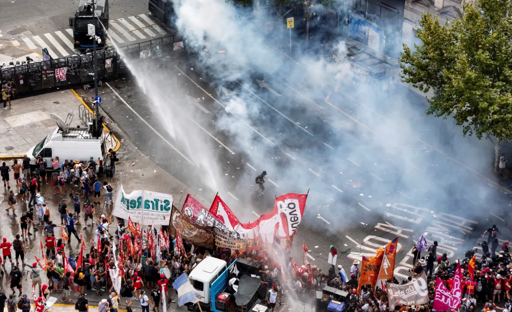
This Wednesday marked the first round in the battle against Argentina’s regressive labor bill as the legislation moves toward the Chamber of Deputies. While media outlets attempted to demonize the protests to obscure growing social opposition, a renewed militancy emerged, signaling a new stage in the fight against the law.
The day’s struggle took shape between two poles: on one side, the unpopular policies of the government and its economic backers; on the other, the perceived betrayal of the bureaucracy of the CGT — Argentina’s largest labor union federation —and the complicity of Peronism. Despite these obstacles, sectors were determined to resist push the movement forward. The Left has seen its role strengthened in this process, and the central challenge now lies in forcing an active national strike when the bill is debated in the lower house — a key step toward a broader popular mobilization and a general strike.
The Media Campaign vs. Social Reality
Even before the day had ended, major media outlets — alongside Senator (and former Security Minister) Patricia Bullrich — launched a fierce campaign to demonize the movement. Their goal was to hide the obvious: deepening social anger toward an economic plan that is pushing large sectors of the working class into increasingly precarious conditions, and a renewed willingness among workers and youth to fight back.
The government — which in just over two years has implemented “chainsaw” austerity, repressed social protest, passed laws concentrating economic power, and subordinated the country to the IMF — attempted to cast itself as a victim. Meanwhile, it continues to advance a reform that attacks the right to organize, facilitates layoffs, eliminates overtime, fragments vacation time, and extends the workday while reducing employer contributions to the national pension fund.
By evening, the government’s narrative began to unravel. After the initial crackdowns, thousands returned to the area around Congress, joined by workers arriving after work. They were met with indiscriminate repression, including tear gas, rubber bullets, and mass arrests.
While the government managed to pass the bill in the Senate, it failed its central objective: projecting an image of governability and calm to financial markets. The government and media operation have been widely questioned, revealing deep tensions. Rising inflation, combined with austerity, declining consumption, and job losses undermined official claims of stability. The streets were anything but peaceful. From social media, PTS (Socialist Workers’ Party) Deputy Myriam Bregman argued that brutal reforms inevitably generate resistance, and that the violence lies not in protest, but in imposing austerity through state repression.
The mobilizations expressed a rejection not only of the labor reform but of the government itself. Thousands took to the streets despite the CGT leadership, which has spent months negotiating with the government without calling for a national strike. Their limited call for mobilization — offered without a strike and granting “freedom of action” to individual unions — aimed to contain social pressure. Nevertheless, many workers and youth mobilized independently, even after working hours and amid the ongoing repression.
The protests were nationwide. In Córdoba, repression occurred under Peronist governor Martín Llaryora, while in the Senate, the reform advanced thanks to the quorum provided by the UCR, the PRO, and sectors of Peronism — the same actors who enabled previous measures like the “Omnibus Law.” These senators, maintaining privileges far removed from the daily reality of millions, reflect a political regime increasingly disconnected from the population.
A government marked by crisis and sustained by imperialist finance capital, alongside a fragmented and often complicit opposition, has led to the emergence of new combative sectors.
The Path Forward Is Working-Class and Youth Organization
What occurred on Wednesday was merely the first round of a broader confrontation. Even if the labor reform is ultimately approved, it will face fierce resistance wherever the state attempts to implement layoffs or precarity, as seen in ongoing conflicts at Lustramax and Garrahan Hospital.
In this context, the working class and youth can rely only on their own strength. The immediate challenge is to deepen organization in workplaces, schools, and neighborhoods, pushing from below for an active national strike. The PTS and the Left Front place themselves in this perspective, participating in ongoing struggles and building on months of solidarity with retirees, healthcare workers, disability collectives, and other sectors in this conflict.
The labor struggle was not resolved on Wednesday; rather, a new stage has begun. The nascent networks built in recent months will shape the next phase of mobilization as the debate moves to the Chamber of Deputies and social resistance continues to grow.
Originally published in Spanish on February 14 in La Izquierda Diario.
The post Argentina: Anger and Class-Struggle Confront Milei’s Reactionary Labor Reform Law appeared first on Left Voice.
From Left Voice via This RSS Feed.