

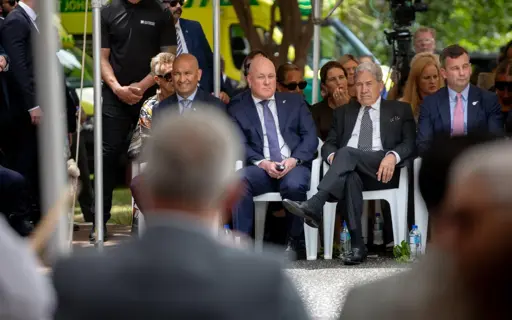

Prime Minister Christopher Luxon at Waitangi. (Photo: Mark Papalii/ RNZ)
At Waitangi this year, the prime minister structured his speech around the three articles of Te Tiriti, and explained what each article says and means.
The problem is that he was just plain wrong, writes legal scholar Carwyn Jones.
When the prime minister, Christopher Luxon, spoke at Waitangi last week, he set out a terribly distorted view of the country’s founding document, Te Tiriti o Waitangi. Here are some of the things he got wrong.
Article 1: Kāwanatanga
Article 1 granted the Crown the authority to establish a government to exercise some authority and regulation over the settler population here in Aotearoa. It did not grant the Crown any authority over Māori. Apart from anything else, that would have been inconsistent with the ongoing Māori authority guaranteed in Article 2.
Nevertheless, the grant of kāwanatanga was a significant concession by Māori. Less than five years earlier, in He Whakaputanga o te Rangatiratanga o Nu Tireni (the Declaration of Independence of New Zealand, 1835), Māori leaders had made it clear that there was no other legal, political, or constitutional authority in Aotearoa, apart from their own.
So, the prime minister was fundamentally incorrect when he described Article 1 as follows:
“It is the agreement that there is a Sovereign, and one government elected by and responsible for all New Zealanders.”
Māori agreed to no such thing. The Waitangi Tribunal has been explicit on this point:
“Our view is that, on the basis of what they were told, the signatories were led to believe that Hobson would be a rangatira for the Pākehā and they would retain authority within their own autonomous hapū . . .
Our essential conclusion, therefore, is that the rangatira did not cede their sovereignty in February 1840; that is, they did not cede their authority to make and enforce law over their people and within their territories. Rather, they agreed to share power and authority with the Governor.”
For the prime minister to claim that Māori agreed that one government should be responsible for everyone is pure invention.
Article 2: Tino rangatiratanga
The central concept in Article 2 is tino rangatiratanga. This is the fullest expression of independence and self-determination. It is a continuation of the existing Māori authority that had been recognised in He Whakaputanga.
In Article 2, the Crown guarantees that this authority will be maintained in relation to all those things that are highly valued. This is a guarantee of legal, constitutional, and political authority, not merely a protection of property rights.
It is a guarantee made by the Crown to iwi and hapū. It creates obligations on the Crown towards iwi and hapū, not the other way around.
It is, therefore, difficult to understand how the prime minister came to describe Article 2 as:
“The authority of iwi and hapū to fulfil their own obligations as partners to the Treaty . . .
It is a recognition not only of property rights, but of responsibility . . .
It is why iwi and hapū have a significant contribution to make to the protection of our natural environment.”
This is a markedly different meaning from that expressed in the Crown’s own Cabinet Office Circular on Te Tiriti o Waitangi / Treaty of Waitangi Guidance, which states:
“Put simply, by Article Two the Crown promises that Māori will have the right to make decisions over resources and taonga which they wish to retain.”
And “taonga”, we should remember, refers to all those things that are highly valued, not merely to physical property.
Consequently, the rights protected by Article 2 are hardly limited to “making a contribution” to protecting the natural environment, but instead provide real decision-making authority in all areas of public policy that affect Māori.
Article 3: Rights of citizenship
Article 3 is often referred to as the “equality” or “citizenship” provision. It includes aspects of both concepts.
It provides that Māori are entitled to the same rights as the settler population. As with Article 2, this is a guarantee made by the Crown to Māori. It doesn’t say anything about the rights of other New Zealanders.
Yet in his speech, the prime minister said this article refers to “that promise that we are all equal in the eyes of the state.”
Here, he again moved away from the language of the cabinet circular, which states:
“Put simply, by Article Three the Crown promises that its obligations to New Zealand citizens are owed equally to Māori.”
This is not at all the same as “we are all equal in the eyes of the state”. Rather, Article 3 is a promise that Māori would enjoy “all the rights and privileges of British subjects”, in addition to, not instead of, the promise of tino rangatiratanga.
The prime minister went further off track in discussing Article 3 by suggesting that a person’s ethnicity should not be relevant to healthcare decisions, among other examples.
Yet public health experts have shown that delivering effective and efficient healthcare in Aotearoa today must take ethnicity into account.
And the Waitangi Tribunal has explained why Te Tiriti and Māori rights are necessary considerations for achieving equitable health outcomes.
Moving beyond misinformation
The prime minister wrapped up his speech at Waitangi by saying: “Some people will take a different view of the Treaty to me. That’s fine.”
It’s true that people will have different views on the role of Te Tiriti in public life. They may disagree about whether the Crown ought to fulfil the promises it has entered into, and how it ought to do so. That’s fine.
However, none of that changes the text or meaning of Te Tiriti o Waitangi.
There are many important matters here that we ought to discuss and debate as a country, but a constructive and mature conversation can’t take place if the discussion is built on misinformation.

Dr Carwyn Jones. (Photo supplied)
Dr Carwyn Jones (Ngāti Kahungunu) is Pūkenga Matua (Lead Academic) of Ahunga Tikanga (Māori Laws and Philosophy) at Te Wānanga o Raukawa, and Honorary Adjunct Professor, Te Kawa a Māui (School of Māori Studies) at Te Herenga Waka Victoria University of Wellington.
The post What the PM said at Waitangi was wrong appeared first on E-Tangata.
From E-Tangata via This RSS Feed.
You must log in or # to comment.