

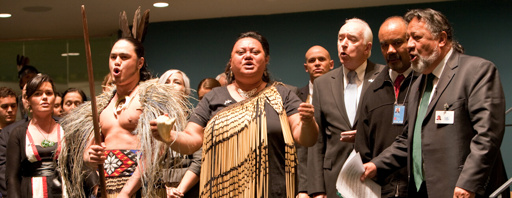

The New Zealand delegation at the UN in 2010, when New Zealand endorsed the United Nations Declaration on the Rights of Indigenous Peoples in 2010. (Photo: Broddi Sigurdarson/UNPFII.)
US President Donald Trump’s threats to colonise Greenland may be countered by Indigenous conceptions of diplomacy, writes Professor Dominic O’Sullivan.
Nanaia Mahuta’s first speech as New Zealand’s first female Māori Foreign Minister gave the international rules-based order a distinctively Māori interpretation. That interpretation remains especially valuable today, as a breaking down of rules, rights, and basic human decency characterises Donald Trump’s foreign policy.
Nowhere is this more evident than in Trump’s recent threats to make Greenland the subject of a new round of colonialism, just as the local Inuit peoples’ colonial relationship with Denmark appears to be coming to an end.
The rules-based order provides no guarantees, but it does at least give non-colonial aspirations a fair chance.
Greenland’s view of Indigenous self-determination and sovereignty goes beyond independent statehood. It relies on international co-operation to advance cultural, economic, and social interests. There is clear alignment with the foreign policy based on Māori values that Mahuta developed.
Comparing these ideas from Indigenous peoples at opposite ends of the world offers a more promising way of thinking about stability, peace, and prosperity.
Inuit people mainly settled Greenland around the 12th century, and their three linguistic and cultural groups account for 90 percent of the population.
Greenland is not a member of the European Union, but it is a member of NATO, whose insistence on rules-based diplomacy over the last few weeks has thwarted Trump’s imperial ambitions. That’s left military invasion as his only obvious path, which he has so far rejected in the face of international pressure.
In 1946, Denmark refused an offer from the United States to purchase Greenland for $100 million in gold, and Trump also tried to buy the territory during his first term in 2019. But Inuit are still not “for sale”.
Māori foreign policy and a doctrine of Indigenous diplomacy
New Zealand, like much of the liberal democratic world, is presently more inclined to timid and sometimes even sycophantic deference to Trump.
While there are economic and security reasons for this, there are also conceptions of fairness and justice — tika and pono — that should influence how a small nation like ours presents itself to the world and contributes to the international order.
As Mahuta put it, these values include:
Manaaki — kindness or the reciprocity of goodwill.
Whanaungatanga — our connectedness or shared sense of humanity.
Mahi tahi and kotahitanga — collective benefits and shared aspiration.
Kaitiakitanga – protection and stewardship of our intergenerational wellbeing.
These values make a significant contribution to an evolving international doctrine of Indigenous diplomacy, which is most comprehensively expressed in the UN Declaration on the Rights of Indigenous Peoples. Greenland, a strong advocate for the declaration, is implementing it with Danish support. Denmark was one of the 143 UN member states that voted to adopt the declaration in 2007. New Zealand, along with Australia, Canada and the US, voted against it, and 11 countries abstained.
In 2010, John Key’s government reversed New Zealand’s opposition, saying the declaration was an aspirational instrument. But under the 2023 coalition agreement with the National Party, New Zealand First insisted that the government stop work on implementation.
Nevertheless, the declaration provides an international relations framework to which Mahuta clearly wanted New Zealand to make a distinctive contribution. It remains of potentially great value to a world struggling to uphold basic humanity.
The declaration is part of the rules‑based order. It says that the rules of self‑determination — and the stability, security, and certainty these can bring — belong to Indigenous peoples as much as anyone else.
The declaration accepts that states have the right to govern. However, Denmark’s colonial authority over Greenland and its people is constrained by the territory’s powers of self-government. Over time, these powers have become more significant, and independent statehood is now a realistic ambition.
Elsewhere in the world — just as Te Tiriti’s rights of rangatiratanga and citizenship, grounded in equal tikanga, constrain the rights of kāwanatanga (government) — the declaration makes the rights of government conditional. Governments must respect Indigenous self-determination, culture, and equal participation in public decision-making.
State sovereignty is not, then, an absolute power over Indigenous nations. They have the right to maintain and strengthen “distinct political, legal, economic, social and cultural institutions”, as Article 5 of the declaration sets out.
These rights respond to an Indigenous claim to political space. Using their own cultural frameworks — not only in their relationships with the states that govern their territories, but also in their relationships with other states and with Indigenous political communities elsewhere — Indigenous peoples have a right to be present, and to contribute meaningfully, wherever public decisions are made.
As Mahuta said: “Underpinning all of our efforts are relationships, relationships, relationships — he tangata te mea nui. These are the building blocks for our international connections.”
Relationships underpin opportunities for people, not just nation states, to have a meaningful political voice. For Greenland, the most effective guard against US imperialism is its relationships with Denmark and its NATO allies, supported by the principle “Nothing about us without us”, the essential and founding presumption of its foreign, security and defence policy for 2024-2033.
The policy emphasises Greenlandic influence on international policies of decolonisation, self-determination and human rights. It refers to Greenland’s advocacy for the declaration and, more broadly, its promotion of substantive Indigenous participation in international forums, such as the Inuit Circumpolar Council, which it sees as an important site of extra-territorial sovereignty and diplomatic voice.
Sustainable development goals
Nanaia Mahuta also saw the UN Sustainable Development Goals as “a strong platform to initiate action that will create long-lasting impact” for Indigenous peoples.
In truth, however, the goals mention Indigenous peoples only twice — once, as peoples whose subsistence farming rights should be respected, and once as peoples whose vulnerability requires that they receive the state education system’s special attention. The goals don’t mention Indigenous self-determination, rights to culture, or rights to meaningful influence in public life.
However, when the declaration is used to critique the UN development goals and is treated as an instrument of international diplomacy, important possibilities arise from otherwise general statements about justice, peace, and the goals’ ultimate objective of “leaving no one behind”.
For example, Goal 16 asks what a just institution looks like and how institutions must work so that no one is left behind. It means that, at home and in international forums, Māori and Inuit people should be able to provide influential answers to questions such as: What does a just school, hospital or parliament look like? What does a just foreign policy look like, and how does it reflect our values and serve our interests as much as anybody else’s?
Contesting imperial claims
Indigenous diplomacy allows Indigenous peoples to set their own terms of engagement with the wider world. Not simply by responding to aggressive imperial claims from the White House, which has defended its position by saying: “We live in a world, in the real world . . . that is governed by strength, that is governed by force, that is governed by power . . . These are the iron laws of the world since the beginning of time.”
The alternative rules-based order could be crafted to open political spaces for substantive participation by Indigenous peoples as peoples of inherent agency. They could participate as shareholders in public authority, not as stakeholders to be consulted in someone else’s project.
A just, rules-based order could use the declaration as a guiding influence on world politics, where Indigenous peoples aren’t merely objects of financial transactions between states, or subjects of international law, but peoples of agency with a substantive presence in the definition and application of international law.
The declaration and the broad claims of indigeneity it expresses also mean that states can’t be the only sites of political authority. Sovereignty only works as a descriptor of political authority if it is defined more broadly. If it’s defined as only the power of the state, then it misses other spaces of authority where important decisions are made, or should be made — iwi and hapū, for example, and Indigenous assemblies or parliaments in other parts of the world. The concept of rangatiratanga within these contexts is also useful simply because a rangatira is the person who “weaves people together”.
Weaving people together is a more ambitious form of relational authority than a world governed by force. It’s worth pursuing for its contribution to the security of all peoples, not just some.
Greenland’s sole protection lies in adherence to a rules-based order.
Dominic O’Sullivan (Te Rarawa and Ngāti Kahu) is a professor of political science at Charles Sturt University, adjunct professor at the Auckland University of Technology and Victoria University of Wellington. Dominic is the author of nine books, including Te Tiriti, Equality and the Future of New Zealand Democracy, which Auckland University Press will publish in June 2026.
The post An Indigenous diplomacy is possible appeared first on E-Tangata.
From E-Tangata via This RSS Feed.