

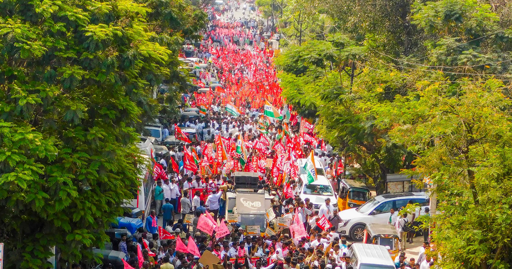
 On Thursday, February 12, an estimated 300 million workers, peasants, students, and professionals from diverse sectors mobilized across India, staging one of the largest coordinated actions in recent years. The nationwide upsurge was organized to defend labor and social rights and to protest the policies of the country’s far-right government.
The strike call was issued by the Central Trade Unions (CTUs), a joint platform bringing together India’s major labor federations, including the Centre of Indian Trade Unions (CITU), the All India Trade Union Congress (AITUC), the All India Central Council of Trade Unions (AICCTU), and the Hind Mazdoor Sabha (HMS), among others.
Responding to the call, workers halted production and services in thousands of coal mines, refineries, industrial plants, banks, and transport networks, with disruptions extending even to remote regions of the country.
The mobilization was not confined to industrial labor. Millions of farmers and agricultural laborers also joined the action under the banner of organizations such as the Samyukta Kisan Sabha (SKM) and the All India Agricultural Workers Union (AIAWA). Demonstrations were organized at district headquarters and village centers nationwide, highlighting the breadth of rural participation. In several states — including Kerala, Odisha, and Tripura — commercial activity came largely to a standstill, as businesses closed in solidarity with the strike.
Mass rallies were also held outside government offices, where thousands marched with banners, placards, and red flags, chanting slogans against government policies. Among the central demands was the revocation of recent trade agreements concluded by India with the United States and the European Union. The CTUs, SKM, and left-wing parties argue that these agreements compromise national sovereignty and undermine the livelihoods of millions of farmers by granting foreign agricultural products unrestricted access to Indian markets.
In addition, farmers and workers reiterated their demand for the withdrawal of a series of laws introduced by the Modi administration — including legislation concerning electricity and seed regulation — which they characterize as pro-corporate and detrimental to the broader population.
The strike received the backing of the country’s principal left parties, including the Communist Party of India (Marxist), the Communist Party of India (CPI), and the Communist Party of India (Marxist-Leninist) Liberation, among others, reinforcing the broad political support behind the nationwide action.
CPIM: Congratulations to Working Class on Successful General Strike
The Polit Bureau of the Communist Party of India (Marxist) congratulates the working class of our country on the successful general strike today. Peasants and agricultural workers joined the working class in protesting against the notification of the four labour codes, the virtual repeal of the rights based Mahatma Gandhi National Rural Employment Guarantee Act, along with other anti-worker, anti-farmer, and anti-people policies of the BJP-led Union government.
The working class made its voice heard loud and clear. The CPI(M) reiterates its solidarity with the workers, farmers, and agricultural workers who are protesting the various anti-people policies of the BJP government.
The government should immediately rescind the notification of the four labour codes and ensure that the hard-won rights of workers are protected. It should rescind the VB-GRAMG legislation, call back the proposal for privatisation of electricity distribution and withdraw the seed bill as well. It should also withdraw from the various Free Trade Agreements (FTAs) and trade deals it has signed, particularly with the US and Europe, as they are detrimental to the interests of Indian workers, farmers and people in general.
From In Defense of Communism via This RSS Feed.