

In the early hours of Thursday morning, the Argentine Senate passed President Javier Milei’s labor reform bill, with 42 votes in favor and 30 against. The bill is part of Miliei’s broader attempts to crush working class organization and resistance in a state where real wages have plummeted by more than 37 percent since 2017 and continue to fall despite efforts to curb inflation by cutting public service.
If passed by the Chamber of Deputies the bill would extend the standard work day to 12 hours, reduce overtime pay and severance, make it easier for employers to fire employees, and severely limit collective bargaining. It would also expand the numbers of workers deemed “essential,” and thus increase the number who are forbidden from going on strike.
The general vote took place at 1:30 a.m., after more than 14 hours of debate, during a day marked by last-minute negotiations in the corridors. Among those voting in favor were the same ultra conservative and centrist parties that had secured the quorum, most notably Milie’s La Libertad Avanza which cast the greatest share of votes in favor of the legislation. The votes against came, among others, from Peronist senators grouped around José Mayans or from dissident Peronists of Convicción Federal.
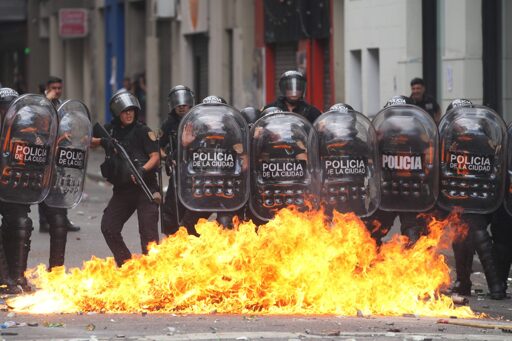
The Senate’s passage of the bill came amid protests by workers, labor unions, and anti-capitalist parties including the Socialist Workers Party (PTS), that began at 1 p.m. in front of the Capitol and continued throughout the afternoon. Police used water cannons and rubber bullets against protesters, many of whom responded with molotov cocktails and brickbats. Despite the government’s brutal crackdown, crowds continued to flock to the square late into the day to express their opposition to the legislation. This mobilization took place despite the imposition of a massive security apparatus that completely barricaded the Capitol building, projecting well the image of a government attempting to conceal from the public what it was about to vote on.
Negotiations on the bill have accelerated over the past 20 days, but in complete secrecy, with articles continuing to be amended until shortly before the vote, without anyone knowing what would be voted on. Interior Minister Diego Santilli, in particular, spent all day walking the halls of the Senate to continue the negotiations. This is a very broad bill, comprising more than 200 articles that modify essential aspects of labor law, the discussions were thus not subject to open debate, and certainly not in front of the workers who will be directly affected. However, the discreet negotiations among all parties allowed for the necessary adjustments to ensure the reform’s passage.
Among the concessions approved by Patricia Bullrich, former Minister of National Security and now Senator, were the elimination of the corporate tax cut that would have affected governors’ incomes (due to revenue sharing), a commitment not to touch union funds and the CGT’s social welfare programs, a guarantee of a bank monopoly on wage payments, and some modifications to the Employment Assistance Fund to prioritize SMEs. All of this was done without altering the “spirit” of the law, which constitutes a brutal attack on the working class.
In fact, the negotiations were so secretive that a change was added on Wednesday, further hardening the agreement for workers. If you become ill or have a health problem, you will no longer be paid for the day and will no longer be entitled to leave at 100% of your salary, but at 75% or 50%. When questioned by our sister publication, La Izquierda Diario, a senator who participated in all the negotiations with Patricia Bullrich revealed that this addition had been proposed by the liberal centrist Radical Civic Union (UCR).
A libertarian legislator also revealed that the government was in direct contact with the leadership of Argentina’s biggest union, the General Confederation of workers, or CGT. In fact the CGT leadership seems to have been directly involved in negotiations up to the point of providing very precise figures on the financial problems it was facing.
With the Senate vote, Milie’s Libertad Avanza has won the first legislative round of the labor reform. It must now face the Chamber of Deputies. The government intends to proceed quickly in the lower house in order to finalize the passage of the law by the end of the month. This haste is a sign of weakness: if the deadlines are extended, rejection and anger could intensify as the details of what the labor reform means for workers become clearer. In any case, after the first day of mobilization, which demonstrated strong anger, the challenge in the coming days is to build the prospect of a massive and widespread strike when the law is presented to the National Assembly, by imposing a serious battle plan from below to force the union leaderships, which has been conspicuously absent, to take action to kill the bill once and for all.
Originally Published in Spanish on February 12 in La Izquierda Diario.
Translated and adapted by Left Voice
The post Argentina Passes Anti-Labor Law Amid Fierce Protest and State Repression appeared first on Left Voice.
From Left Voice via This RSS Feed.