

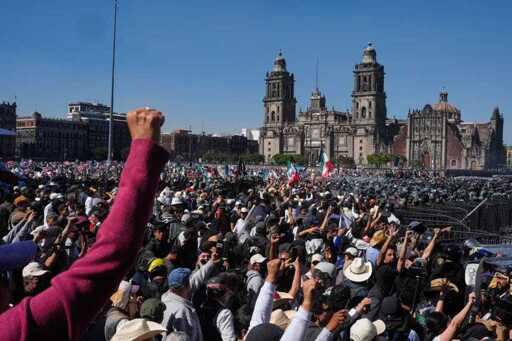
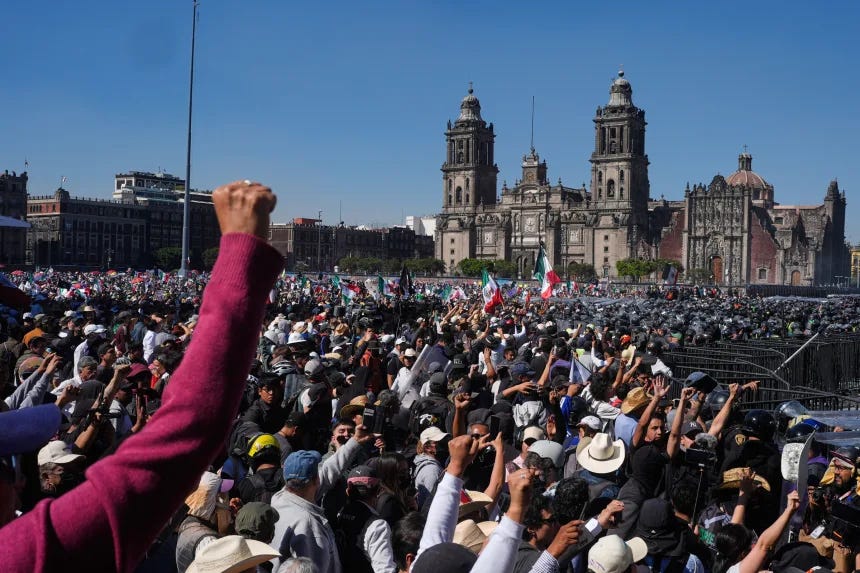
Zocalo Square Nov 2025, Marco Ugarte/AP
Mexico is facing a familiar problem—one that has shaped its history for more than a century. How do you protect your sovereignty when you live next door to a superpower that sees your country less as an equal and more as a strategic asset?
That question sits at the center of a wide-ranging discussion hosted jointly by CODEPINK’s WTF Is Going On in Latin America & the Caribbean and Soberanía, the Mexican Politics Podcast. Journalists and analysts Kurt Hackbarth and José Luis Granados use Mexico’s current moment to examine a broader set of pressures: economic coercion, foreign intervention, humanitarian crises, and the shrinking space for independent policy in a U.S.-dominated world.
Their conclusion is sobering. Mexico is buying time—but the costs of that strategy are rising.
CODEPINK Substack is a reader-supported publication. To receive new posts and support our work, consider becoming a free or paid subscriber.
A Conspiracy Theory With Dangerous Implications
The discussion opens with a claim that would be laughable if it weren’t so politically useful. In U.S. right-wing media circles, a theory has taken hold that Mexico’s 50 consulates across the United States are part of a covert plan to “take over” the country.
The allegation, promoted by conservative author Peter Schweizer and echoed by figures like Steve Bannon and Donald Trump, casts routine diplomatic offices as a national security threat. It collapses under even minimal scrutiny. Mexico maintains an extensive consular network because roughly 50 million people of Mexican origin live in the United States, many of them needing legal, labor, and immigration assistance. Large parts of the U.S. Southwest were once Mexican territory—hardly an obscure historical footnote.
But, as Hackbarth and Granados point out, the danger isn’t the claim itself. It’s what the claim enables.
Framing Mexican diplomacy as hostile feeds paranoia, legitimizes xenophobia, and helps justify harsher policies. And those policies are no longer theoretical. U.S. officials have openly discussed unilateral security interventions, including the possibility of drone strikes inside Mexico. In that context, misinformation becomes more than rhetoric—it becomes political cover.
As Granados dryly noted, if any embassy has a long record of interfering in other countries’ domestic politics, it is not Mexico’s.
Cuba, Oil, and the Cost of Solidarity
From there, the conversation turns to something far more immediate: Cuba’s deepening energy crisis. With Venezuelan oil shipments blocked and U.S. sanctions extending ever outward, Cuba’s fuel reserves are dwindling fast. The humanitarian consequences are measured in days, not months.
Mexico has historically taken a different position from Washington when it comes to Cuba. Since the Cuban Revolution, successive Mexican governments—across party lines—have opposed U.S. efforts to isolate the island. That stance has become a point of national pride, a quiet assertion of independence in a region long shaped by U.S. pressure.
Under President Claudia Sheinbaum, however, the risks of that position have grown sharper. The Trump administration has threatened 100 percent tariffs and even military action against any country that supplies oil to Cuba. Mexico has responded by temporarily suspending PEMEX oil shipments, while sending 536 tons of essential food items and 277 tons of powdered milk on February 8 at the risk of triggering U.S. retaliation.
It’s a delicate balancing act. Hackbarth warned that oil tankers could be seized—or worse. Granados countered that restraint carries its own danger. Every concession signals that coercion works, and every retreat makes the next demand easier.
Strip away the diplomacy, and the underlying issue is clear. Cuba’s crisis is not an accident. It is the product of decades of U.S. economic warfare—now enforced not just against Cuba itself, but against any country that dares to help.
Water, Trade, and the Rewriting of Old Treaties
Cuba is only one pressure point. Mexico is also facing mounting disputes over water, trade, and infrastructure.
A key flashpoint is a water-sharing agreement dating back to 1944, formally known as the Treaty for the Utilization of Waters of the Colorado and Tijuana Rivers and of the Rio Grande. Often called simply the 1944 Water Treaty, it governs how the two countries share water from their transboundary rivers and created the International Boundary and Water Commission to manage disputes.
For decades, the treaty has been seen in Mexico as one of the rare bilateral agreements that is reasonably fair. It has survived political swings, economic crises, and long stretches of diplomatic tension.
Now it’s under strain. Severe drought has hit northern Mexico and the U.S. Southwest alike. When Mexico sought emergency relief under the treaty for water-stressed cities like Tijuana, the U.S. response was blunt refusal, accompanied by public accusations and threats.
The fear in Mexico goes beyond immediate shortages. Reopening the treaty could mean renegotiating it under far less favorable conditions, especially given today’s power imbalances and the accelerating impacts of climate change.
Similar dynamics are playing out under the USMCA trade agreement. U.S. officials have pushed for greater influence over Mexican energy policy, foreign investment rules, and supply chains—particularly those involving China.
As Granados put it, none of this is happening in isolation. It’s pressure applied across multiple fronts, designed to extract concessions piece by piece.
Rare Earths and the New Resource Scramble
That strategy is especially visible in the scramble for rare earth minerals.
Mexico has entered preliminary agreements aimed at facilitating exports of rare earths to the United States, part of Washington’s broader effort to secure supply chains and reduce dependence on Asia. That push was publicly framed through initiatives such as Secretary of State Marco Rubio’s Inaugural Critical Minerals Ministerial, held on February 4, 2026, at the U.S. State Department.
The meeting brought together representatives from more than 50 countries (including Mexico) and the European Commission, all focused on diversifying access to lithium, rare earths, and other materials deemed essential to national security and energy transition technologies. While presented as cooperative, the message was clear: allies and neighbors are expected to align their resource policies with U.S. strategic priorities.
For Mexico, the implications are significant. Under former president Andrés Manuel López Obrador, the country nationalized its lithium reserves, asserting state control over critical resources. But those reserves—many located near the U.S. border—remain highly attractive to multinational corporations as Washington looks for alternatives to Chinese supply chains.
Hackbarth offered a blunt warning. Becoming economically “indispensable” to the United States has rarely protected countries from interference. More often, it invites it.
Taxing the Powerful—and the Politics Required
Not all the news is grim. The discussion also highlights a rare domestic victory: a landmark court ruling against billionaire Ricardo Salinas Pliego.
Salinas Pliego, the founder and chairman of Grupo Salinas, controls a vast business empire that includes TV Azteca, Banco Azteca, and major retail and telecommunications interests. For decades, he has embodied Mexico’s oligarchic class—immensely wealthy, politically connected, and largely insulated from accountability.
Tax authorities accuse him of owing billions of pesos in back taxes, liabilities he has fought through an intricate web of legal appeals. His case became a symbol of a broader system in which elite figures used the courts to delay payment indefinitely, exploiting a judiciary widely viewed as friendly to corporate power.
The ruling against Salinas Pliego was only possible after sweeping judicial reforms and Morena’s supermajority in Congress. As Granados emphasized, taxing the rich isn’t a slogan. It requires power, institutions, and political will.
Even so, the victory has limits. The most egregious cases will eventually run out, and meaningful fiscal reform remains politically explosive in a country where economic elites are accustomed to impunity.
Building a Welfare State Under Siege
All of this is unfolding as President Sheinbaum pursues an ambitious domestic agenda. Her government is pushing to integrate healthcare systems, expand public transportation, and invest heavily in social welfare and infrastructure after decades of neoliberal austerity.
New commuter rail lines are already slashing travel times. Healthcare reforms are allowing patients to access services across systems. These projects have tangible effects on daily life—and they help explain Sheinbaum’s cautious foreign policy. Protecting the domestic transformation means avoiding a direct confrontation with the United States.
Still, both journalists express unease. Latin American history is filled with reformist governments that tried to build humane systems while holding off external pressure—only to be destabilized, sanctioned, or worse.
The Primary Contradiction
In the end, the discussion circles back to a central reality. Mexico’s greatest threat does not come from a weak domestic opposition. It comes from outside its borders.
Conspiracy theories about consulates, pressure over Cuba, disputes over water and trade, and the scramble for resources all point in the same direction. Mexico sits at a geopolitical crossroads, tethered economically, culturally, and geographically to a superpower increasingly willing to discard international norms when they become inconvenient.
Whether Mexico can continue to walk that line—protecting its people, supporting regional solidarity, and resisting imperial overreach—remains an open question. What is clear is that the stakes are rising, and the margin for error is shrinking.
Stand in Solidarity with Cuba! Join the Join the Nuestra America Flotilla Today!
Teri Mattson currently works with the Venezuela Solidarity Network. She is an activist with the SanctionsKill coalition and CODEPINK’s Latin America team. Her writing can be found at Anti-War.com, CommonDreams, Jacobin, and LAProgressive. Additionally, she hosts and produces the YouTube program and podcast WTF is Going on in Latin America & the Caribbean.
From CODEPINK Substack via This RSS Feed.
Canada has your back Mexico. We are in this together. Let’s strengthen trade between us and cut out the middle man. We got some good shit up here, you got some good shit down there, let’s dance!
