

Police forces that made arrests under the Palestine Action ban could be hit with a wave of lawsuits following the group’s “monumental victory” in court, legal experts have said.
While the full implications of the high court ruling aren’t yet clear – the ban is still officially in place and the government plans to appeal – Novara Media understands that protesters who resisted the group’s proscription are already being encouraged to explore the possibility of legal redress.
A lieutenant with the Metropolitan police told Novara Media officers would no longer make arrests of people holding placards expressing support for the group.
The verdict handed down on Friday 13 February found the proscription of Palestine Action to be unlawful on two grounds. Firstly, that it disproportionately impacts free speech and, secondly, that then-home secretary Yvette Cooper breached her own policy in the proscription process.
A three-judge panel made up of Dame Victoria Sharp, Dame Karen Steyn and Sir Jonathan Swift ruled that Cooper had failed to carry out a ‘proportionality’ test correctly and did not take into account the impact the decision would have on the right to protest.
The three judges deliberated for over two months on the landmark judicial review brought by Palestine Action’s co-founder Huda Ammori. Sharp is the most senior judge in the administrative court and has been president of the King’s Bench Division of the high court of justice since 2019.
While reading the 46-page judgement, Sharp said: “A very small number of Palestine Action’s activities amounted to acts of terrorism within the definition of section one of the 2000 Act. For these, and for Palestine Action’s other criminal activities, the general criminal law remains available.
“The nature and scale of Palestine Action’s activities falling within the definition of terrorism had not yet reached the level, scale and persistence to warrant proscription.”
The government plans to appeal the high court’s decision, and the judges stressed that the ban on Palestine Action will remain in place ahead of a potential appeal and another hearing later in the month.
The Met has said the ruling places them in an “unusual” position and officers will focus on “gathering evidence” of offences where support for Palestine Action is expressed “to provide opportunities for enforcement at a later date” rather than making arrests.
Ammori called the ruling a “monumental victory” and urged the government to “respect the court’s decision and bring this injustice to an end without further delay”.
Amnesty International UK echoed her sentiment by “strongly urging” the government to rethink its appeal.
Tom Southerden, Amnesty International UK’s director of law and human rights director, told Novara Media: “We think [the government] should respect this decision, drop the case, leave it here. This has been a disastrous mistake. Thousands of people have been arrested. It needs to end today.”
The ban means being a member of or showing support for the direct action group – which targets business complicit in Israel’s genocide in Gaza – is an offence punishable by up to 14 years in prison.
The judicial review brought by Ammori marks the first time in British history that a proscribed group has been able to legally challenge proscription in this way.
Responding to the ruling, former Labour leader Jeremy Corbyn told Novara Media: “This is a vindication for those who had the courage and humanity to oppose genocide. This government thinks it can shield itself from accountability for the role it has played in one of the greatest crimes of our time. Today’s historic judgment proves it will not succeed.”
Current home secretary Shabana Mahmood posted on X that she will “fight this judgment in the court of appeal”, writing: “The court acknowledged that Palestine Action has carried out acts of terrorism. It concluded that its actions are not consistent with democratic values and the rule of law.
“Supporting the Palestinian cause is not the same as supporting Palestine Action. The government’s proscription followed a rigorous process, endorsed by parliament.”
Jonathan Purcell, head of public affairs and comms from the International Centre of Justice for Palestinians, dubbed the verdict “a common sense ruling that’s on the side of free speech and civil liberties” and blasted the government’s move to appeal as “a farce”.
What does the verdict mean in practice?
As the proscription of Palestine Action has been ruled unlawful, a legal expert from Cage International told Novara Media this means the thousands of arrests and hundreds of charges against people protesting the ban should never have taken place, because the law itself was unlawful.
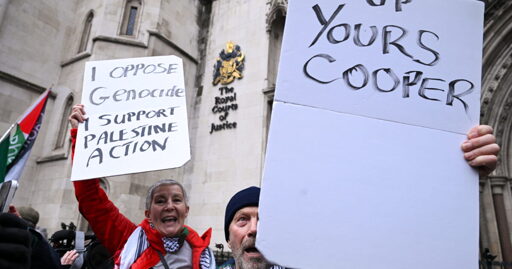
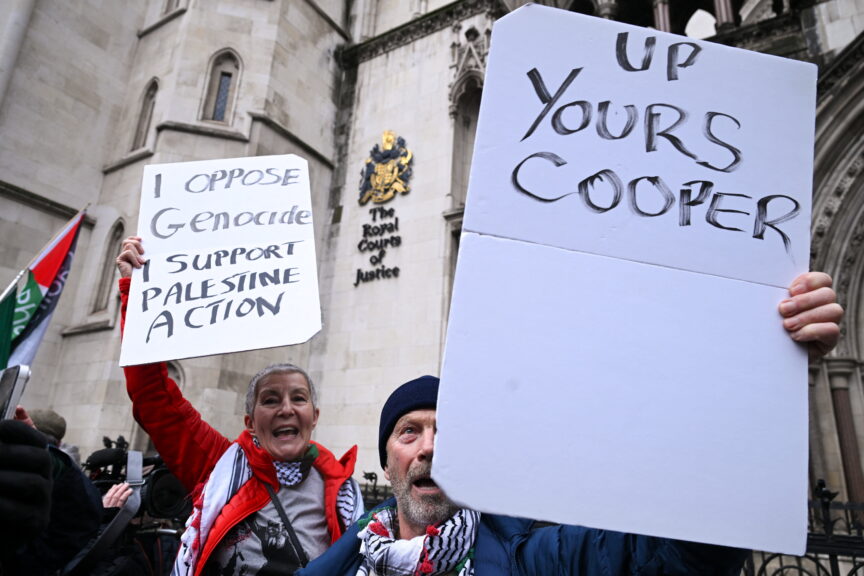
Once the ban is fully lifted, the actions of thousands of people holding placards that read: “I oppose genocide. I support Palestine Action” will be treated as perfectly lawful – as if the ban had never happened.
People who have been arrested under the Terrorism Act will also have grounds to sue the relevant police force once the proscription order is fully quashed.
Police forces could be opened up to “thousands of legal claims”, former government lawyer and co-founder of Defend Our Juries Tim Crosland told Novara Media.
“The basic principle is if the underlying order is unlawful, then any arrests, any raids, any prosecutions that are based on that order – they are unlawful, too,” Crosland said.
“It doesn’t kick in just yet, because the order hasn’t actually been quashed. But ultimately, if the high court decision stands and isn’t overturned, then yes, in principle, that’s thousands of legal claims against the police, maybe against the Home Office too, for unlawful arrest.”
Crosland added that the scale of financial consequences could be huge, even at a conservative estimate of £10,000 per person.
Another legal expert was more pessimistic in outlook, however, warning that even if the government’s appeal fails, legal action is theoretically possible but without precedent and unlikely to result in success.
Amnesty’s Southerden told Novara Media: “If the proscription was unlawfully made, as they ruled today, that proscription should not stand, and the criminal offences that go with it should not exist.”
What has happened since the Palestine Action ban?
The controversial proscription led to more than 2,700 arrests at protests, with elderly and disabled people, former priests and an RAF veteran arrested and carried away by groups of police officers. A man holding a Private Eye cartoon and a man wearing a t-shirt that read ‘Plasticine Action’ have also been arrested under the ban.
Even Metropolitan police officers have criticised the ban. Several told Novara Media on condition of anonymity that they felt “ashamed and sick” for arresting disabled people as terrorists.
“Instead of catching real criminals and terrorists, we are arresting pensioners and disabled people calling for the saving of children’s lives,” a Met officer said. “It makes me question why I’m even in this career anymore.”
The police federation said officers were “emotionally and physically exhausted” and the “relentless” demand for policing wasn’t sustainable.
There have been more arrests made under UK terror law since Palestine Action was proscribed in July 2025 than during the entire ‘war on terror’.
Asim Qureshi, research director at Cage International, told Novara Media: “The Defend Our Juries civil disobedience rightly pointed to the ridiculous use of terrorism legislation to undermine direct action in the UK. Instead of stopping the weapons from leaving the UK and being directly involved in a genocide, they have sought to criminalise those acting with their conscience.”
Ammori was granted a judicial review by justice Sir Martin Chamberlain in a landmark ruling back in July. The government unsuccessfully attempted to appeal his decision in September – and Ammori was granted two further grounds on which to challenge the legality of the ban, in addition to the two initially granted by Chamberlain.
Ammori’s legal challenge, which was heard over three days from 26 November to 2 December, was brought on four grounds: the proscription of Palestine Action interferes disproportionately with the rights to free speech and assembly; the home secretary failed to consult with Palestine Action before making her decision; the Home Office failed to consider relevant factors – including the level of public support for Palestine Action; the ministry failed to comply with its own policy when deciding to proscribe.
Sharp, Steyn and Swift were swapped in unexpectedly in November, replacing Chamberlain. The three judges’ pro-government and pro-Israel connections led campaigners to condemn the process as a “stitch-up”.
The judicial review included witness statements from Irish author Sally Rooney, human rights groups Amnesty International and Liberty, UN special rapporteur on protecting human rights Ben Saul, and Novara Media.
Defend Our Juries organised two weeks of mass civil disobedience events across 20 towns and cities to coincide with the review.
Why was Palestine Action proscribed?
Then-home secretary Yvette Cooper proscribed Palestine Action as a terrorist organisation after a Commons vote in which the direct action group was ‘bundled’ in with two white supremacist organisations – the Maniacs Murder Cult and the Russian Imperial Movement.
Palestine Action’s aim is to end global participation in Israel’s “genocidal and apartheid regime” in the Occupied Palestinian Territories. Israel’s genocidal war on Gaza has killed, at a conservative estimate, 72,000 Palestinians and wounded 171,000 since October 2023.
Proscription put Palestine Action in the same category as Al Qaeda and Isis. It was the first time in British history that a direct action group had been branded a terrorist organisation.
Cooper told parliament in June that she intended to proscribe Palestine Action following its “aggressive and intimidatory attacks against businesses, institutions and the public, which has crossed the thresholds established in the Terrorism Act 2000”.
Under UK law, counter-terror legislation defines terrorist acts as including “serious damage to property”.
The ban came after an alleged break-in by five activists at an RAF airbase in Brize Norton, during which two planes were sprayed with red paint in June 2025. But Keir Starmer’s Labour government was considering a ban as early as March the same year.
Documents seen by Declassified from this period show that the Joint Terrorism Analysis Centre (JTAC), based within MI5, concluded that “the majority of direct action by Palestine Action would not be classified as terrorism… but does often involve criminality”. They also showed that the government’s own Proscription Review Group (PRG) concluded a ban would be “novel and unprecedented” due to there being “no known precedent of an organisation being proscribed… mainly due to its use or threat of action involving serious damage to property”.
The JTAC and PRG found the threshold to ban the group had been met based on three out of a total of 385 incidents involving “serious property damage” to arms factories.
A Channel 4 Dispatches documentary that aired this week questioned whether claims of a link between Palestine Action and Iran were used to obscure the fact that the actual basis for the ban was criminal damage.
The government’s independent reviewer of terrorism legislation, Jonathan Hall KC, who consulted on the ban, told the programme the government’s press briefings linking Palestine Action to Iran were “wrong”, adding he was “not aware” of any evidence to support the claims.
The Iran link claims, widely disseminated among the mainstream press, were planted by a PR firm, according to a report in Private Eye magazine.
From Novara Media via This RSS Feed.