

Article Summary
• The MARA Act would enable commercial-scale demonstration projects of all types— finfish, seaweed, and shellfish—in federal waters (3 to 200 nautical miles offshore).
• Supporters say it’s needed as a first step toward cutting red tape and reducing U.S. reliance on imported seafood. They also point out the need to feed a growing population, and that the open ocean is a more stable environment for raising seafood than are coastal waters.
• Opponents fear that offshore farming could repeat the mistakes of large-scale coastal fisheries and argue that other acts being considered by Congress could encourage local fish processing and distribution, cutting the need for imports.
• So far, there’s little research on the ecological impacts of submersible pens in deep ocean water. The act is intended to promote science-backed pilot projects with stringent oversight.
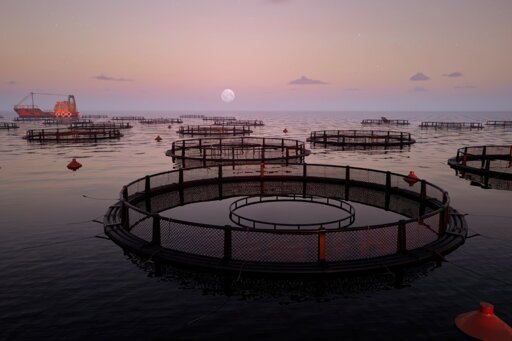
Half a mile off the Big Island in Hawaii, where the currents run swift and the depths reach 200 feet, Blue Ocean Mariculture raises kanpachi (Seriola rivoliana), a native Hawaiian yellowtail, in what is the United States’ sole open-ocean, commercial finfish farm.
Small in comparison to coastal Norwegian salmon farms, with annual combined exports of 1.2 million tons, Blue Ocean Mariculture produces about 1,100 tons of fish annually in net pens submerged 30 to 130 feet under water. Roughly half the fish is sold to distributors and stores in Hawaii, while the rest goes to markets on the U.S. mainland, according to Taylor Korte, vice president of marine operations at Blue Ocean Mariculture.
The company’s conservation efforts have earned it Seafood Watch’s rank of yellow, or a good alternative to endangered species like bluefin tuna, but not quite as stellar as a green ranking for sustainably harvested seafood, like farmed mussels or Arctic char. Blue Ocean kanpachi, a rich, mild-flavored, versatile fish, is on the menu in restaurants across the country, from Mama’s Fish House in Maui to Sugarfish in New York and California, where it’s served raw as sashimi or ceviche—or baked, grilled, or steamed.
Although it is close to shore, Blue Ocean Mariculture is considered an environmental and economic model for very deep open-water aquaculture. And now, it has become the poster child for the Marine Aquaculture Research for America (MARA) Act.
The MARA Act creates a pathway for permitting pilot systems to get them in the water, where they can be researched following rigorous criteria.
The bill was introduced last fall to develop aquaculture of all types (finfish, seaweed and shellfish) in federal waters, defined as 3 to 200 nautical miles offshore. The bill has strong bipartisan support and could advance in the Senate as early as March, Maddie Voorhees, U.S. aquaculture campaign director for the Environmental Defense Fund (EDF), told Civil Eats.
The MARA Act is the latest bill to reflect a decades-long drive, largely by industry groups such as the Stronger America Through Seafood Coalition, to advance U.S. aquaculture in the open ocean. Coalition members include Cooke Aquaculture, one of the world’s largest aquaculture companies, responsible for the 2017 fish escape disaster in Puget Sound; big feed businesses like Cargill and JBS; and Sysco, a food service giant.
MARA Act champions say the law is needed to cut red tape and reduce U.S. reliance on imported seafood. Opponents of industrial fish farming fiercely push back on the proposal and say there are better ways to boost consumption of domestic seafood.
While the MARA Act rehashes prior bills—like the 2020 AQUAA Act and the 2023 SEAfood Act, which failed to pass because they couldn’t garner enough support or overcome the opposition—it differs in that it includes more robust provisions for researching the ecological and economic viability of offshore aquaculture operations before fully authorizing them. In essence, the MARA Act creates a pathway for permitting pilot systems to get them in the water, where they can be researched following rigorous criteria laid out by the law and with substantial stakeholder oversight.
With the high level of discord and chaos in the country right now, it’s anyone’s guess whether Congress will be able to focus on passing the bill this year. But one thing is certain: The bid to develop offshore aquaculture is not going away. And neither are its opponents.
The Continued Push for US Aquaculture
Offshore aquaculture proponents’ central argument is that it will help the country lessen its dependency on seafood imports. The U.S. now imports 90 percent of the seafood it consumes, half of it farmed, but that’s partially because the country has lost much of its processing infrastructure and sends most of its catch to other countries for cleaning, filleting, freezing, canning, and smoking.
As Voorhees sees it, we already consume lots of farmed seafood. “We’re just not involved in the regulatory process of making sure it’s sustainable,” she said. “There’s a big question about our ability in the U.S. to become leaders and follow the science and see how we can do it well.”
U.S. aquaculture is puny by global standards, and proponents like Michael Coogan, research assistant professor at New Hampshire University’s Center for Sustainable Seafood Systems, see opportunity. “The U.S. produces 0.2 percent of the world’s aquaculture, which is insane, because we have the largest exclusive economic zone in the world, 200 nautical miles all around our entire coastline that we can work with,” he said.
“There’s a big question about our ability in the U.S. to become leaders and follow the science and see how we can do it well.”
Of course, there are other ways to close the seafood import gap, including by investing in our own seafood processing capacity. The Domestic Seafood Production Act, introduced into the House of Representatives in 2024 but not yet voted on, would provide resources for working waterfronts to invest in processing, as well as distribution infrastructure to support local food systems. It could help Americans reconnect with less familiar wild-caught species that are now largely exported.
Another central argument advanced by MARA Act advocates is that the law is needed to clarify the convoluted regulatory pathway for offshore aquaculture. At present, there are more than 60,000 regulations set by multiple agencies. That’s three to 70 times more than in any other food production sector, including beef and wild-caught fish, according to doctoral research by Margaret Hegwood at the University of Colorado at Boulder, which will be published this year.
“There’s no consolidated piece of legislation [for aquaculture] like wild capture [of seafood] has with the Magnuson-Stevens Act,” said Halley Froehlich, associate professor of aquaculture and fishery sciences at the University of California Santa Barbara.
The lack of a clear regulatory pathway is also why there are currently no commercial aquaculture producers in federal waters, although a few, including Ocean Rainforest, a kelp farm off Santa Barbara, and Velella Epsilon, a red drum producer in the Gulf of Mexico, are deep into the process of seeking permits.
Offshore aquaculture proponents also want to scale up ocean-based proteins to feed a growing world population, because seafood often has a lower greenhouse gas footprint than land-based proteins like beef. And, they say the open ocean offers more space and a more stable environment for growing seafood than do coastal waters, which have many competing uses and are more vulnerable to storm surges.
“The shallower the water, the smaller the body of water, the larger the impacts are going to be” from big storms or hurricanes, Coogan said.
Submersible high-tension nets, like those used by Blue Ocean Mariculture, are engineered to withstand storms, and they can dig down deeper into the ocean if a big storm comes through, he said, adding that a lot of the wave energy is lost at a depth of about 30 feet. Such nets may help reduce escapes, one of the major concerns with finfish farming, though there is little data on this.
Diving Into the MARA Act
The MARA Act would enable commercial-scale demonstration projects of all types—seaweed, shellfish, and finfish—in federal waters. Only species that are native or “historically naturalized” (i.e. thriving in the wild) are eligible. That means no Atlantic Salmon in the Pacific.
Also, the act directs the National Oceanic and Atmospheric Administration (NOAA) to create a program, with external research institution oversight—including by the National Academies of Science—for studying the farms’ impacts and economic potential over a ten-year period. The act streamlines and clarifies the regulatory process for permitting aquaculture in federal waters, codifies into law NOAA’s authority over aquaculture, and strengthens the agency’s strategic plan for aquaculture.
The bill’s science-based approach won the backing of the EDF and its Coalition for Sustainable Aquaculture. They joined forces with the Stronger America Through Seafood Coalition in a letter of support to Congress signed by 140 representatives of research institutions, along with aquaculture and food companies—but notably no other conservation or environmental groups.
“The MARA Act gives us the science-driven space to research this and help build a domestic seafood industry that we can really trust,” Voorhees said. “We need these commercial-scale demonstration projects [because] we don’t have the data to say [whether] this is the right move for the U.S. and that it’s going to be safe and environmentally sound. But we also don’t have the data to say that it’s not.”
“We don’t have the data to say [whether] this is the right move for the U.S. and that it’s going to be safe and environmentally sound. But we also don’t have the data to say that it’s not.”
Fish-farming opponents scoff at the research provisions in the bill and say there’s already enough science documenting the myriad problems with finfish aquaculture: fish escapes, disease, antibiotic use, waste accumulation, and reliance on wild fish for feed, with heavy impact on those fisheries and the communities they sustain.
“The evidence is pretty clear that it’s a bad operating model,” said James Mitchell, policy director of Don’t Cage Our Oceans, a campaign led by the North American Marine Alliance (NAMA). NAMA also sent a letter to Congressional leaders opposing the bill, signed by 420 fishing groups, food advocacy and conservation organizations, farmers, aquaculture producers, chefs, tribal groups, and others.
“The MARA Act is not ‘Let’s study everything first.’ It’s putting them in the water, letting them get a foothold, and then later saying, ‘What are some best practices we can learn from this?’ ”
But it’s a bit of a chicken and egg problem, said Froehlich, at the University of California Santa Barbara. “People are asking, what is [the farm] going to do in the water in this particular context? But there’s no permit that allows you to get anything in the water and [do the research]. You can’t have it both ways.”
Froehlich also points to more recent advances in aquaculture, like more efficient feed production, that are addressing some of its challenges.
Fish farm opponents further claim the bill is an industry giveaway, but that’s not how Neil Sims, a marine biologist and aquaculture entrepreneur who cofounded Blue Ocean Mariculture and other ventures, views it. The MARA Act “is compromise legislation for the industry, not what I would have originally liked to see.”
Sims frets about “the limited number of farms of limited scope,” and the lengthy, step-by-step process that will take ten years before a facility is given the green light. The reporting requirements and university oversight are “a lot heavier regulation and closer monitoring than is needed from my perspective,” he said.
Still, Sims acknowledged, “that’s probably what’s needed at this stage—complete transparency.”
Why Does the Push for Offshore Aquaculture Keep Failing?
Opposition to coastal finfish farming is substantial in the U.S., based on well-documented problems in the salmon industry, and that leads to wariness about developing farms in deeper ocean waters. Mitchell, for example, cites a special 2024 issue of Science Advances, devoted to aquaculture, that included ten articles and essays documenting the negative impacts of the practice—including fish-based feed that depletes wild fisheries; animal welfare; water pollution; and impacts on wild fish, among them the spread of disease.
There is scant research, however, on the ecological impacts of submersible pens in deep ocean water. Studies on submersible systems in Panama and Puerto Rico have found little environmental effect on either the water column or the ocean floor, but they warn of possible impacts if the operations grow larger.
Blue Ocean Mariculture has been collecting environmental data, including on shark and marine mammal interactions, for nearly two decades and is partnering with two university researchers to publish the data this year. Those studies will help advance the science on these kinds of systems.
“We would really need some assurances that the farm product isn’t going to out-compete the wild product.”
Pushback can also come from the commercial fishing industry and from coastal communities who fear potential pollution problems. Finfish species for offshore aquaculture need to be carefully selected to not conflict with wild-caught fisheries, said Eric Brazer, deputy director of Gulf of America Reef Fish Shareholders’ Alliance, citing red snapper as an example of an important species for commercial fishers that should not be farm raised in the Gulf.
“We would really need some assurances that the farm product isn’t going to out-compete the wild product,” he said.
Fisher organizations worry, too, about competition over NOAA’s limited resources and ability to regulate effectively.
“We’re already struggling with financial and resource limitations on the wild fish management side [at NOAA],” Brazer said, citing ten Gulf fishery management rules they are waiting for that have “gotten lost in the process somewhere.”
Nevertheless, Brazer said that his organization generally supports offshore aquaculture, especially after NOAA included them as stakeholders in the process for siting aquaculture opportunity zones in the Gulf. “We think that if it’s done right, you can have sustainable offshore finfish aquaculture and sustainable wild harvest fisheries living together, but you have to involve commercial fishermen.”
While Brazer worries that NOAA’s resources could be drained by offshore aquaculture, Froehlich worries about the agency’s ability to set strong criteria for evaluating the demonstration projects under an administration that is dismantling regulations and disregarding rules and norms.
“The Mara Act looks great in normal times, but what we are experiencing is not normal right now,” she said.
Not All Aquaculture Is the Same
Finally, there is a public misunderstanding that aquaculture is all the same, and a lack of knowledge about what the MARA Act covers. Aquaculture is not just finfish, and it’s not all large scale. Smaller-scale seaweed and shellfish farms such as the Ocean Rainforest kelp project could also be placed in federal waters.
Coogan is experimenting with a mussel and scallop farm that’s 2.7 miles offshore as an example of what could be built in federal waters. The farm is 130 acres, larger than what he would have been able to secure along the coast, and lies at a depth of 150 feet. The mussels are raised on vertical lines and the scallops are grown in cages.
“All or nothing when it comes to food is not really how it works.”
“Aquaculture in general, people just think it’s bad,” said Froehlich. “They don’t recognize the diversity. And just like any kind of food system, it will have an impact, but the relative amount is dictated by who is doing it, how it’s being overseen, how it’s monitored, and where that data goes.”
Froehlich authored an opinion piece that laid out more recent advancements in aquaculture and went toe-to-toe with the Science Advances issue. “There are still big challenges in aquaculture, like disease. But ignoring the improvements already made and not focusing on how to improve the real issues is frustrating. All or nothing when it comes to food is not really how it works.”
Is Blue Ocean Mariculture a Viable Model?
Voorhees cites the small-scale Blue Ocean Mariculture as the model for what the MARA Act could achieve. Limited studies suggest that farming in the open ocean has less impact on the environment, though siting and the number of facilities in a given area are important considerations.
The swift currents around the Blue Ocean Mariculture farm keep the fish healthy, Korte said. He added that the company does not use antibiotics or pesticides to treat diseases or parasites, though it does treat the fish for skin flukes, or worms, with hydrogen peroxide. The company chose the site carefully, he said, considering the hydrology—the water’s depth and flow around the site—and how nutrients might disperse into the surrounding environment.
Feini Yin, communications director at NAMA, questions the economic viability of small farms. She worries they will have to grow to be profitable, and that if they expand, their environmental impact will increase. Consolidation in the salmon industry gives cause for concern.
In response, Korte told Civil Eats that the company is “cash positive on different months.” Its core operational profitability is pretty good, he said, “but we do have a lot of capital expense,” and the company is “in a slow growth phase” as it proves out its economics and market acceptance.
Korte said the company does not have big expansion plans at its Big Island site. However, it envisions developing similar farms in other U.S. locations. “Our current goal is [1,650 tons] by the end of 2028, and that’s a great model for an economically and ecologically viable farm,” he said, adding that he thinks that farms that size are a “viable economic solution for growing the seafood industry in the U.S.”
Indeed, small-scale producers in many segments of U.S. aquaculture are profitable, Carole Engle, an aquaculture economist at Virginia Agriculture and Research Extension Center, told Civil Eats. “It all depends on them building an effective business model that takes into account the generally higher costs of small-scale production when they design their overall marketing plan.”
With big food businesses and their investors pushing for offshore aquaculture, it seems unlikely, however, that the MARA act will result in the creation of many small-scale, sustainably oriented farms. Indeed, the Act does not set size parameters for the commercial demonstration projects it will authorize. NOAA will do that.
“A lot of farmers go into aquaculture because they want to do something connected to nature and don’t want to hurt the environment. That’s not the case for everybody,” Froehlich said. “Who is involved in the aquaculture process and who’s benefiting from it matters a lot.”
The post Bipartisan Bill Seeks to Advance Offshore U.S. Aquaculture appeared first on Civil Eats.
From Civil Eats via This RSS Feed.