


Dan Ninham
Special to ICT
By day, Naomi Lang is a teacher at the Chandler Ice Den in Chandler, Arizona. On a recent night, she was watching the television coverage of the figure skating ice dance qualifiers for the 2026 Milan Cortina Olympics.
Lang was a major force as a competitive ice dancer and represented the United States repeatedly in international arenas. She was a five-time national champion and placed in the top 10 in each of five world championships.
She also became the first Native American woman to represent the United States in the Winter Olympics as a member of the U.S. team in 2002 in Salt Lake City, Utah.
She went on to skate professionally in shows across the United States, Europe and Russia, and in 2023 was inducted into the North American Indigenous Athletics Hall of Fame.

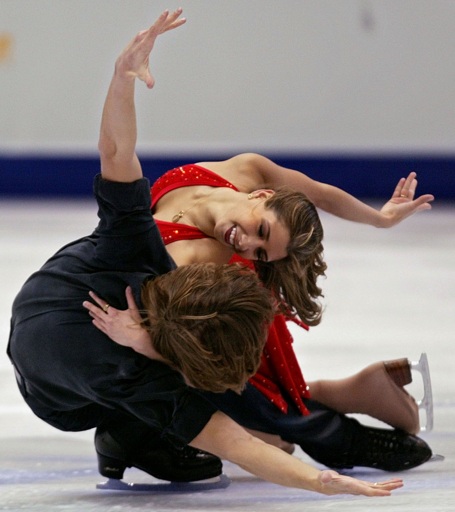
Favorites Naomi Lang and Peter Tchernyshev perform during the compulsory dance at the U.S. Figure Skating Championships on Jan. 9, 2002, in Los Angeles. Credit: AP Photo/Mark J. Terrill
Today, Lang continues to empower young skaters as she has for 20-plus years, encouraging them to pursue their own dreams on the ice.
As the 2026 Milan Cortina Olympics approached, she spoke to ICT contributor Dan Ninham about viewing the Olympics from an Indigenous perspective. The questions and answers have been edited slightly for clarity.
ICT: Please introduce yourself, your tribe, who you are as an Olympian, and where you.
LANG: I’m Naomi Lang. I’m from the Karuk Tribe in Northern California. I am a figure skater. I’m a 2002 Olympian, a five-time national champion, and I currently reside in Arizona.
ICT: What does it mean to you to represent your indigenous community on a world stage?
LANG: Representing the Indigenous community on a world stage was probably the coolest thing that happened to me at the Winter Olympics. Becoming the first Indigenous female to participate in the Winter Olympics was quite an incredible feeling of accomplishment and pride. Being the first person to actually do that, and showing that my hard work and my perseverance and just working through all my struggles through life and sport. … It hopefully set an example for other future athletes along the way to pursue their dreams as well.
ICT: How has your cultural background influenced your approach to the sport of skating?
LANG: It’s interesting because I grew up a little bit differently [and] I didn’t live on a reservation or I really wasn’t connected with my Indigenous family until later in life after my father passed away. So I’m really on a reconnection journey at this point, and I feel like if life hadn’t happened that way, I wouldn’t be where I am today with my culture.
So I feel like everybody has their own path in reconnection, and right now I’m experiencing the most wonderful thing of learning my language, going to ceremonies, and it may not have had the same impact on me if I had learned it back when I was younger compared to now and have experienced things in life that I have.
ICT: What message did you hope to send to Indigenous youth watching you compete? And how are you continuing to share your story to Indigenous communities?
LANG: I think the most important thing is to let people know that they can do big things and dream big things. If you don’t come from the richest family or you don’t have the most expensive things, you can still work hard to make your dreams come true. You can still persevere over hard times as I did because I did not grow up very well off, yet I made it in the most expensive sport through perseverance and hard work. So I think for me, being on the world stage shows that you can make it no matter what if you put your mind to it. I think that’s my main message.
ICT: You’ve had a number of firsts in your career. How does it feel to be a trailblazer in the sport of skating?
LANG: Even to this day, and it’s been what … over 10 years since the Olympics happened? I still feel that excitement that I was able to do that. Nowadays I’m able to share my story. I just finished an event at the Heard Museum in Arizona, one of the biggest Native museums probably in the country. I was able to share my story and connect with people, and to be able to do those things and trailblaze and maybe give hope to the younger generation really means a lot to me. And I really try to show up for my tribe as well. I have another event coming up at Mount Shasta where I’m gonna do a figure skating event for them. We’ve never skated together before so it’s really exciting for me. And I just want to keep doing that, keep showing up for my culture.
ICT: What was your biggest challenge in getting to the Olympics and how did you overcome it?
LANG: The biggest challenge, well, there’s a lot of challenges that go along with getting to the Olympic rings. I just had this conversation that it is not a straight line in sport. … You’re this way, then you go this way, you might get injured, you might have a mental breakdown, but some way, somehow you make it to those Olympic rings and it takes a strong mind. The hardest thing I would say was probably 9/11. … I was living in New Jersey at the time and we could actually see the smoke from the towers at that moment when everything happened. That was right before the Olympics were going to happen, I think in like three months. So we were very uncertain and it was very mentally draining and heartbreaking that just something like that could happen to the world, because I’m going to cry.
But it’s the perseverance and the camaraderie of the country that brought everybody together and it ended up being the most amazing event in our own homeland … Our own U.S. athletes felt so protected and loved at the same time.
ICT: What is the most important lesson you have learned about resilience as an Olympic athlete?
LANG: It’s so important to be resilient and just not give up. I think that’s what really makes you an Olympic athlete is if you’re resilient. Whatever is thrown at you, you kind of have to work through it no matter what. And it’s a great life lesson for just life in general. Like, if you’re at a job and somebody says something to you or maybe you get fired, you can’t let those things stop you. You have to keep pursuing your dreams and keep trusting yourself that you know what you want and that you’re strong enough to do it.

Native Americans enter the Rice-Eccles Olympic stadium during the opening ceremonies of the 2002 Winter Olympics in Salt Lake City on Feb. 8, 2002. The ceremony showcased the Native nations of Utah. Credit: AP Photo/Kevork Djansezian
ICT: Describe your favorite memory in your Olympic competition.
LANG: I actually have two favorite memories. So my first one was …I was chosen as the U.S. athlete to give the gift to the Five Nations [of Utah] in the opening ceremonies to basically open the games. So I have a vivid memory of these magnificent men in all their regalia on horses riding across the ice surface in the big opening ceremony stadium. Everything was white. The lights were white. Everything was just beautiful. It looked like snow. And they were just coming at me. And I was like, ‘Wow, where am I right now? Is this like heaven?’ It was just an incredible moment. So you can kind of see me on the video as I give the present to them. The smile on my face was like a little kid. It was just an incredible moment to be able to do that.
And my second favorite memory would be at the end of my program, I’m waving to the crowd. I’m like, ‘Wow, I just did that. I’ve skated my best. I gave it a hundred percent. I can finally say I’ve done everything.’ And all of a sudden yellow roses were just flying from the stands all over the ice. And at that time yellow was meaning friendship, camaraderie. People coming together was the color that they chose for the roses to be thrown on the ice. So I got to go home with buckets and buckets of yellow roses that night and sorted through all of them … That was probably the coolest experience, yeah.
ICT: What advice would you give to other Indigenous athletes with Olympic dreams?
LANG: If you have a dream, make sure that you are visualizing that dream every day and that is in your mind and you’re pursuing that in any moment you can. Don’t take no for an answer. Just make sure that you trust yourself. Make sure you surround yourself with good people. Make sure you’re healthy. Make sure that you listen to your coaches. They do know what they’re doing. Take instruction well, be a good student, and just follow your dreams. That’s all you need to do. Trust yourself.
ICT: Do you have anything that you would like to add that we didn’t touch on?
LANG: I actually brought out my costumes. I don’t get to really take them out of my closet very often. So maybe every four, maybe 10 years. I think it is 10 years since I actually brought them out of my closet. So I have my torch here. I have my opening ceremonies jacket. So actually at the opening ceremonies, President [George W.] Bush came and sat with the Olympic figure skating team in our stands, which was really cool. And this is the jacket and the infamous hat that everybody wanted at that moment in time. So that was pretty cool.
But a fun fact is on the bus ride there I actually rode the bus with the Backstreet Boys, which was really cool. Our theme for the Olympics was “Light the Fire Within.” and it says it right on this side here. I don’t know if you can see it very well, and then there’s my number, which matches my outfit. So we all had our own everything. It was really cool. So just some fun facts about my Olympic games.
ICT: Were you able to hang out with the Backstreet Boys or were they staying away from everybody?
LANG: No, they were actually really nice and they really wanted to meet the athletes and find out what sports we were in. So we actually got to talk to them a little bit and I got some pictures. So yeah, they were really nice. I was happily surprised.
This was fun. I love to share my Olympic memories with everybody.
The post ‘Dream Big Things’: An Indigenous view of the Olympics appeared first on ICT.
From ICT via This RSS Feed.