

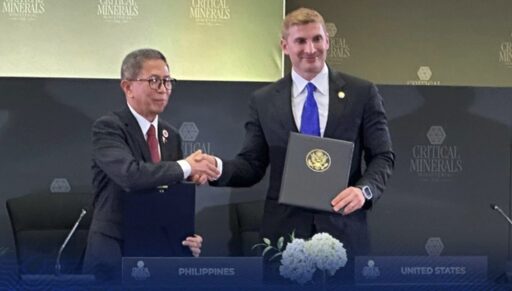
MANILA – Civil society groups and environmental advocates have raised concerns over the recent critical minerals cooperation agreement between the Philippines and the United States.
The deal was described by the US Government as part of its coordinated efforts to strengthen “U.S. national security and economic competitiveness” while Environment Secretary Raphael Lotilla claimed that the the Memorandum of Understanding (MOU) would help the Philippines “process our own resources, create high-skilled jobs, and strengthen our position in the global high-tech supply chain”.
This deal comes as Ferdinand Marcos Jr. ‘s administration gears up to expand critical minerals mining as part of the country’s renewable energy and industrial development goals. Marcos Jr. has repeatedly called for leveraging the Philippines’ mineral resources to support the country’s own renewable energy transition. The agreement complements a ?280-million, US-funded program to support reforms in the Philippine critical minerals sector launched in 2023.
Environmental advocates are not convinced. They warned that expanding mining under the banner of renewable energy risks deepening environmental degradation, displacing communities, and weakening safeguards, particularly in mineral-rich areas already affected by deforestation, water pollution, and human rights complaints.
Philippine Center for Anti-Imperialist Studies, in a statement, said that the agreement signals an era of more destructive and extractive mining, threatening to worsen environmental degradation, toxic waste, and the displacement and killing of Indigenous peoples.
According to the Kalikasan People’s Network for the Environment in the Philippines, in its submission to the UN Office of the High Commission on Human Rights, at least 272 environmental defenders were killed bbetween 2001 and 2019. Of those killed, half of the victims were anti-mining advocates.
International League of Peoples’ Struggle – Philippines warned that the agreement would be used not only for renewable energy but also for “advanced weapons systems and artificial intelligence” to serve as part of the US “imperialist agenda” in a critical minerals race against China. Currently, China produces about 60–70 percent of the world’s rare earth minerals and processes around 90 % of global rare earth supply. ILPS then insists that raw minerals should be used for national industrialization and not foreign interests.
As the Philippines remains to be one of the top producers of nickel, the central question remains whether the country’s energy transition will prioritize genuine national development or whether it will deepen dependency to exportation within a high-stakes global competition for critical minerals. (AMU, RVO)
The post PH, US ink critical minerals deal bodes ill for the environment, defenders – groups appeared first on Bulatlat.
From Bulatlat via This RSS Feed.