

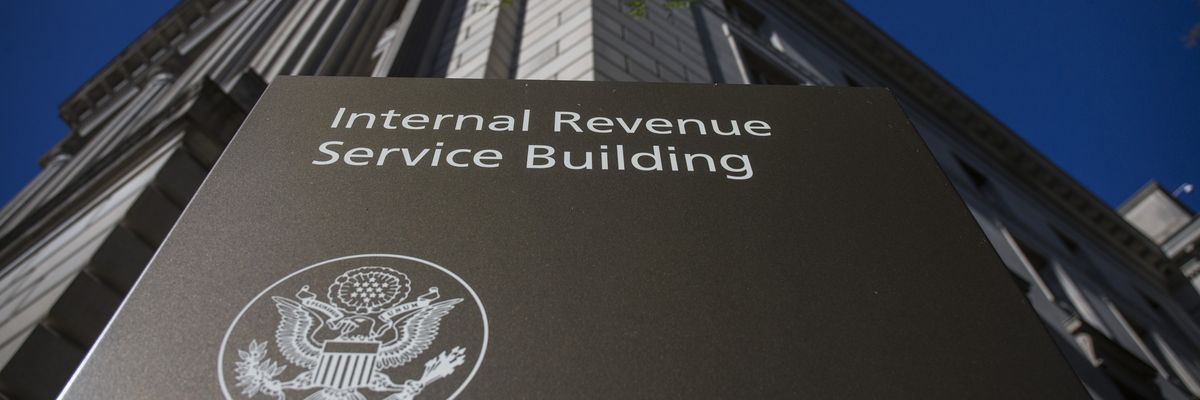
Privacy officials at the Internal Revenue Service were sidelined in discussions last year about the Department of Homeland Security’s demand for taxpayer data about people the Trump administration believed were not authorized to be in the US, and a court filing by the IRS Wednesday may have illustrated some of the officials’ worst fears about the plan.
According to a sworn declaration by Dottie Romo, the chief risk and control officer at the IRS, the agency improperly shared private taxpayer data on thousands of people with immigration enforcement officers.
The data was shared, the Washington Post reported, even in cases in which DHS officials could not provide data needed to positively identify a specific individual.
Two federal courts have preliminarily found that the IRS and DHS acted unlawfully when they moved forward with the plan to share taxpayer addresses and have blocked the agencies from continuing the arrangement. A third case filed by Public Citizen Litigation Group, Alan Morrison, and Raise the Floor Alliance is on appeal in the DC Circuit.
But before the agreement was enjoined by the courts, DHS requested the addresses of 1.2 million people from the IRS, and the tax agency sent data on 47,000 people in response.
Thousands of people’s confidential data was erroneously included in the release, sources who were familiar with the matter told the Post.
Despite Romo’s sworm statement saying an error had been made by the agencies, a DHS spokesperson continued to defend the data sharing agreement, telling the Post that “the government is finally doing what it should have all along.”
“Information sharing across agencies is essential to identify who is in our country, including violent criminals, determine what public safety and terror threats may exist so we can neutralize them, scrub these individuals from voter rolls, and identify what public benefits these aliens are using at taxpayer expense,” the spokesperson told the newspaper. “With the IRS information specifically, DHS plans to focus on enforcing long-neglected criminal laws that apply to illegal aliens."
Records have shown that a large majority of people who have been arrested by US Immigration and Customs Enforcement and other federal agents since President Donald Trump began his mass deportation and detention campaign have not had criminal records, despite the administration’s persistent claims that officers are arresting “the worst of the worst” violent criminals.
Undocumented immigrants are also statistically less likely than citizens to commit crimes, and have not been found to attempt to participate in US elections illegally.
When DHS initially asked for taxpayer data last year, IRS employees denounced the request as “Nixonian” and warned that a data sharing arrangement would be illegal. Providing taxpayer information to third parties is punishable by civil and criminal penalties, and an IRS contractor, Charles Littlejohn, was sentenced to five years in prison after pleading guilty in 2023 to leaking the tax returns of Trump and other wealthy people.
Trump has sued the IRS for $10 billion in damages due to the leak.
Romo on Wednesday did not state whether the IRS would inform individuals whose confidential data was sent to immigration officials; they could be entitled to financial compensation.
Dean Baker, senior economist at the Center for Economic and Policy Research, noted that judging from Trump’s lawsuit against the IRS, “thousands of trillions of dollars” should be paid to those affected by the data breach.
Lisa Gilbert, co-president of Public Citizen, said the “breach of confidential information was part of the reason we filed our lawsuit in the first place.”
“Sharing this private taxpayer data creates chaos,” she said, "and as we’ve seen this past year, if federal agents use this private information to track down individuals, it can endanger lives.”
From Common Dreams via This RSS Feed.
So, that means I can sue the IRS for $10 billion?
