

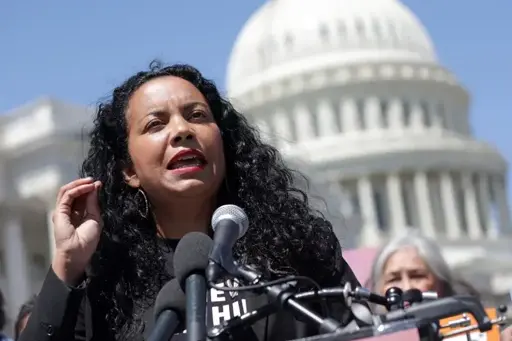
Just days before New Jersey’s special election primary on January 5, few of the state’s political analysts and local reporters were talking about the possibility of a win by Analilia Mejia, the left-wing candidate in an 11-candidate Democratic primary. But for anyone who has paid attention to social movements in New Jersey — from the movement for Palestine to anti-ICE activism — it is unsurprising that Mejia achieved a win against a range of competitors, from milquetoast moderates to raging Zionists.
The primary in New Jersey’s 11th Congressional District determined who will be the Democratic Party nominee in a special election in April to replace Mikie Sherrill, now the governor, in the House. Former congressman Tom Malinowski was originally projected to win. He was endorsed by New Jersey senator Andy Kim and had the most financial backing in an election that saw several million dollars spent over just a few months.
On election night, some local news outlets called the election for Malinowski, who had an early lead. But before the night was over, Mejia edged ahead. After several days of counting provisional ballots, Malinowski endorsed Mejia on February 10. Senators Andy Kim and Cory Booker, along with Governor Sherrill, quickly followed suit.
NJ-11 isn’t an especially left-wing district. In fact, it’s arguably one of the state’s more conservative districts. It’s the wealthiest one in New Jersey and the 11th wealthiest in the entire country, consisting of affluent suburbs where many residents work in finance, mainstream media, and pharmaceuticals. There is also a strong local Zionist lobby. This context makes Mejia’s win, as a longtime organizer with the Working Families Party and former political director for Bernie Sanders’s 2020 presidential campaign, particularly surprising to many political analysts. On the campaign trail, Mejia was the only candidate to acknowledge that Israel’s actions in Gaza constitute genocide, and she was also the only candidate to call for abolishing ICE.
Much of the coverage of her win, from local outlets and foreign policy–focused publications, has emphasized the role AIPAC played in attacking Malinowski ahead of the primary. The Zionist lobby group spent more than $2 million running ads against Malinowski because he suggested that aid to Israel should come with conditions. To be clear, Malinowski is a staunch Zionist; he just wasn’t as fervently pro-Zionist as nearly every other candidate in the primary.
It’s true that AIPAC miscalculated, but Mejia didn’t win only because AIPAC blundered. She won because her left-wing positions are becoming more popular, even in regions where capitalist interests are strong. This was clearly indicated by Zohran Mamdani’s victory in New York’s mayoral election. Even in New Jersey’s primary for governor, which Sherrill won on a centrist platform, Newark mayor Ras Baraka came in second after running the most left-wing campaign in the crowded primary.
The demand for left-wing positions is reflected nationally in polling, which shows that pro-Palestine views have gained traction, while other surveys indicate that opposition to ICE is growing. Mejia’s stance on these two issues in particular motivated people I know to canvas for her during one of the coldest winters in decades. As I have reported for Left Voice over the past several years, the movement for Palestine took root in the suburbs of New Jersey long before Mejia embraced the movement in her campaign. Regarding immigrant rights, it was only a few years ago that activists in our state successfully forced the closure of three ICE detention centers. Activists continue to fight every day against a renewed ICE offensive in our state.
As demonstrated by Mejia’s win and subsequent endorsements from Malinowski, Sherrill, Kim, and Booker, the Democratic Party is gradually recalibrating to engage with a base that is genuinely committed to resisting the oppression and violence of the far-right Trump administration.
But Mejia’s win doesn’t change the fact that the Democratic Party as an institution remains imperialist to its core and increasingly compromises with the Far Right’s war on immigrants. The experience of the Squad illustrates the limitations of attempting to reform the Democratic Party. In the worst case, there are figures like Alexandria Ocasio-Cortez, who has increasingly aligned with the party’s establishment. Mamdani has also quickly tied his political trajectory to establishment Democrats like Kathy Hochul. In the best case, there are figures like Rashida Tlaib, whose own party closed ranks with Republicans to censure her for denouncing genocide. Regardless of where Mejia ends up on this spectrum once in office, the Democratic Party as an institution will continue to impede those who want to mount a strong resistance against the Far Right.
Meanwhile, the socialist Left should recognize that the demand for strong leadership against oppression and the Right presents an opportunity to fight for our own party, one that breaks with the Democrats and grounds these fights in examples of class struggle like those seen in Minneapolis.
Mejia’s win is an inspiration, and those who organized for it deserve significant credit for demonstrating how, even in less left-wing districts, opposition to genocide and anti-immigrant terror can gain popular support. It is essential that we organize institutions independent of the Democratic Party to advance these struggles.
The post Analilia Mejia’s Upset Win in New Jersey Shows That the Movements for Palestine and to Abolish ICE Aren’t Marginal appeared first on Left Voice.
From Left Voice via This RSS Feed.