

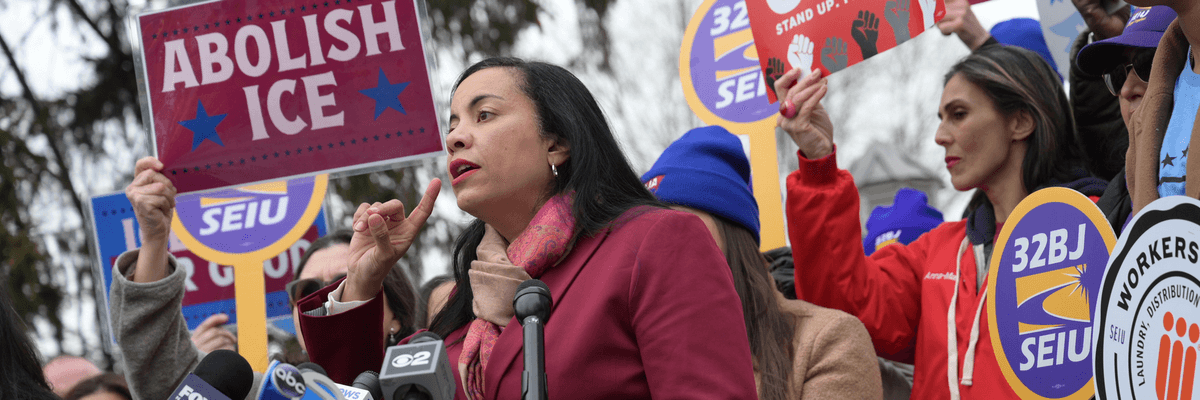
Recent progressive electoral victories have been followed by assurances from centrist Democratic politicians and strategists that such successes can’t be replicated elsewhere, and congressional candidate Analilia Mejía’s primary win this week was no exception—but Sen. Bernie Sanders implored voters not to listen to the naysayers who continue to insist that “moderation” is the key to winning elections for Democrats.
Emphasizing that Mejía, a grassroots organizer, was known to just 5% of voters in New Jersey’s 11th Congressional District when she launched her campaign in November, Sanders said Wednesday: “Make no mistake. This can be done everywhere.”
Mejía ran against 10 other candidates, including former US Rep. Tom Malinowski (D-NJ), in the Democratic primary ahead of the April 16 special election to fill the seat left vacant by Gov. Mikie Sherrill.
The progressive candidate was outspent 4-1, said Sanders, but proved unstoppable “because she had the courage to stand up for the working class in her area and throughout this country.”
Mejía is a vocal supporter of shifting from the for-profit health insurance system to Medicare for All and has called for other progressive policies including tuition-free community college, a moratorium on new artificial intelligence data centers, and a federal law guaranteeing paid sick leave.
She has also called to abolish US Immigration and Customs Enforcement, the 23-year-old agency that President Donald Trump has deployed to cities across the US to carry out his violent mass deportation agenda, demanded an end to ICE’s mass surveillance, and held training sessions for voters on anti-authoritarianism, civil disobedience, and how to prepare for encounters with federal immigration agents.
After Malinowski conceded to Mejía, Democratic strategist Steve Schale, who led former President Barack Obama’s campaign operations in Florida in 2008, attempted to throw cold water on the progressive victory.
“The loudest voices are on the progressive left, but I don’t know if that’s where the party is,” Schale told The Hill Wednesday, asserting that Democratic voters in “southern states with large Black populations… don’t sound like progressives in New York and Northern New Jersey."
After New York Mayor Zohran Mamdani’s victory in the Democratic primary last June against former Gov. Andrew Cuomo, former Transportation Secretary Pete Buttigieg—who has been named as a possible contender in the 2028 presidential race—was similarly dismissive, even though Mamdani, like Mejía, went from being barely known among voters to beating his establishment rival in just a few short months after focusing relentlessly on affordability and working-class issues.
Other progressive victories victories could be on the horizon in Maine, where Democratic Senate candidate Graham Platner has had a double-digit lead over Gov. Janet Mills in polls ahead of the June primary and raised three times as much as Mills and Sen. Susan Collins (R-Maine) combined in small donations in the final quarter of 2025; and North Carolina, where Durham County Commissioner Nida Allam is challenging Rep. Valerie Foushee for a second time after losing a close race in 2022.
Allam raised more than twice as much money as Foushee in the last quarter, according to numbers released last week.
Like Sanders, the New Jersey Working Families Party expressed optimism about Mejía’s victory, with Antoinette Miles, the party’s state director, saying Tuesday that “she has sent a clear signal that it’s a new day in New Jersey politics, and that our country is ready for bold, working-class leadership.”
“In just 10 weeks, through the dead of winter, Analilia built a grassroots campaign for and by all New Jerseyans. Her bold message of an economy that works for all of us and an end to ICE’s brutality resonated with voters who are fed up with the status quo,” said Miles. “Together, we’ve proved that organized people can defeat organized money.”
Sanders added that “what Analilia did in New Jersey can in fact be done in every part of this country.”
“The American people want real change,” he said. “Let’s do it.”
From Common Dreams via This RSS Feed.