

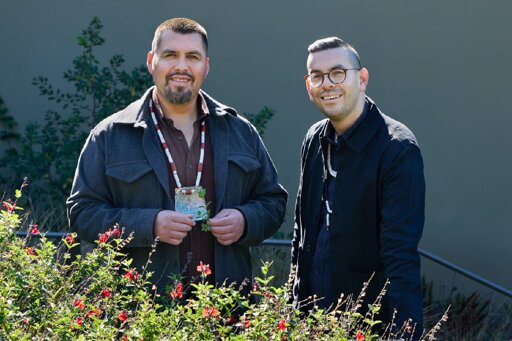
Photographs by Aya Brackett
Hello, horše ṭuuxi, I’m Vincent Medina. I’m Ohlone from halkin, in the San Francisco East Bay, and I grew up right here in my homeland, where my family has always been.
I’m Louis Trevino. Most importantly, I’m Vincent’s partner in life and in love, for which I am every day so very grateful. And I too am Ohlone from here in the East Bay, and I have dedicated myself to Vincent and to his beautiful and dynamic vision for our people and our land.
Medina: Our ‘ammatka Cafe, “the dining room” in our Chochenyo language, is high in the hills at the Lawrence Hall of Science, part of the University of California, Berkeley. The cafe is part of an initiative called ‘ottoy—meaning “to repair.”
A hundred years ago, UC Berkeley declared the Ohlone people extinct. That led to us being denied federal recognition, federal funding, and land rights.
‘ottoy acknowledges the rightful presence of us Ohlone through the exhibits of this museum, through other initiatives on UC Berkeley’s main campus, and also through land tracts associated with the university, all in partnership with Lawrence Hall. The central mission of ‘ottoy is to build up knowledge of and respect for our beautiful, living culture while acknowledging the harm that the university has committed.
‘The Dining Room’

Inscription above the entrance to the Lawrence Hall of Science. (Photo credit: Aya Brackett)
At ‘ammatka, we’re creating an understanding of our culinary traditions. As diners look out through the windows here, they see the East Bay hills, the flatlands, and the San Francisco Bay, which allows us to story-tell about how biodiverse, how special this landscape is.
In the days before colonization, the bay shore below was teeming with life—Olympia oysters, California mussels, abalone and Washington clams, sea otter colonies that would stretch so far into the water that they looked like cobblestones. White sand dunes interspersed with pickleweed marshes and tiny red California beach strawberries, gray whales sailing in through the Golden Gates, salmon going downstream through the Golden Gate into the Pacific Ocean and then swimming back up to spawn.
It’s a world that’s so beautiful you want to see it again, and these narratives are still passed down in our community. From that lush bay shore, you’d go into willow thickets that provided the foundational material for our beautiful baskets, which Ohlone people are known for. Then up into the redwood forests, filled with all kinds of mushrooms—the chanterelles, porcini, and candy caps, then down into the interior valleys full of oaks that provide acorn, our staple food, and up to Mount Diablo, the mountain of our creation.
Within this relatively small area that is the East Bay, there was a huge amount of biodiversity and abundance, shaped by the hands of Ohlone people for thousands of years. Our forebears consistently took out overgrowth with small burns that led to constant regeneration, enriching the soil with ash, allowing plant communities to continuously grow stronger.

At the ‘ammatka café, all signage is in English, Spanish, and Chochenyo, and the same is true throughout the Lawrence Hall of Science, where the cafe is located. (Photo credit: Aya Brackett)
That knowledge has never been lost, because our forebears have worked intergenerationally to preserve it, even through the hardest times of colonization.
Our families survived three successive waves of that here in the East Bay: the Spanish missions, where we survived at Mission San Jose and Mission Dolores; the Mexican occupation during the rancho period; and then the Gold Rush, when the State of California legalized genocide against our Ohlone people as well as Indigenous people all throughout the state. The first American governor of California said, in 1851, that “a war of extermination will continue . . . . until the Indian race became extinct.”
When the violence was heavy, our family moved into the interior valleys of Sunol, about 35 miles southeast of Berkeley, and successfully secured land rights as the Verona Band of Alameda County. My great-grandmother was born there. Traditional culture continued to flourish there from the 1860s until the late 1920s.
In 1868, through the Morrill Act, UC Berkeley, a land-grant institution, was founded and directly benefited from the theft of Indigenous lands. Then in 1925, the university wanted to seize our land in Sunol, to turn it into a place of recreation for university men. That was when Albert Kroeber, first head of anthropology here at UC Berkeley, declared the Verona Band “extinct for all practical purposes,” which led, two years later, to the loss of federal recognition and land rights for us Ohlone people.
Our great-grandparents’ generation found ways to transcend. When they couldn’t live on their land in Sunol, they worked hard to stay here in the East Bay, working in orchards, washing the clothes of white folks, but maintaining their dignity and maintaining the culture.
Because of them, here we are today, where every generation of our family has always been. Colonization does not define our story. Our story is about joy, celebration, and about how victorious the generations before us were in keeping the oldest traditions of the East Bay alive. That’s not a story of loss or defeat. That’s a story of incredible strength and permanence.
A hundred years from the time that the university erroneously declared us extinct, here we are correcting those words and having the last say, working in partnership with the Lawrence.
Cooking With Old-Time Knowledge
We first started cooking in 2017, when we launched mak-‘amham (Chochenyo for “our food”), a series of programs for our Ohlone people: cooking classes, gathering trips, dinners and food deliveries for elders, and language classes.
We wanted to follow old-time knowledge and old-time taste preferences. So we would spend a lot of time talking to the elders about the foods they grew up with. They really missed them, because many traditional Ohlone foods had become inaccessible because of development on our land, privatization of land, and restrictions on gathering within park districts that existed until relatively recently. With mak-‘amham, we started cooking for a core of individuals so they could have access to traditional foods, and also so we could learn to cook with our elders’ leadership.

A greeting from the East Bay Ohlone people in the gardens of Lawrence Hall. (Photo credit: Aya Brackett)
My great-aunt Auntie Dottie, who is 95 now, learned a lot about the old traditional foods from her mother, who was born in 1890. Auntie Dottie would talk about how at every family gathering when she was young, there would be acorn on the menu. She calls acorn “the bread of life.” And greens that her mother would gather, and how delicate their taste was. All these different greens had their own flavor, she said, and would be layered with nuts, fruits, and berries to create something that was rich and full. They included watercress and also rooreh, what was previously referred to as miner’s lettuce.
We did a video about this, because the miners were terrible to our Ohlone people and to California Indians across the state. We found it to be unjust that miners got associated with such a delicious green when they were only eating it for 10 years or so, and we Ohlone have been eating it for thousands of years. In the video, I said, “Let’s not call it miner’s lettuce. Let’s call it by its Native name. And if you can’t remember that, just call it ‘Indian lettuce.’ ” The Jepson Herbarium saw the video, and they changed its name to the Chochenyo name, rooreh.
Trevino: Auntie Dottie grew up in the height of the Great Depression in the 1930s, in a town that was called Alvarado, which is now part of Newark / Union City in the East Bay. It was not an easy time to grow up, but she never felt a sense of lack because her mother knew about all these plants, and mushrooms, and fruits, and other things she would teach her children to gather. In fact, their home was a place where other people would come because they knew they could have a meal.
Also, in the 1920s on the Sunol Rancheria, our Ohlone forebears recorded as much as they could about language and the old-time stories, but also really beautiful recipes and descriptions of foods that were eaten in the 1800s.
One of them was acorn bread cooked in a wrapping of sycamore leaves. Another one is the seed cakes, muyyen. They’re made of chia, California amaranth, tarweed, and sometimes lupin seeds, toasted and then ground into flour and shaped into slender little cakes. Each seed has its own unique flavor—some taste like anise, some like burnt popcorn. They all complement each other, creating ultra-nutritious, very delicious cakes full of good fats, protein, and fiber.
Cafe Ohlone, our first restaurant, came out this project with our elders, serving almost entirely pre-contact foods; it closed in 2020 with the pandemic. Our occasional seasonal restaurant, ‘ottoytak, also at UC Berkeley near the Hearst Museum, continues. And now we also have the ‘ammatka Cafe at the Lawrence.

A freshly planted pollinator garden at the Lawrence, part of the ‘ottoy initiative’s land restoration. Ohlone elders remember wildflowers carpeting this hillside, so bright they would hurt your eyes, says Vincent Medina. This spring, with any luck, they will bloom again. (Photo credit: Aya Brackett)
One of the really beautiful things we’ve both learned from our elders is this idea that you trust the way a dish is being described to you and the way that it’s always been done. And now, we’re applying that trust to our cooking today, as we’re regaining access to gathering places and increasing our gathering rights. Not asking why, but just doing it, and then tasting the final dishes and finding that, of course, they’re delicious, and then sharing those dishes with the family through our work. It’s a beautiful process of closing that circle.
‘ammatka Cafe’s Food Culture
Medina: The older generation had such confidence in the kitchen without using measuring cups—they just seasoned until the flavor was where it needed to be. Louis’s grandmother Mary Lou Yamas had these ways of measuring salt and other seasonings on her palm by the size of the circle it made there.
At ‘ammatka, we have a culinary team in the kitchen, and you can’t always describe seasonings by the size of the circles they make. As culinary directors, it’s been a very fun process to standardize our experiences in cooking.
We also procure the gathered ingredients and co-lead an Indigenous garden with the Native American Student Development center here at UC Berkeley. It’s growing food for the cafe, like native onion, native berries, and watercress. Otherwise the ingredients are from local markets and farms.
Cafe Ohlone was almost entirely a pre-contact menu, but ’ammatka Cafe is very 2026. We have tater tots, because young people like tater tots! Everything, though, is paired with traditional ingredients to build up understanding. So the tater tots are served with an herbed aioli that has native tarragon, native onion, and sage that’s gathered, dried, and made into a flour.
We also have an Ohlone salad, made with watercress from the Indigenous Garden, as well as native onions, blackberries, gooseberries, dried California strawberries, edible flowers, pickleweed from the marshes, and purslane. And a smoked-duck sandwich—we traditionally hunted duck on the bay shore—with house-made rose-hip jam and Mt. Tam triple-cream cheese.

Louis Trevino (left) and Vincent Medina in the ‘ammatka café, with a view of Ohlone homelands. (Photo credit: Aya Brackett)
Louis developed his Ohlone brownies years ago, for mak-‘amham, wanting to introduce acorn flour, chia flour, and hazelnut flour to Ohlone youth. Little by little, he was planning on getting rid of the chocolate, but the elders would hoard the brownies, grabbing them even when the kids were around. They told Louis, “You don’t get rid of those brownies, Louis.”
It’s a reminder that traditional and contemporary can coexist. That’s part of a living culture, and us being able to tell our story, even if it’s not exactly the same as it was 200 years ago. It’s change on our own terms, and this menu does that.
An Ohlone Food Future
We also lead the mak-warép (“our land”) Ohlone Land Conservancy, focused on restoring lands here in the East Bay using traditional knowledge and land stewardship practices.
We’re in the middle of planting three 1-acre gardens at the Russell Research Station in Lafayette—a basketry garden, a medicinal garden, and a culinary garden—so that we have readily available Ohlone foods for the older generation who really crave these foods.
We are also developing our relationship with the East Bay Regional Parks. Only a few years ago, gathering in the parklands was criminalized. We are working toward full gathering permits and access throughout the park district.
And we are aligned with Hog Island Oysters and the Wild Oyster Project to restore our native West Coast Olympia oysters within our lifetimes.
Other Ohlone land stewardship practices, like our cultural fire burns, are coming back into practice. I’m proud to say that we had our first cultural burn last October in two generations, and now we’re working with Cal Fire to plan more. This system worked so well for us in the past that in Chochenyo we have no word for famine, but we do have a word for abundance—yowwini.
What we would like to see now are changes in policy so we are able to reacquire land. Because then we could implement the full spectrum of land stewardship practices—from cultural burns that enrich the soil to traditional irrigation and coppicing methods to growing a wide variety of plants that we know would do well in our microclimates.
Our vision of an ideal food future would include seeing our people respected as a force in the East Bay culinary landscape.
It would be such a wonderful thing if, when people think about the East Bay, they think of Ohlone cuisine and how you can taste the landscape through our foods—chanterelles from the redwood forests, pickleweed from the bay shore, acorn from the oak woodlands. It doesn’t mean erasing or negating other foods, because the East Bay is a very cosmopolitan food scene. But it means centering that which is Indigenous. When people associate the foods of this place with us Ohlones, they don’t question if we’re here in our home; they just accept it as an inherent fact. And when they get to taste place-based knowledge, that uplifts our culture, builds up respect, and is pleasant for everybody involved, whether they are Ohlone or not.
This conversation has been lightly edited for length and clarity.
The post Through Food and Culture, the East Bay Ohlone Are Repairing Centuries of Harm appeared first on Civil Eats.
From Civil Eats via This RSS Feed.