


This story was originally published by WyoFile.
Mike Koshmrl
WyoFile
Jason Baldes sat horseback outside his neighbor’s gate for hours in early October waiting for the highest levels of Wyoming government to help resolve what, on its surface, looked like little more than an old school good-fences-make-good-neighbors ranching dispute.
Had the matter involved cattle or sheep, it would likely have been settled in no time. But the alleged offenders that day were buffalo, a native species with a newly complicated legal status and a long history of attracting politically charged debate.
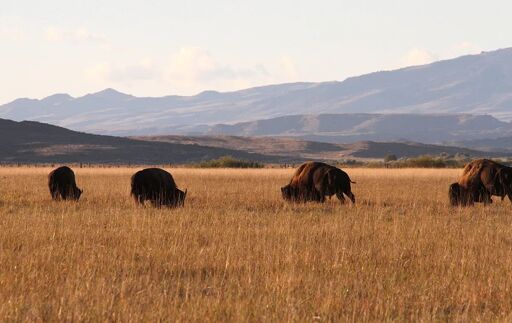
Baldes is Eastern Shoshone and the face of a high-profile, successful effort to reintroduce the culturally significant species to the Wind River Indian Reservation and, eventually, restore its status as wide-ranging wildlife.
On Oct. 1, some of the buffalo associated with his reintroduction program had broken through their fencing and wandered onto neighbor Mitch Benson’s alfalfa field. When Baldes and his horse Ceesei arrived to retrieve the errant ungulates, however, things went sideways.
“He wouldn’t let me in,” Baldes told the Wyoming Legislature’s Select Committee of Tribal Relations on Jan. 28 in Riverton. “It took eight hours of negotiation with the state for him to let me in on the horse, and it took me 10 minutes to get them off of his ground.”
Benson’s not-so neighborly reception apparently stemmed from what he felt was the right thing to do based on the law. The Fremont County farmer and rancher declined requests for an interview with WyoFile, but he relayed his version of that day and prior evening’s events in his own testimony to the panel of state lawmakers and in a letter addressed to Gov. Mark Gordon.
“I did everything right, and I won’t apologize for it,” Benson told the state senators and representatives. “I don’t mean to bring any disrespect to my relatives or my friends that are enrolled members.”
Benson said he wanted “clarity” over the status of escaped tribal bison and how they’re supposed to be managed before there’s “damage done to relationships.” He professed “respect” for the tribes’ plans for growing wild bison herds, though he also shared concerns for how the rewilding effort would affect tribal cattle ranchers.
After the Northern Arapaho bison landed on Benson’s property, he called the local brand inspector, who couldn’t identify ownership of the animals and pointed him toward the Wyoming Game and Fish Department. Calls also went out to Game and Fish Director Angi Bruce and Wyoming Livestock Board Director Steve True, according to his testimony.
Benson also received a call from the Wyoming Livestock Board, informing him that a complaint had been filed against him for “illegally holding tribal buffalo.”
Wildlife, or not?
The complicated legal status of bison in Wyoming and on the Wind River Indian Reservation underlies the tension that led Benson to thwart Baldes’ efforts to herd bison home that October day. Although business councils for both the Eastern Shoshone and Northern Arapahoe tribes, which share the reservation, have declared bison to be wildlife and are working to amend the tribal game code to do the same, Wyoming law designates bison instead as livestock in the vast majority of the state (wild herd areas near Grand Teton National Park and on the east side of Yellowstone National Park are the exceptions.) Their livestock status carries over to private lands in the vicinity of the Eastern Shoshone and Northern Arapaho’s herds.
“As the statute is currently written and in our agreement with the Livestock Board, these are not designated as wildlife — they’re privately owned,” Wyoming Game and Fish Department Chief Warden Dan Smith testified to the committee. “When they come off the reservation onto private land or even outside the reservation boundary, they would be considered privately owned bison, and so they do not fall under the authority of the Wyoming Game and Fish Department.”
Under Wyoming law, some tribal bison within the borders of the reservation are designated as livestock even when they haven’t escaped, because they’re pastured on privately owned deeded land north of the Wind River.
Baldes explained to the committee that his plans for scaling up tribal buffalo herds — which have swelled from 10 animals on 300 acres to over 300 buffalo on almost 20,000 acres in nine years — has relied on buying up private land. Through the Wind River Tribal Buffalo Initiative, he’s raised over $10 million so far for the acquisitions.
“It was probably haphazard, and there were some things we had to do in order to make it happen, like being on [private] fee land,” Baldes testified about growing the herds. “That’s where we had to start. The goal is to roll that fee land over into trust status, but in order to do that we have to roll it back to the tribe. The tribe has to petition, and then almost every application is opposed by the state and the county. Being that it’s in the middle of Midvale Irrigation District, we can almost safely assume it’s going to be opposed.”
If the long-term vision comes to pass, and the bison come to roam land held in trust by the tribes, some of the legal complexities would unwrinkle — the state would lose jurisdiction.
In the meantime, Baldes refutes the idea that the enclosed Eastern Shoshone buffalo he’s raising are legally livestock. (The Northern Arapaho’s herd is already fenced on tribal trust land.)
“It’s not so much that Wyoming sets the rules, and we all got to live by it,” he told WyoFile. “The reservation was created before the state. The treaties supersede statehood.”
Treaty or no, it was Bruce, the Game and Fish director, who ended the October impasse, according to Benson’s legislative testimony. On speaker phone with the two neighbors at loggerheads, she told Benson that she was taking “full authority” and authorized Baldes to remove the bison from the pasture.
That ended the dispute, at least for the day. In his letter to the governor’s office, Benson alleged tribal bison breached their enclosures again in mid-October.
Toward a solution?
Benson’s calls for legal clarity didn’t fall on deaf ears. Fremont County Democrat Rep. Ivan Posey, an Eastern Shoshone member who co-chairs the committee, was receptive.
“I don’t think the buffalo are going to go away,” Posey said. “Neither are the cattle. So we’re going to have to find some kind of a solution.”
Sen. Cale Case, a Lander Republican, doesn’t anticipate any bills addressing the controversy will arrive during the Legislature’s fast-approaching session, which is focused primarily on passing the budget. But the topic would be “ripe” for study in the interim period leading up to the Legislature’s 2027 general session, he said.
Case said it’s worth discussing a bill reclassifying bison as wildlife near the Wind River Reservation. It could be a nuanced measure, he said, granting the tribes jurisdiction over the species in the vicinity and forgoing the need for state hunting licenses.
Testifying in Riverton, Northern Arapaho Business Council Chairman Keenan Groesbeck spoke to that concept.
“When is the state going to recognize tribes’ sovereignty?” Groesbeck said. “We classify them … as wildlife. But the state doesn’t.”
Baldes is leery of Wyoming lawmakers getting involved.
“We don’t want to see a bad bill come in front of the Wyoming Legislature, especially the Freedom Caucus,” he said. “We’ve seen how bad legislation can go for tribes in Montana. We’ve been fighting anti-bison, anti-tribal legislation there for decades.”
The Wind River Tribal Buffalo Initiative is trying to be “proactive” so that “the state doesn’t feel like they have any need to intervene,” said Baldes, who’s exploring the use of electronic ID tags to individually identify initiative animals.
There are indications that solutions are already available in Wyoming law and regulation.
Responding to Benson’s letter, Gov. Mark Gordon wrote that there’d been a “misunderstanding” on that fraught day in October. Although the brand inspector responded to the stray bison report, he lacked the legal authority to identify ownership of the animals, according to the governor.
Gordon also instructed Benson on how to handle errant bison if they end up on his pasture again: Call Tribal Fish and Game, and then the Wyoming Livestock Board if he needs further assistance.
“As a cattle rancher and owner, I have much experience with animals breaching fences,” Gordon wrote in his response letter. “I also know that Wyoming has long been a fence out state and that principle applies to bison as well.”
The Tribal Buffalo Initiative is making efforts to fortify its own fences, the governor noted.
“However, I am actively working with tribal liaisons and state agency personnel to find solutions to prevent bison from straying, address the impact on landowners, and clarify relevant state statutory language,” Gordon wrote.
For his part, Baldes says that his aim is to avoid any further division.
“Early on, we built relationships with neighbors who are farmers and ranchers — who became some of our closest allies,” he told WyoFile. “The hope is that we can continue to be collaborative in nature to help this project move forward.”
Editor’s note: Jason Baldes is married to Patti Baldes, a member ofWyoFile’s board of directors. WyoFile’s newsroom operates independently of any board input or influence.
The post Bison’s ‘livestock’ status in Wyoming inflames tensions over tribal rewilding appeared first on ICT.
From ICT via This RSS Feed.