

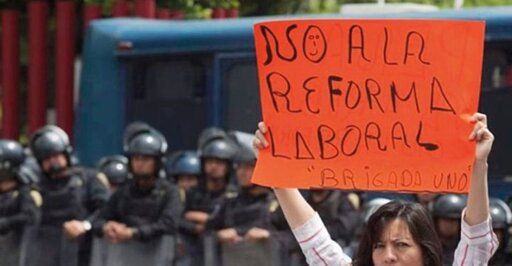
This Wednesday Argentinians will take to the streets as President Javier Milei’s labor reform bill is discussed in the Senate. The project contains a barrage of austerity measures including elimination of paid overtime, restriction of the right to strike and to organize unions, and reduction of corporate income taxes and payroll taxes. The bill would also make it easier for companies to fire workers and offer them less severance pay, and divert contributions to public retirement funds into privately-managed alternatives
Some Peronist governors and lawmakers have been negotiating with the federal government, promising partial support in return for concessions. The CGT — the country’s largest federation of trade unions — has called to mobilize but crucially stopped short of calling for a general strike.
Officially the bill aims to “create jobs” and “modernize” the economy, but there is little to no evidence it will do either. Instead it appears to be another salvo in the nation’s history of attacks against workers’ organizing capacity and purchasing power in the vein of laws passed by the 1976 dictatorship and the presidency of Carlos Menem. Union leaders have described the bill as part of a “third wave” of a historic process of anti-labor reform rooted in the logic and objectives of Argentina’s last and bloodiest dictatorship. As a result of this roll-back of labor victories since the late 70s almost half of Argentina’s workforce labors in informal conditions, and a significant portion of even formal workers do so under precarious conditions.
The true aim of the bill is to tilt the balance of power between workers and employers further in the employers’ favor and to further subjugate the country’s economy to foreign interests.
The country’s socialist Left argues that changes in the Argentine labor code should reflect advances in technology so as to solidify rather than weaken workers’ rights, strengthen their ability to engage in collective bargaining, increase their participation in decision making and extend rather than reduce their free time. The Left has long championed the distribution of working hours among workers to reduce unemployment, as well as the 5-day, 6-hour work week to increase both leisure time and workers’ energy for communal organization.
Congressional Deputies with Left Voice’s sister organization, the Partido de los Trabajadores Socialistas/Socialist Workers’ Party (PTS) and their coalition partners in the Frente de Izquierda y de Trabajadores-Unidad/Workers’ Left Front-Unity (FIT-U) have spent the past months denouncing the government’s plans and its noxious consequences for workers and low-income families. Militants and sympathizers have spent weeks carrying out agitation campaigns in both the capital and other parts of the country. They have also carried out campaigns of solidarity for combative workers affected by early attempts to test the waters for the upcoming reform package.
An important early struggle against the labor reform occurred at Lustramax Factory, a cleaning products and paper goods manufacturer. Workers occupied the factory to fight back against illegal lay-offs. Despite intimidation tactics and use of the police to break-up the organized workers, the fired workers were re-instated after they organized in assemblies, arranged permanent sit-ins, blocked highways, took the factory, and were surrounded by solidarity festivals and a strike fund which drew nation-wide attention to the conflict.
As Argentina’s economic crisis worsens — fueled in large part by illegitimate debt to the predatory International Monetary Fund — and the consequences of the government’s fiscal and economic policies become more clear, future struggles lurk on the horizon. This fight will require a united and mobilized working class, organized from the rank-and-file, forcing union bureaucrats to take action. Support for the class struggle coming from Left deputies in Congress and international solidarity can strengthen the fight against the reform.
Combative unions, sectors of the feminist and student movements, public sector health workers, representatives from the environmental movement, and many others have pledged to join the fight against regressive reform measures. They have even received calls for solidarity from workers in imperialist countries in Europe including France and the Spanish State. Supporters of the bill will also rely on international support as the world’s bourgeoisie watches developments in Argentina with interest to see how much of a model to emulate they might find, and many corporations such as Carrefour stand to gain should the bill pass into law.
Parliamentary debates concerning the labor reform bill are scheduled to begin this Wednesday, February 11. People from across the country will take to the streets on the same date. The PTS and FIT-U will be present to rally workers to defend their interests, carrying forward their own banners, slogans and demands.
The post In Argentina a Fight against Anti-Worker Labor Reforms is Beginning appeared first on Left Voice.
From Left Voice via This RSS Feed.